

bus route optimization, Dispatch Software, asset school bus tracking system, best gps device for school bus, driver navigation, easy gps tracker for school bus
If your morning starts with a stack of new transportation requests for students who live three towns over or require a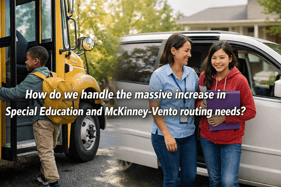 wheelchair lift, you aren’t alone. Ask any K-12 Transportation Director today what’s keeping them up at night, and they’ll likely point to the staggering rise in Special Education (SPED) and McKinney-Vento routing requirements.
It’s not just your imagination: the numbers back it up. Nationally, students qualifying for IDEA Part B services increased by about 12.6% between 2019 and 2024. That’s roughly 7.6 million students who require specialized support. Combine that with the rising number of students experiencing housing instability under the McKinney-Vento Act, and you have a logistics puzzle that would make a Rubik’s Cube look like child’s play.
So, how do we handle this "new normal" without breaking the budget or losing our sanity? Let’s dive into the strategies that are helping districts stay compliant, reliable, and efficient.
Understanding the "Why" Behind the Growth
Before we solve the problem, we have to understand its shape. The increase in Special Education needs isn't just about higher enrollment - it’s about a wider range of services. We are seeing more students with complex medical needs, behavioral requirements, and individualized equipment that demand specific routing logic.
On the McKinney-Vento side, the challenge is mobility. Under the law, students experiencing homelessness have the right to remain in their "school of origin," even if they move into a shelter or temporary housing outside of district lines. This means your buses are often crossing borders and traveling long distances for a single student.
It’s a heavy lift, but it’s also a vital service. These students are often the most vulnerable in our communities, and the bus ride is their first step toward a stable school day.
1. Stop Routing by Hand (Seriously)
If you are still trying to manage SPED and McKinney-Vento routes on a paper map or a basic spreadsheet, you are essentially fighting a forest fire with a water pistol. The variables change too quickly. A student’s temporary housing might change three times in a month, or a SPED student’s IEP might be updated to include a specific aide.
Using dedicated transportation routing software allows you to pivot instantly. When a new McKinney-Vento request hits your desk, the software can automatically calculate the most efficient way to incorporate that stop into existing routes, or alert you if a contracted vehicle is a more cost-effective option.
2. Leverage Integration to Reduce Lag Time
One of the biggest hurdles in specialized routing is the "information gap." The Registrar’s office knows a student has moved, but the Transportation Department doesn't find out until three days later.
By integrating your routing software with your Student Information System (SIS), like Pearson PowerSchool, you ensure that as soon as an address or a program code changes in the office, it flags in your routing system. This integration saves schools significant money by eliminating "ghost stops" and ensuring you aren't sending a bus to a house where a student no longer lives.
3. Think Outside the Yellow Bus
Let’s be honest: sometimes a 72-passenger bus is the worst tool for a McKinney-Vento route. If you have one student living 20 miles outside the district, sending a full-sized bus is a drain on fuel and driver hours.
Many districts are now adopting a hybrid fleet model. This includes:
- Small Vans and SUVs: These are easier to navigate through tight apartment complexes or shelters.
- Contracted Services: Using vetted, third-party transportation providers for out-of-district McKinney-Vento trips can often be cheaper than paying overtime to your own staff.
- Inter-District Collaboration: If three different districts have students living in the same regional shelter, why are three different buses going there? Coordination between neighboring transportation directors can lead to shared routes and shared costs.
4. Prioritize Driver Training and Retention
Specialized routing requires specialized drivers. Managing a student with an emotional disability or a medical condition is a much different job than driving a standard neighborhood route.
The school bus driver shortage is real, and the turnover is often highest among those handling the most difficult routes. To combat this, districts should focus on:
- Specific Training: Give your drivers the tools they need to handle behavioral issues or medical emergencies. Confidence leads to retention.
- Incentives: Consider safe driving incentives specifically for those handling specialized routes.
- Consistent Assignments: For SPED students, consistency is key. Keeping the same driver and aide on a route helps build a relationship with the student and their parents, which leads to fewer incidents and a smoother ride.
5. Communication is Your Best Friend
Parents of students in Special Education or those experiencing housing instability are often under a high amount of stress. They need to know: not guess: where the bus is.
Implementing a parent app or a student bus tracking system can drastically reduce the number of phone calls to your office. When a parent can see in real-time that the bus is five minutes away, it builds trust and allows them to prepare the student for a successful transition from home to bus. Communication between parents and transportation isn't just a "nice to have": it’s a safety requirement for these populations.
6. Data-Driven Funding Requests
When you go to the board to ask for more budget, "it feels like we're busier" won't cut it. You need data.
Modern routing systems can generate reports that show exactly how much your McKinney-Vento costs have increased and how many specialized miles you are logging. This data is crucial when applying for student safety technology funding or state reimbursements. If you can show that specialized routing is eating up 40% of your budget while serving 10% of your students, you have a much stronger case for additional resources.
Summary and Key Takeaways
Handling the massive increase in Special Education and McKinney-Vento routing isn't about working harder - it’s about working smarter. The complexities are too high for manual processes.
- Embrace Tech: Use software that integrates with your SIS to catch changes in real-time.
- Diversify Your Fleet: Don't be afraid to use smaller vehicles or contracted services for long-distance, single-student routes.
- Support Your Staff: Specialized routes need specialized training and consistent personnel.
- Communicate: Use tracking apps to keep parents informed and reduce office chaos.
- Use Your Data: Prove the need for more funding with clear, concise reporting on specialized transportation costs.
At the end of the day, our goal is to ensure every student, regardless of their physical needs or housing situation, has a safe, reliable way to get to the classroom. It’s a challenge, but with the right tools and a little bit of flexibility, it’s one we can meet head-on.
Ready to see how BusBoss can simplify your SPED and McKinney-Vento routing? Contact us today for a demo, and let’s get those routes optimized!

PRESIDENT
Sonia has been involved with BusBoss since the late 1990’s, and has personally overseen many projects for various customers ranging from large urban and suburban districts to smaller rural school districts from all over the country.
 (484) 941-0820