

bus route optimization, Dispatch Software, asset school bus tracking system, best gps device for school bus, driver navigation, easy gps tracker for school bus
The landscape of student transportation management is undergoing a quiet but profound transformation. For decades,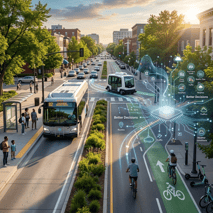 transportation directors have been inundated with data, GPS pings, idle times, mileage reports, stop-arm violations, and driver logs. However, the challenge has rarely been a lack of data; it has been the overwhelming task of synthesizing that data into something useful.
Enter Large Language Models (LLMs). While most people associate LLMs like GPT-4 or Claude with writing emails or generating creative content, their true power for the transportation industry lies in data analysis. By leveraging the ability of these models to process and interpret vast datasets, transportation departments can move beyond reactive reporting and toward proactive, strategic decision-making.
At BusBoss, we understand that your priority is the safety and efficiency of your fleet. Integrating advanced technology into your workflow isn’t about following a trend; it’s about finding better ways to protect your "precious cargo."
The Data Deluge in Student Transportation
Every day, a single school bus generates thousands of data points. When you multiply that by a fleet of fifty, a hundred, or five hundred buses, the sheer volume of information becomes impossible for a human to analyze in real-time. Historically, directors relied on "exception reporting" looking for the red flags in a sea of green.
But exception reporting only tells you that something went wrong after it happened. To truly optimize a fleet, you need to understand the "why" behind the numbers. This is where LLMs excel. Unlike traditional software that follows rigid rules, an LLM can identify complex patterns across multimodal data sources, such as combining weather patterns with historical GPS lag to predict where delays are most likely to occur tomorrow morning.
How LLMs Transform Transportation Management
Large Language Models function as a bridge between raw numbers and human-readable insights. Here are three primary ways they are changing the game for transportation directors:
1. Pattern Recognition Across Disparate Sources
Transportation data is often siloed. Your GPS data lives in one system, your maintenance logs in another, and parent complaints in a third. LLMs can ingest these heterogeneous datasets simultaneously. For example, an LLM can analyze a sudden spike in fuel consumption across three specific routes and cross-reference it with recent engine sensor data and driver feedback regarding new road construction.
Instead of a director spending hour digging through spreadsheets, the LLM provides a concise summary: "Routes 12, 14, and 22 are experiencing a 15% increase in fuel use due to detour-related idling at the Main Street intersection. Recommend temporary route adjustment until construction concludes."
2. Predictive Safety Insights
Safety is the cornerstone of any transportation program. Analyzing safety events such as hard braking, rapid acceleration, or stop-arm violations is critical. LLMs can take this a step further by identifying the environmental factors that contribute to these events.
By analyzing historical safety data alongside external factors like sun glare positions at specific times of day or localized traffic density, LLMs can help directors implement proactive training. If data shows a higher frequency of hard-braking events at a specific corner during the winter months, directors can provide targeted driver training tips or adjust the route timing to avoid peak congestion. For more on how technology improves safety, see our guide on 7 proven ways GPS systems promote safer drivers.
3. Natural Language Querying
Perhaps the most significant advantage of LLMs in transportation management is the democratization of data. You no longer need to be a data scientist to get answers. With an LLM-powered interface, a director can simply ask:
- "Which routes had the most unplanned stops last week?"
- "Compare our average idle time this month to the same period last year."
- "What is the most cost-effective way to integrate three new student stops into the current North-End zone?"
Enhancing Route Optimization
Efficiency isn't just about the shortest distance between two points; it’s about the most reliable path. Standard route optimization software does an incredible job of calculating mathematics, but LLMs add a layer of contextual reasoning.
LLMs can analyze "soft" data, such as notes from drivers about difficult turnarounds or parent feedback about unsafe walking conditions at a specific stop. By clustering this feedback, the model can suggest route modifications that improve both safety and community satisfaction: factors that are often missed by purely mathematical algorithms.
Turning Public Feedback into Actionable Insights
Communication is a massive part of a transportation director’s role. Every day, offices are flooded with emails and calls from parents and school administrators. Sorting through this feedback to find legitimate trends can be a full-time job.
LLMs excel at sentiment analysis and categorization. They can process hundreds of emails and identify that 40% of complaints are regarding a specific bus being late, and then cross-reference that with the GPS data for that bus to determine if the delay is due to a driver performance issue or a systemic traffic problem. This allows the department to respond with facts rather than anecdotes, fostering trust within the community.
The Future: Real-Time Decision Support
As we look toward the future of fleet management, the integration of LLMs will move into real-time decision support. Imagine a system that monitors live traffic feeds, weather alerts, and student boarding data simultaneously.
If a student is missing from their usual stop, or if a sudden road closure occurs, the LLM can instantly generate a communication to parents and provide the driver with an optimized detour that minimizes the impact on the rest of the schedule. This level of responsiveness was once a dream; with modern AI frameworks, it is becoming a reality.
Implementation: Reliability Matters
While the potential of LLMs is vast, the reliability of the underlying software is what truly matters. AI is only as good as the data it consumes. For a transportation department, this means having a robust, secure, and accurate core system like BusBoss.
We have spent over 20 years refining the tools that school districts need to operate. As technology evolves, we remain committed to ensuring that these innovations serve a practical purpose getting students to and from school safely and on time.
Summary and Key Takeaways
The integration of LLMs into data analysis for transportation is not about replacing human directors; it is about empowering them. By automating the "grunt work" of data processing, LLMs allow transportation professionals to focus on high-level strategy and student safety.
- Actionable Insights: Move from raw data to clear, narrative summaries of fleet performance.
- Predictive Safety: Identify environmental and behavioral patterns before accidents occur.
- Efficiency: Combine mathematical optimization with contextual "human" data for better routes.
- Communication: Quickly synthesize community feedback to address systemic issues.
The move toward AI-driven insights is a journey. Whether you are looking to reduce your pupil transportation costs or simply want to get home an hour earlier by spending less time on spreadsheets, LLMs are the tool that will get you there.
Ready to see how advanced routing and data tools can transform your district? Schedule a demo with BusBoss today and discover the future of transportation management.

PRESIDENT
Sonia has been involved with BusBoss since the late 1990’s, and has personally overseen many projects for various customers ranging from large urban and suburban districts to smaller rural school districts from all over the country.
 (484) 941-0820