

bus route optimization, Dispatch Software, asset school bus tracking system, best gps device for school bus, driver navigation, easy gps tracker for school bus
Picture your city five years from now. Traffic lights communicate with emergency vehicles. Garbage trucks follow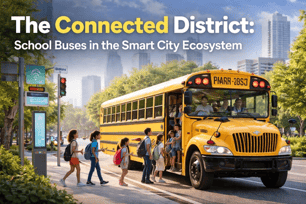 optimized routes based on real-time fill levels. Public transit adjusts schedules on the fly based on ridership patterns.
Now picture those bright yellow school buses, the ones carrying your community's most precious cargo, operating in complete isolation from all of this.
Doesn't make much sense, does it?
The smart city revolution is here, and school transportation is stepping up to claim its rightful place in the connected urban ecosystem. Let's explore what this means for districts ready to think bigger.
What Is a Smart City Ecosystem, Anyway?
A smart city ecosystem is essentially a network of interconnected systems: transportation, energy, public safety, and healthcare, all sharing data and working together to make urban life more efficient, sustainable, and livable.
Think of it as the city's nervous system. Sensors collect data. Platforms analyze it. Systems respond and adapt in real time.
School buses? They're not just vehicles anymore. They're mobile data nodes, moving through neighborhoods twice a day, every school day, touching the lives of millions of students and families.
School Buses: The Missing Piece of Urban Infrastructure
Here's something most city planners overlook: school bus transportation significantly impacts traffic patterns, air quality, and community development. During morning and afternoon hours, these vehicles represent a major component of city traffic.
When school buses operate in a silo: disconnected from traffic management systems, emergency services, and city-wide planning: everyone loses. Students sit in traffic longer. Parents wait anxiously without updates. Districts burn fuel (and budgets) on inefficient routes.
But when school buses plug into the smart city grid? That's when the magic happens.
Real-time traffic coordination means buses can dynamically reroute around accidents, construction, or congestion. City traffic systems can adjust signal timing to help buses stay on schedule.
Emergency response integration connects buses directly to first responders. If there's an incident, help arrives faster because everyone's working from the same data.
Environmental monitoring allows fleet managers to track emissions, reduce idle times, and contribute to city-wide air quality goals.
The Benefits Are Real (and Measurable)
Let's talk results. When school districts integrate their transportation systems with broader smart city infrastructure, the benefits stack up quickly:
Shorter Rides, Happier Students
Smart routing strategies eliminate unnecessary miles, balance student loads across vehicles, and use dynamic routing to avoid problem areas. The result? Shorter travel times for students and less congestion for everyone else on the road.
For parents wondering how student tracking technology is changing expectations, connected systems deliver the real-time visibility families now demand.
Enhanced Safety at Every Level
Connected school buses leverage multiple safety technologies working in concert:
- Live GPS tracking with onboard cameras
- Collision avoidance systems
- Real-time emergency response integration
- Intelligent driver monitoring
These aren't isolated gadgets: they're nodes in a safety network. When something goes wrong, the right people know immediately. Learn more about creating a culture of safety in school bus operations.
Significant Cost Savings
Research suggests that implementing advanced transportation technology: GPS tracking, RFID-based student tracking, and protective sensors, could save districts millions annually through improved efficiency and reduced liability.
Districts looking to optimize routes for efficient transportation find that smart city integration amplifies those savings even further.
The Challenges Worth Addressing
Innovation isn't without its hurdles. Here's what districts need to consider:
Investment and Planning
Smart city integration requires upfront investment, and there's no one-size-fits-all playbook. Each district has unique needs, infrastructure, and priorities. Successful implementations typically start with proof-of-concept phases before scaling up.
Data Privacy and Security
When you're collecting data about students and their movements, privacy isn't optional: it's paramount. IoT devices can be vulnerable to cyberattacks, making robust security protocols essential.
Districts must establish clear policies about data ownership, storage, and sharing, especially when public-private partnerships are involved.
Coordination Across Stakeholders
True smart city integration means working across multiple agencies: school districts, city governments, transportation authorities, technology providers, and regulatory bodies. That requires patience, communication, and aligned incentives.
Your IT Department: The Unsung Hero
Here's a shift many districts haven't fully embraced yet: IT departments are now essential partners in transportation decisions.
The most successful smart city integrations happen when IT and operations teams collaborate from day one. IT professionals assess whether solutions align with existing infrastructure, meet security standards, and integrate seamlessly with district systems.
Cloud-connected transportation platforms need robust wireless connectivity, secure data management, and proper API integration. That's IT territory, and their expertise is invaluable.
The Road Ahead: AI and Predictive Intelligence
As computational power advances, artificial intelligence promises to take connected transportation even further:
- Predictive maintenance that flags vehicle issues before they cause breakdowns
- Real-time route optimization that adapts to changing conditions minute by minute
- Driver behavior insights that improve safety and reduce liability
- Demand forecasting that helps districts plan resources more effectively
The districts embracing these technologies today will be the ones defining best practices tomorrow.
Your District's Place in the Connected Future
School buses have always been more than just vehicles: they're a lifeline connecting students to opportunity. In the smart city ecosystem, they become something even more powerful: active participants in building safer, more efficient, more sustainable communities.
The technology exists. The benefits are proven. The question is simply, how soon does your district want to get connected?
Ready to explore how BusBoss can help your district join the smart city revolution? Visit our website to learn how our routing and fleet management solutions integrate with the transportation technology of tomorrow (while solving your challenges today)

PRESIDENT
Sonia has been involved with BusBoss since the late 1990’s, and has personally overseen many projects for various customers ranging from large urban and suburban districts to smaller rural school districts from all over the country.

 (484) 941-0820