
bus route optimization, Dispatch Software, asset school bus tracking system, best gps device for school bus, driver navigation, easy gps tracker for school bus
Play blog summary Listen
School transportation directors are often asked to improve safety, control costs, and provide better communication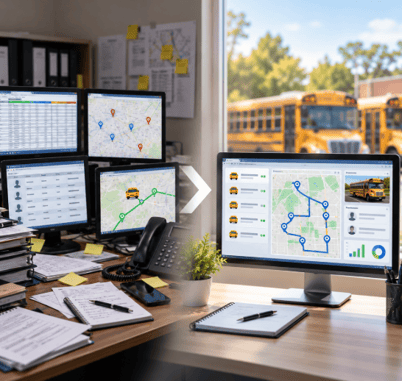 while working with tools that were never designed to work together.
One system manages routes. Another tracks buses. A third records student ridership. Staff may rely on spreadsheets for changes and phone calls for urgent communication. These disconnected transportation systems create extra work and make it harder to know which information is current.
The solution is not always to replace every tool at once. The better approach is to connect core transportation functions through integrated transportation management platforms. A unified system gives your team one operational view of students, vehicles, routes, drivers, and daily changes.
Why disconnected systems create daily problems
Disconnected tools usually develop over time. A district adds GPS tracking to an existing routing system. Later, it adopts a parent communication app or a separate ridership tool. Each purchase may solve one immediate need, but the full operation becomes harder to manage.
Common warning signs include
- Staff enter student or address information more than once
- Route changes do not reach drivers quickly
- Dispatchers cannot easily compare planned routes with actual travel
- Parents receive updates from a different system than transportation staff use
- Ridership records require manual review
- Reports take hours to assemble from multiple databases
These issues affect more than convenience. An outdated address can lead to an incorrect stop. A delayed route update can confuse a driver. A missing ridership record can make it harder to account for students during an emergency.
BusBoss addresses these challenges through a connected school transportation management system that brings routing, tracking, ridership, dispatch, and communication into a shared environment.
What a unified transportation platform should connect
A unified platform should support the full transportation process rather than only one task.
1. Route planning and scheduling
Effective route planning requires more than drawing lines on a map. Districts must account for school calendars, bell times, special transportation needs, student addresses, vehicle capacity, and driver availability.
ROUTEpatrol Web supports browser based collaboration so multiple authorized users can work on routing and scheduling tasks. Districts can also review BusBoss Professional, BusBoss Enterprise, BusBoss Express, and BusBoss SaaS to match the system to their operating model.
The value comes from connecting planned routes to what happens in the field. This helps transportation leaders identify unnecessary mileage, underused buses, and scheduling conflicts that affect operational efficiency.
2. Fleet visibility and live dispatch
A route plan is only useful if dispatchers can see how the fleet is performing during the day.
TRIPpatrol GPS tracking displays vehicle locations on detailed maps and can compare planned routes with actual travel. This gives dispatchers better information when a bus is delayed, deviates from its assigned route, or stops in an unexpected location.
DISPATCHpatrol adds live route management. Dispatchers can record driver absences, mark buses out of service, combine or split routes, and send updated instructions without rebuilding the entire operation.
This connection is important for fleet management. Instead of treating each bus as an isolated asset, your team can view vehicles, drivers, students, and routes as part of one daily operation.
3. Student visibility and ridership accuracy
Vehicle location does not tell you which students are on board. Student level information is essential for daily accountability and emergency response.
STUDENTpatrol can record when students board or leave a bus using RFID, NFC, barcode, tablet, or manual updates. That information can be made available to authorized transportation staff and school administrators.
For a closer look at common data problems, read Why Student Ridership Data Fails in Large Districts.
4. Communication with families and schools
When transportation information is spread across multiple systems, parents may receive late or inconsistent updates. A unified platform allows communication to follow the same route and student records used by dispatchers.
PARENTpatrol provides bus locations, estimated arrival times, stop information, delay notifications, and boarding updates. This can reduce uncertainty for families while giving transportation teams a more consistent communication process.
How unified software supports real time rerouting
Unexpected events are part of school district transportation. A driver may call out. A bus may become unavailable. Severe weather or road construction may require an immediate change.
A connected system should support four steps
- Detect the disruption instantly through GPS status, route deviation alerts, driver reports, or dispatch updates
- Reassign and adjust using intelligent software by combining or splitting routes and assigning available drivers or buses
- Push instructions directly to driver tablets through ROUTEpatrol Tablet App
- Keep parents and schools informed through PARENTpatrol, STUDENTpatrol, and approved district communication channels
This workflow reduces phone calls, handwritten changes, and the risk that one group continues working from an outdated route.
How to replace disconnected systems
Replacing several tools requires careful planning. Use this process to reduce disruption
- Map the current workflow
Document where student, route, vehicle, driver, and ridership data is created, changed, and shared. - Identify the source of truth
Decide which system owns each type of information. Avoid allowing the same record to be edited independently in several places. - Prioritize transportation data integration
Connect your student information system with routing and transportation tools. BusBoss LiveSYNC can move student additions, withdrawals, address changes, and routing information between BusBoss and supported SIS platforms. - Roll out in stages
Begin with core routing and data connections. Add live tracking, driver tablets, student ridership, dispatch, and parent communication as staff become comfortable. - Measure the results
Track duplicate data entry, route changes completed digitally, ridership record corrections, parent calls, missed stops, mileage, and response time during disruptions.
A connected approach can also support shared transportation programs. DISTRICTpatrol helps organizations centralize district and contractor information while managing shared transportation costs and reporting.
The takeaway for transportation directors
Disconnected tools make transportation harder to control because important information is divided between systems, departments, and manual processes. Unified transportation management platforms connect route planning, fleet management, student visibility, dispatch, communication, and reporting in one operating environment.
The goal is not technology for its own sake. The goal is accurate information that reaches the right person at the right time. That supports safer decisions, stronger communication, better data accuracy, and improved operational efficiency.
If your district is evaluating a more connected approach, schedule a BusBoss demo to review your current systems, identify integration priorities, and see how BusBoss can support your transportation operation.

PRESIDENT
Sonia has been involved with BusBoss since the late 1990’s, and has personally overseen many projects for various customers ranging from large urban and suburban districts to smaller rural school districts from all over the country.
 (484) 941-0820