
bus route optimization, Dispatch Software, asset school bus tracking system, best gps device for school bus, driver navigation, easy gps tracker for school bus
Play blog summary Listen
School transportation directors need reliable answers to simple but important questions.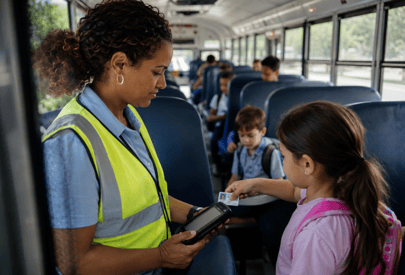
Did each student board the assigned bus? Did they exit at the correct stop? Can staff confirm a student’s location when a parent calls?
Many districts invest in student ridership verification systems to answer these questions. Yet the technology can still produce incomplete manifests, conflicting records, and delayed alerts. In most cases, the problem is not one broken device. It is a breakdown across data governance, daily workflows, and system upkeep.
Understanding these failure points can help your district improve ridership data accuracy without adding more manual work.
1. Data governance gaps create unreliable records
Ridership verification depends on accurate student, route, stop, and eligibility data. If those records are incomplete or outdated, even the best student boarding verification technology will produce questionable results.
Large districts often manage data across several offices and applications. Enrollment may live in the student information system. Route assignments may live in transportation software. Student IDs may be managed by school staff. Each system may use different update schedules and naming rules.
That creates common problems such as
- A student changes schools but remains assigned to an old route
- A new stop is approved but never reaches the driver tablet
- A withdrawn student remains active in the ridership database
- A student has duplicate records across connected systems
- A route change has no effective date or approval history
The solution is a defined source of truth. Transportation and information technology teams should agree on which system owns each data field, who can change it, and how updates reach other school transportation systems.
BusBoss supports this approach through tools such as LiveSYNC and SIF Agent, which help automate information exchange between student records and transportation operations.
2. Workflow misuse turns safety tools into data entry tools
A verification system can only validate what staff and drivers use correctly. When alerts are disabled, manual overrides become routine, or drivers skip scans during busy loading periods, the system may record activity without confirming that it is correct.
This is a frequent form of enterprise district misuse. It does not necessarily mean staff are careless. Large operations face substitute drivers, changing bell schedules, special programs, field trips, and long dismissal lines. Under pressure, teams may create workarounds that seem practical in the moment.
Over time, those workarounds weaken the value of the data.
For example, a driver may manually mark every student as boarded because scanning takes too long. A school office may change a stop by email without updating the official assignment. A dispatcher may turn off exception alerts because too many records are being flagged.
To correct this, directors should establish a workflow that is easy to follow during the busiest parts of the day.
- Define when a student must scan on and scan off
- Document when a manual override is allowed
- Require a reason for each override
- Train permanent and substitute drivers using the same process
- Review exception reports instead of ignoring them
- Assign one team to resolve recurring data problems
STUDENTpatrol supports RFID, NFC, and barcode based ridership capture. It can record student boarding and exiting activity, show current passenger information, and generate alerts when a student uses an incorrect bus or stop.
The ROUTEpatrol Tablet App can also provide drivers with navigation and ridership collection in the same operating workflow.
3. Disconnected systems make accurate data difficult to use
Ridership records lose value when they remain isolated from route planning, vehicle tracking, dispatch, and parent communication.
A scan may be accurate, but staff still need context. They may need to know the bus location, the assigned route, the expected stop, and whether a driver received a recent change. Searching across separate applications slows response time and increases the chance of conflicting answers.
An integrated platform connects these pieces.
ROUTEpatrol Web helps transportation teams manage routes, students, and operational information through a browser based environment. TRIPpatrol helps compare planned routes with actual travel. PARENTpatrol gives families access to bus locations, estimated arrival times, and notifications related to boarding and exiting.
This connected view is especially important during disruptions. If a route must change, the district should be able to
- Detect the disruption instantly
- Reassign and adjust using intelligent software
- Push instructions directly to driver tablets
- Keep parents and schools informed
These steps reduce the risk that a route change will create a second data problem.
4. System maintenance challenges are often overlooked
Hardware and software require regular attention. Tablets need updates. Scanners need testing. GPS devices need connectivity. Student cards need replacement. User permissions need review.
These system maintenance challenges are easy to postpone because transportation teams are focused on daily service. However, small failures accumulate. A damaged scanner leads to manual entries. A tablet with an outdated application fails to receive current manifests. A missed integration update leaves route information out of sync.
Create a maintenance schedule that includes
- Testing scanners and tablets before each school year
- Keeping spare devices available for failed equipment
- Reviewing inactive student IDs and duplicate records
- Confirming that data imports and exports completed successfully
- Checking GPS and cellular connectivity
- Reviewing software permissions and alert settings
- Auditing data after major route or SIS changes
A platform such as DISPATCHpatrol can help dispatchers monitor operations, communicate with drivers, and send approved route updates to connected tablets. The technology still needs defined ownership and regular testing, but it gives teams a stronger operational foundation.
A practical review for transportation directors
Use these questions to identify where your ridership process is breaking down.
- Which system is the official source for student transportation assignments?
- How quickly do enrollment and address changes reach transportation staff?
- Can your team identify every manual ridership override?
- Are drivers trained to respond to wrong bus and wrong stop alerts?
- How often are scanners, tablets, and GPS devices tested?
- Can dispatchers see ridership, route, and vehicle information together?
- Do parents receive information from the same data used by transportation staff?
- Which team reviews incomplete scans and recurring exceptions?
If your team cannot answer these questions consistently, the next step may be process improvement rather than another standalone device.
Summary and takeaway
Student ridership data fails in large districts when governance is unclear, workflows are bypassed, and maintenance is treated as an occasional task. Reliable student ridership verification systems require more than scanners and GPS. They need accurate source data, practical driver procedures, connected school transportation systems, and regular review.
When those elements work together, transportation leaders gain better ridership data accuracy, faster incident response, and clearer communication with schools and families.
See how BusBoss can connect routing, ridership, dispatch, and parent communication in one transportation environment. Schedule a personalized demo with the BusBoss team.

PRESIDENT
Sonia has been involved with BusBoss since the late 1990’s, and has personally overseen many projects for various customers ranging from large urban and suburban districts to smaller rural school districts from all over the country.
 (484) 941-0820