
bus route optimization, Dispatch Software, asset school bus tracking system, best gps device for school bus, driver navigation, easy gps tracker for school bus
Every morning, thousands of school bus drivers perform a silent, high-stakes ritual. They activate their yellow lights,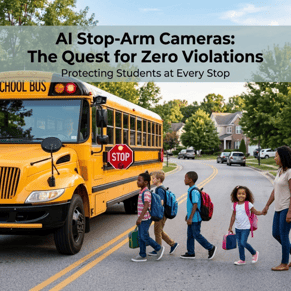 come to a complete stop, and extend the stop-arm, a universal signal that means "stop, children, are crossing." Yet, for many drivers on the road, this signal is treated as a suggestion rather than a law.
The numbers are staggering. According to recent industry data, an estimated 45 million illegal passings occurred during the 2024 school year alone. That is 45 million times a child’s life was put at risk by a distracted or impatient motorist. At BusBoss, we believe that one violation is one too many. That is why the industry is shifting toward a high-tech solution, AI Stop-Arm Cameras.
The Invisible Threat at the Bus Stop
For years, school districts relied on drivers to manually report stop-arm violations. Imagine being a bus driver, you are managing 50 energetic students, navigating traffic, keeping an eye on your mirrors, and following a tight schedule. Expecting a driver to also write down a license plate number, vehicle make, and driver description in the three seconds a car flies by is nearly impossible.
This is where traditional enforcement fails. Without concrete evidence, law enforcement can rarely issue a citation, and motorists continue their dangerous habits without consequence. To truly reduce illegal school bus passing, we need a system that never blinks.
What Exactly is AI Stop-Arm Technology?
Unlike a standard dashcam that simply records a continuous loop of video, AI-powered stop-arm cameras use vision-based artificial intelligence. These systems are "trained" to recognize specific behaviors and objects.
When the bus stop-arm is deployed, the AI sensors create a virtual "enforcement zone." If a vehicle enters this zone while the lights are flashing, the AI immediately identifies it as a potential violation. It doesn't just record; it analyzes. The system captures:
- High-resolution video of the violation.
- Clear images of the vehicle’s license plate.
- The exact GPS coordinates and time-stamp of the incident.
The Workflow: From Detection to Deterrence
A common concern among parents and administrators is the accuracy of these systems. No one wants to be falsely accused of a crime because a computer made a mistake. That’s why the best AI safety systems utilize a multi-step verification process:
- AI Detection: The camera identifies a vehicle passing the stopped bus.
- Evidence Collection: The system packages the video and license plate data into a secure digital file.
- Human Review: Safety professionals review the footage to ensure the violation is valid and the license plate is clear.
- Law Enforcement Integration: The verified evidence is sent to local police departments. An officer reviews the clip one last time before a citation is mailed to the vehicle owner.
By integrating technology with human oversight, districts can ensure that enforcement is both fair and effective. This level of precision is why many districts are now engaging in stop-arm camera advocacy to bring this tech to their local communities.
The Goal: Behavioral Change, Not Just Fines
Is the goal of these cameras to generate revenue for the city? Absolutely not. The real "North Star" is behavioral change.
The data proves that enforcement works. Implementation of AI cameras has led to an 81% reduction in violations in some districts. Perhaps the most encouraging statistic is that 98% of people who receive a citation for a stop-arm violation do not repeat the offense.
Most drivers aren't malicious; they are distracted or unaware. A ticket in the mail serves as a powerful wake-up call that forces them to pay attention the next time they see a yellow bus. The "Quest for Zero Violations" isn't about writing more tickets; it’s about creating an environment where drivers wouldn't dream of passing a stopped bus.
Integrating Safety with Routing and Tracking
At BusBoss, we know that stop-arm cameras are just one piece of the safety puzzle. For a transportation department to be truly "reliable," all its systems need to talk to each other.
When your school bus routing software is integrated with safety tech, you can identify "high-risk" stops. If the AI cameras report frequent violations at a specific corner, planners can adjust the route to move that stop to a safer, less congested side street.
Furthermore, combining camera tech with GPS systems allows transportation directors to monitor driver performance and ensure that buses are stopping exactly where they are supposed to. This holistic approach is how we move from reactive safety to proactive prevention.
Addressing Parental Concerns
Whenever new technology is introduced, especially technology involving cameras, parents often have questions. They want to know if their children’s privacy is being protected.
The AI in stop-arm cameras is specifically designed to look outward at traffic, not inward at the students. When combined with student tracking devices, parents get a comprehensive view of their child’s safety without compromising privacy. It’s about building a "shield" around the bus stop. We’ve even put together a guide on how to confront parental concerns regarding tracking and safety tech to help districts navigate these conversations.
The Road Ahead: Zero Is Possible
The quest for zero violations might sound like a pipe dream, but with AI, it is becoming a measurable goal. As more districts adopt these systems, we see a "halo effect" where driver awareness increases across entire regions, even on routes without cameras.
Technology is finally catching up to the dangers of the modern road. By automating the detection of stop-arm violations, we are taking the burden off the bus driver and putting the accountability exactly where it belongs, on the motorist.
Key Takeaways:
- AI vs. Manual: AI cameras are far more accurate than manual reporting and allow drivers to focus on the road.
- Enforcement Works: 98% of violators do not repeat the offense once they receive a citation.
- Integration is Key: Safety is most effective when cameras, GPS, and routing software work together.
- Behavioral Change: The ultimate goal is to educate drivers and eliminate the threat of illegal passings entirely.
Ready to upgrade your district's safety standards?
Don't wait for a "close call" to take action. Explore how integrated routing and safety solutions can protect your students. Download our 10 Questions Guide to learn what you should be asking your software provider today, or use our ROI calculator to see how automation can save your district time and resources.
Schedule your BusBoss School Bus Routing Demo Today! Because at BusBoss, your precious cargo comes first.

PRESIDENT
Sonia has been involved with BusBoss since the late 1990’s, and has personally overseen many projects for various customers ranging from large urban and suburban districts to smaller rural school districts from all over the country.
 (484) 941-0820