

bus route optimization, Dispatch Software, asset school bus tracking system, best gps device for school bus, driver navigation, easy gps tracker for school bus
Play blog summary Listen
In dispatch, late information is often wrong information. Even accurate data loses value when the decision window has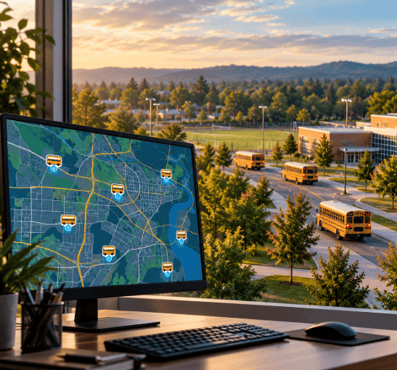 passed. A bus shown at its previous stop does not help much when it has already missed the next one.
This is why transportation directors need to look beyond the label real-time dispatch software. The important question is how quickly accurate information moves from a vehicle to dispatch, from dispatch to a driver, and from the district to families. This post covers three causes of delay, how they compound across a large fleet, and what to evaluate before choosing a platform.
The three delay patterns to investigate
- Latency Vehicle position depends on the GPS reporting interval, cellular coverage, server response time, and the time needed to refresh the dispatch view. A device that reports once every minute already creates a delay before network or processing time is added. On a difficult morning, a two minute old map can show a bus near the wrong stop even though the bus has already moved. Ask how quickly an event appears in dispatch and whether the system shows the age of the latest location update. Tools such as TRIPpatrol GPS tracking are designed to compare planned activity with actual vehicle movement and support timely deviation awareness.
- Data synchronization problems Information can be accurate in one system and outdated in another. A route change may not reach the driver tablet. A driver status may not reach dispatch. Student information may lag behind an enrollment or address change. Vehicle to route assignments can also drift when staff update records in separate applications. The result is reconciliation work during the busiest part of the day. A district should confirm whether each change has a delivery status and whether the same route, vehicle, driver, and student identifiers are used throughout the platform. LiveSYNC is built to keep student changes aligned between BusBoss and a district SIS.
- Alert overload A system can be technically fast and still slow down people. Too many notifications cause dispatchers to mute alerts, dismiss routine warnings, or overlook the one event that requires immediate attention. Critical alerts become buried among minor lateness notices and repeated updates. Evaluate whether alerts can be ranked by severity, grouped by incident, and tuned for different roles. A dispatcher may need an off route or missed stop warning while an administrator may need a broader service summary.

A reliable DISPATCHpatrol workflow supports the response to a disruption through four clear actions.
- Detect the disruption instantly Identify a late vehicle, route deviation, unavailable bus, or missed stop as soon as the available data supports the decision.
- Reassign and adjust using intelligent software Move a route, split service, or assign a replacement while preserving the student and stop information needed by the new driver.
- Push instructions directly to driver tablets Send the current assignment and directions through the ROUTEpatrol Tablet App so drivers are not relying on outdated paper instructions or phone calls.
- Keep parents and schools informed Share useful updates through channels such as PARENTpatrol so families and school staff receive the same operational picture.
Why delays compound at scale
Fleet scaling does not simply add more vehicles. It multiplies the number of location updates, status changes, route events, student movements, alerts, and user actions that arrive during the same short period.
That changes the nature of large fleet management. Dispatchers cannot review every event with equal attention. They need a system that identifies exceptions and places them in a useful order. A late bus carrying a time sensitive program may need attention before a small delay on a route that remains within its service window.
Dispatch system scalability should therefore be measured in decision time. The number of users, records, or logins supported matters, but those measures do not show whether the platform remains useful during morning pullout. The better test is how long it takes to identify an issue, understand its impact, make a change, and confirm that the change reached the people affected.
At scale, one late or conflicting record creates work in several places at once. Dispatch, routing, student records, and communication all have to stay aligned during the busiest parts of the day. If those connections slow down under peak load, small issues spread quickly.
What to evaluate in a platform
- Event visibility Measure the time between a vehicle event and its appearance in dispatch. Review the GPS reporting interval, the effect of cellular gaps, and the way stale data is labeled.
- Change confirmation Check whether dispatchers can see that a route change was sent, received, and opened on the driver device. A sent message is not the same as a confirmed instruction.
- Alert control Confirm that alerts are ranked by severity and can be tuned by role, route group, event type, or operating period. Fewer actionable alerts are more useful than more notifications.
- Consistent identifiers Verify that the same vehicle, route, driver, stop, and student identifiers hold across dispatch, planning, ridership, and communication tools. STUDENTpatrol can help connect ridership events with the active vehicle and route record.
- Peak responsiveness Test map loading, filtering, route edits, and alert handling while several users work at the same time. BusBoss Enterprise combines planning functions with GPS tracking for districts that need a connected view of fleet operations.
- Connectivity recovery Ask what happens when a vehicle loses cellular service. The system should show the last known update, identify the gap, and restore data in a controlled way when the connection returns. Clear status information is essential for dependable real-time vehicle tracking.
Test the platform before you buy
Demonstrations usually happen with clean data, few users, and no time pressure. That is not the environment transportation teams need to evaluate.
Use actual route, vehicle, driver, and student data in a controlled test. Run it during peak pullout time with several concurrent users. Create a route change and confirm that the driver receives it. Simulate a connectivity gap and review how the platform reports the last known position. Generate routine and serious alerts together to see whether the difference is clear.
You can also compare the planning experience in ROUTEpatrol Web with the live operational view. The goal is not to produce a perfect demonstration. It is to find out whether the platform preserves decision quality when fleet operations become busy.
Key takeaway
Dispatch delays usually come from one of three places. Information arrives late, systems disagree, or important alerts are hidden by noise. At scale, each weakness affects more vehicles and creates more work for dispatchers.
The right platform should make timing measurable, confirm that changes were received, preserve consistent records, and help staff focus on exceptions. Review the broader BusBoss products and schedule a demonstration using your own operating conditions. A practical test can show whether the system provides timely information when your district needs it most.

PRESIDENT
Sonia has been involved with BusBoss since the late 1990’s, and has personally overseen many projects for various customers ranging from large urban and suburban districts to smaller rural school districts from all over the country.
 (484) 941-0820