

bus route optimization, Dispatch Software, asset school bus tracking system, best gps device for school bus, driver navigation, easy gps tracker for school bus
Play blog summary Listen
For a school transportation director, a route change only works when everyone sees the same update. If dispatch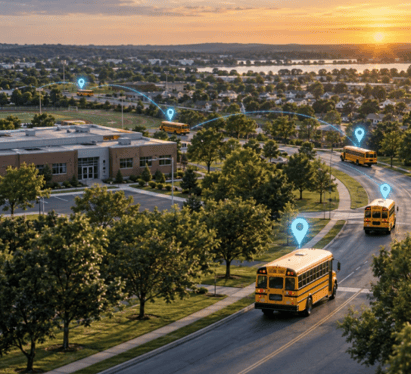 changes a run but the driver tablet, student record, or school staff view does not update, small errors quickly become service problems.
Reliable data sync keeps dispatch, routing, tablets, GPS, and family communication working from one current view.
Why dispatch data sync breaks during a districtwide rollout
A districtwide software rollout affects more than the transportation office. It touches school staff, dispatchers, drivers, multiple yards, information technology teams, families, and sometimes outside transportation providers. Each group may use different systems and follow different procedures.
The most common implementation challenges include the following.
- Routing changes do not reach the driver tablet
A dispatcher may adjust a stop, combine runs, or assign a replacement bus. If the update depends on manual steps or a delayed refresh, the driver may still leave with the old route.
- Dispatch edits overwrite each other
In a districtwide software rollout, several dispatchers may touch the same route. Without version control and change ownership, one edit can replace another and create confusion.
- Student information becomes stale
New enrollments, withdrawals, address changes, and school assignments affect transportation every day. Manual entry between the SIS and routing platform increases the chance of a bad manifest or an outdated stop.
- Tablet and network interruptions hide delivery failures
A tablet may lose service or fail to refresh after restarting. If the platform cannot confirm delivery, dispatch may assume the driver has instructions that never arrived.
- Radio and phone workarounds create different versions
When sync fails, teams fall back on calls, radio traffic, paper sheets, and notes. Those tools help in emergencies, but they often leave dispatch, drivers, and schools with different versions of the same change.
Why scale makes the problem worse
A small operation may resolve a mismatch through personal knowledge. A larger district cannot rely on that. Multiple yards may share buses, drivers, and substitutes, while elementary, secondary, special education, and activity routes all run on different patterns.
This is where school bus dispatch software must support school transportation management at the district level. Staff need to see who made a change, when it happened, which route was affected, and whether the driver received it.
Fleet tracking alone does not solve this problem. Telematics can show vehicle location, but districts also need student assignments, stop details, bell schedules, route versions, and driver instructions. Those connections make school bus fleet coordination and school bus routing work in real operations.
What an integrated platform should provide
A strong platform should treat route data as an operational record rather than a file that moves from one system to another.
One source of route truth
Dispatchers, route planners, and drivers should work from the same current route information. ROUTEpatrol Web supports web based routing and planning, while DISPATCHpatrol helps staff reassign routes and make temporary same day changes without rewriting the permanent plan.
Immediate delivery with acknowledgement
A route update should go directly to the driver tablet and show whether it was delivered and acknowledged. ROUTEpatrol Tablet App gives drivers updated route details, navigation, notifications, and student ridership information.
This creates a clear loop for real-time bus dispatch. Dispatch sends the instruction, the driver receives it, and the platform records the exchange. If the tablet is offline, staff should see that exception right away.
Reliable SIS synchronization
Student records should not require repeated manual entry. LiveSYNC moves student additions, withdrawals, address changes, and other updates between BusBoss and the district SIS.
This reduces duplicate work and helps protect the accuracy of manifests, stops, and assignments, especially during registration and midyear changes.
A documented change history
Every operational change should have a record. Transportation leaders need to review the original route, the temporary adjustment, who approved it, and when it was sent to the driver.
That history supports training, incident review, compliance reporting, and better decisions about recurring route problems. It also helps separate a temporary exception from the permanent school bus routing plan.
Exception handling that protects the permanent plan
A broken down bus or driver absence should not force staff to rebuild the regular schedule. Temporary changes should apply only to the affected run and date while preserving the approved route design.
This helps teams respond quickly without creating new errors for the next morning. It also gives planners better data when they review disruptions later.
The four step response to a live disruption
An integrated real-time bus dispatch process should follow four clear steps.
- Detect the disruption instantly
Use GPS alerts, driver messages, absence reports, vehicle status, and school notifications to identify the problem.
- Reassign and adjust using intelligent software
Review available buses, drivers, route capacity, student needs, timing, and safety constraints before selecting the response.
- Push instructions directly to driver tablets
Send the updated route, stop order, student list, and driver message through the connected tablet workflow. Confirm delivery and acknowledgement.
- Keep parents and schools informed
Use PARENTpatrol to share bus locations, estimated arrival times, delays, and route changes. STUDENTpatrol can provide live ridership information and help staff identify affected students.
For broader vehicle visibility, TRIPpatrol compares planned routes with actual travel and supports deviation alerts. Together, these tools connect operational response, student safety, and communication.
Key takeaways for transportation directors
- Treat dispatch, routing, tablets, student records, GPS, and parent communication as one connected workflow.
- Require acknowledgement for important route updates instead of assuming that delivery occurred.
- Keep temporary disruption changes separate from the permanent route plan.
- Track failed sync events, stale records, disconnected tablets, and unconfirmed instructions.
- Pilot the process across one yard or school tier before expanding across the district.
Real time data sync is part of dependable school transportation management. When every team works from the same current data, dispatchers respond faster, drivers get clearer instructions, and schools and families receive more accurate information.
BusBoss connects routing, dispatch, GPS, ridership, SIS data, and communication tools in one environment. Schedule a BusBoss demo to see how an integrated platform can reduce delays, errors, and confusion during your districtwide software rollout.

PRESIDENT
Sonia has been involved with BusBoss since the late 1990’s, and has personally overseen many projects for various customers ranging from large urban and suburban districts to smaller rural school districts from all over the country.
 (484) 941-0820