

bus route optimization, Dispatch Software, asset school bus tracking system, best gps device for school bus, driver navigation, easy gps tracker for school bus
Play blog summary Listen
Accurate boarding records come from several connected parts of a district’s work. A student’s enrollment, transportation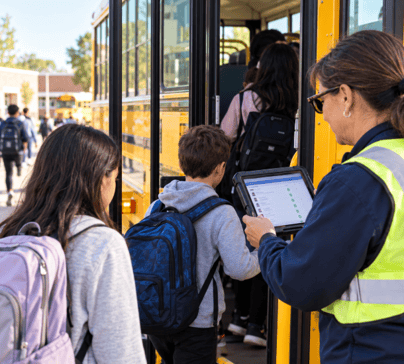 assignment, device, run, and recorded boarding event can each be correct on its own while still failing to agree with the others.
Trying to repair every part at once often creates more confusion. This playbook improves accuracy in stages. Each stage removes a different class of error, moving from repairing the record to improving the process that keeps it correct.
Stage One: Establish the true record
Start with the information the district trusts. The goal is to bring transportation assignments into line with authoritative student records, not to alter boarding events until the numbers appear to match.
- Set a baseline. Pull a current enrollment extract and compare it with your transportation record using a stable student identifier. Count the differences by school and student status. This establishes the size of the gap. The stage is complete when you have a dated comparison and a clear count of records that do not match.
- Group the differences. Sort mismatches into students missing from transportation, students who have left but remain listed, and students with changed addresses or eligibility. This turns a broad accuracy concern into manageable types of record repair. The stage is complete when each mismatch has a category and a responsible person to review it.
- Name the authority for each field. Decide which record controls enrollment status, address, eligibility, route, stop, and boarding event. For example, the SIS may own enrollment details while the transportation record owns an assigned stop. This prevents two staff members from making competing edits. The stage is complete when field ownership is documented and understood.
- Correct assignments from the source. Update the transportation record using the authority you identified for each field. Do not rewrite a ridership event to make it fit a changed assignment. Preserve what was recorded and fix the underlying student or route information. The stage is complete when sampled student assignments match their authoritative records.

Stage Two: Fix the SIS flow
A clean record can become inaccurate again if information moves late, incompletely, or through undocumented manual steps. Improving student boarding verification means making the flow between the SIS and transportation clear enough to manage.
- Map the fields and handoffs. List which information moves between the SIS and transportation, such as student ID, enrollment status, school, address, eligibility, and transportation assignment. Mark which fields are entered by staff instead. This clarifies where a change can stall or be missed. The stage is complete when the field list identifies a source and method for every item.
- Test with a deliberately messy record. In a safe test environment, use examples that include a midyear transfer, a withdrawal, and an address change. Confirm that each change updates the right student and does not leave an outdated assignment behind. This tests the flow under realistic conditions. The stage is complete when all three changes produce the expected records.
- Measure elapsed time. Record when a change is made in the SIS and when it becomes available to transportation staff. Compare the elapsed time with the service level the district needs. A connection that eventually works may still be too slow for a change that affects tomorrow’s ride. The stage is complete when the district has a measured result and an agreed response target.
- Set a cadence and owner. Decide whether updates run daily or weekly, and name the person responsible for confirming successful processing and following up on rejected records. LiveSYNC is one BusBoss option for moving student changes between supported SIS connections and transportation records. The stage is complete when the schedule, owner, and follow up path are documented.
Stage Three: Tighten device and run mappings
A student record can be sound while boarding events are still assigned to the wrong vehicle or run. Check the connection between equipment, active service, and what drivers see.
- Match devices to vehicles in service. Compare the device register with the vehicles actually being used. Resolve devices assigned to spare vehicles, equipment moved between buses, and units no longer active. This removes errors caused by outdated assignments. The stage is complete when every active device has a confirmed vehicle.
- Confirm each device reports to the correct run. Compare device, vehicle, and run assignments before service begins. Make sure a substitute vehicle or a temporary assignment does not leave the device reporting against the usual run. This helps ensure events are attributed to the trip that actually occurred. The stage is complete when test events appear under the intended run.
- Resolve unknown cards against enrollment. Compare the card register with the current enrollment record. Identify unissued, inactive, duplicated, or incorrectly assigned cards and correct the register. This gives staff a clear way to resolve unknown card alerts. The stage is complete when each active card has a confirmed student or a documented reason it remains unassigned.
- Rehearse the wrong run. Test what a driver sees when a device is set to the wrong run. Check whether the screen makes the mismatch clear and whether staff know how to correct it before boarding continues. The ROUTEpatrol Tablet App supports driver access to route details and ridership collection. The stage is complete when drivers and supervisors can demonstrate the correct response.
Stage Four: Correct exceptions at the source
During the correction period, review exceptions daily. A queue is useful when it leads to a durable fix, not when staff repeatedly clear the same alert without correcting its cause.
- Review the queue each day. Make time for a daily review while correcting the records and processes established in earlier stages. Assign an owner and due date to each item. This keeps errors from sitting unnoticed. The stage is complete when new exceptions are reviewed and assigned within the district’s agreed timeframe.
- Sort exceptions by class. Group records as missing student, wrong run, duplicate event, or unknown card. Give each group a clear next step and owner. This makes recurring patterns easier to address without turning the work into a broad investigation. The stage is complete when every open exception has a category.
- Fix the layer that owns the error. Correct a student’s enrollment information in its authoritative source, a device assignment in the device register, and a run mapping in its own record. Avoid patching the event itself when the underlying data is wrong. This is central to ridership data accuracy. The stage is complete when the correction addresses the cause and a subsequent record reflects it.
- Record who changed what and why. Document the person, time, reason, and field changed. This helps the next staff member understand the correction and recognize recurring system maintenance challenges. The stage is complete when corrections can be understood without relying on someone’s memory.
Stage Five: Make the correct path faster than the workaround
A process that is accurate but difficult to follow will invite shortcuts. Make the official correction path practical for the people who need it.
- Find the side lists. Ask staff where they keep spreadsheets, paper notes, or personal lists to compensate for missing or outdated information. These lists point to friction in the official process. The stage is complete when each side list has a known purpose and owner.
- Compare the time required. Time a common correction through the approved process and through the workaround. Note every unnecessary step, wait, or duplicate entry. This shows precisely why staff choose the shortcut. The stage is complete when you have a clear record of where time is lost.
- Remove the friction. Simplify the steps, clarify permissions, or improve staff training where those changes will make the approved path easier. In larger districts, enterprise district misuse can begin when the spreadsheet is quicker than the system. The stage is complete when staff can make common corrections through the official process without relying on a side list.
- Retire lists after the process works. Remove duplicate records only after confirming that the official source is current and accessible to the people who need it. Keep any required historical records according to district policy. The stage is complete when staff no longer need the side list for routine corrections.
Stage Six: Verify with a spot check cycle
After the record and process improvements are in place, use small, repeatable checks to see whether they are holding up in daily service.
- Follow five riders end to end each week. Choose five students and compare each record across the SIS, transportation assignment, and boarding event. Include different schools or run types over time. This tests whether the records agree across the full process. The stage is complete when each sampled rider can be followed through all three records or has a clearly assigned correction.
- Compare counts with manifests. Reconcile recorded riders by run against the corresponding manifests. Review differences with the staff responsible for those records rather than assuming that a count alone explains the cause. The stage is complete when each difference is resolved or assigned for follow up.
- Track the oldest open mismatch. Record how long the oldest unresolved issue has remained open and who owns its next action. This helps leadership see whether corrections are keeping pace with new exceptions. The stage is complete when the age and owner of the oldest item are reported each week.
- Share accuracy in plain numbers. Report the number of riders sampled, the number whose records agreed, the number of open exceptions, and the age of the oldest one. Keep the measures simple enough for school leaders to interpret. The stage is complete when leadership receives a consistent update and can see whether results are improving.
Sequence and ownership matter
The stages work in order. Process reform cannot hold if staff are still using inaccurate student records. Likewise, device and run checks cannot fix a student whose transportation assignment is wrong at its source. Repair the underlying records first, then improve the flow and daily handling that keep them correct.
Assign ownership clearly. SIS and enrollment staff should own the fields their office controls. Transportation staff should own assignments, devices, runs, and exceptions. School leaders can help resolve questions about eligibility and address changes. A named coordinator can keep the stages moving and share progress across school transportation management. Clear responsibility also supports school bus fleet coordination without making every correction a districtwide task.
What better accuracy makes possible
Reliable records help staff respond with confidence when service changes. During a disruption, real-time bus dispatch depends on knowing which students are assigned to each run. DISPATCHpatrol supports same day route changes, while STUDENTpatrol can record student boarding and exiting activity. TRIPpatrol adds vehicle trip information, and PARENTpatrol supports family updates.
Good records also give school bus dispatch software a dependable starting point, and school transportation technology can only be trusted when the records beneath it agree. When a district considers a districtwide software rollout, correcting student and transportation records before migration can reduce implementation challenges. Districts can review the broader BusBoss product range and BusBoss Enterprise as they consider the tools that fit their needs.
Student boarding verification is the final measure of whether the stages held. When a scan can be traced to a current assignment in every case sampled, the district has moved from correcting errors to preventing them.
Summary and next steps
Accuracy improves when a district fixes records before reforming the processes around them. Start with a current enrollment comparison this week. Then map the SIS flow, confirm vehicle and run assignments, correct exceptions at their source, remove workarounds, and report a weekly spot check.
The practical takeaway is to make every correction traceable and every owner clear. To discuss how BusBoss tools may support your district’s approach, schedule a demo.

PRESIDENT
Sonia has been involved with BusBoss since the late 1990’s, and has personally overseen many projects for various customers ranging from large urban and suburban districts to smaller rural school districts from all over the country.

 (484) 941-0820
