

bus route optimization, Dispatch Software, asset school bus tracking system, best gps device for school bus, driver navigation, easy gps tracker for school bus
Play blog summary Listen
School bus dispatch is manageable when a transportation team has a small fleet, a limited service area, and few daily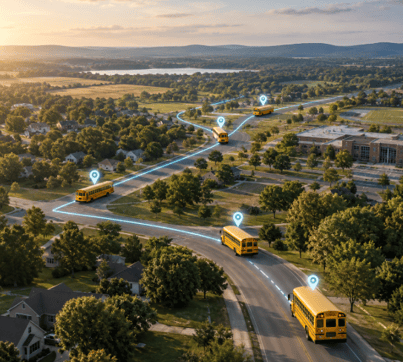 changes. The operating model becomes more demanding as the fleet grows. A callout, vehicle issue, road closure, or student address change can affect several routes at once.
Many districts experience a major change in complexity between 50 and 150 buses. At 50 buses, dispatchers may still rely on personal knowledge, phone calls, shared spreadsheets, and printed route documents. At 150 buses, those same habits create delays, conflicting instructions, and limited visibility.
Scaling is not only about adding more vehicles. It requires a coordinated approach to route planning, dispatch, live location data, student ridership, driver communication, and parent updates. This guide explains the operational and technical issues transportation directors should address when evaluating real-time dispatch software.
What dispatch scaling means for a school district
Dispatch and routing serve different purposes.
Routing creates the planned transportation network. It assigns students to stops, places buses on routes, considers capacity, and accounts for schedules and special requirements.
Dispatch manages the operation as it happens. It responds when a driver is absent, a bus is unavailable, traffic changes, or a route needs to be adjusted during the school day.
A scalable system must connect both functions. A dispatcher should not have to rebuild an entire route in one system, call a driver with instructions, update a separate tracking tool, and then answer parent questions with incomplete information.
The goal is one accurate operational picture that can be shared with the right people.
Why the 50 to 150 bus range matters
The move from 50 to 150 buses often exposes weaknesses that were not visible in a smaller operation. The district may now have more schools, more depots, more bell schedules, and more specialized transportation requirements.
Common changes include
- More simultaneous route exceptionsA single morning may include several driver absences, a vehicle taken out of service, late school dismissals, and road construction. Dispatchers need to manage these events without losing track of the original assignments.
- More users and decision makersDispatchers, supervisors, drivers, school staff, contractors, and administrators may all need access to transportation information. Each group needs different views and permissions.
- More complicated bell timesA change at one school can affect tiered routes across the district. A route serving an elementary school, middle school, and high school may depend on precise timing. A small delay can carry into later runs.
- More specialized transportationSpecial needs routing may require lift buses, aides, longer boarding times, specific equipment, or carefully planned handoffs. A generic fleet tool may show the vehicle location but not the student level requirements that shape the route.
- More data dependencyAs the fleet grows, outdated student records and inconsistent route information become more disruptive. Accurate enrollment, addresses, custody arrangements, stop assignments, and ridership records become central to daily dispatch.
This is why large fleet scaling should be treated as an operational design project rather than a simple software purchase.

The district specific requirements generic fleet software may miss
Generic fleet and trucking platforms often focus on vehicles, drivers, mileage, maintenance, and commercial deliveries. Those functions can be useful, but school transportation has additional requirements.
A school bus operation must account for
- Bell time coordination
- Student eligibility
- Assigned stops
- Special needs transportation
- Custody and alternate addresses
- Student boarding and exit records
- School specific loading procedures
- Parent communication
- Child check processes
- Route compliance and student safety
A truck can be rerouted to a new destination without considering whether a student is approved to board at that location. A school bus route needs to account for the identity, assignment, and safety needs of every student.
This distinction matters when reviewing school transportation technology. A platform should support the transportation process from planning through dispatch and communication. It should not treat the bus as the only important data point.
The technical foundation for dispatch system scalability
Strong dispatch system scalability depends on more than a map with moving vehicle icons. Transportation leaders should evaluate how data moves between systems and how quickly changes reach the people who need them.
A scalable platform should support these capabilities
- Centralized route informationDispatchers should work from current route assignments, student records, bus information, and driver assignments. This reduces the chance that different staff members are using different route versions.
- Reliable system integrationStudent information changes should flow into transportation records without repeated manual entry. BusBoss LiveSYNC helps synchronize student additions, withdrawals, address changes, custody information, and routing data between a district SIS and BusBoss.
- Live vehicle dataDispatchers need current bus locations, route progress, stop activity, and deviation information. TRIPpatrol provides real-time GPS vehicle tracking and can compare planned routes with actual travel.
- Driver device updatesA route change is not complete until the driver receives clear instructions. The ROUTEpatrol Tablet App provides route navigation, student ridership collection, driver notifications, and updated route details.
- Role based accessDispatchers may need full operational control. School staff may need student and route information. Parents should only see information connected to their children. Access should reflect each user’s responsibilities.
- Historical reportingA scalable operation needs more than live visibility. Leaders should be able to review route deviations, late arrivals, boarding events, vehicle activity, and recurring exceptions to improve future planning.
The four step process for real time bus rerouting
When a disruption occurs, transportation teams need a repeatable workflow. The process should include four steps.
1. Detect the disruption instantly
The system should help dispatchers identify a driver absence, vehicle problem, route deviation, delay, or road closure as soon as possible. Live location data and operational alerts reduce the time between an event and a response.
2. Reassign and adjust using intelligent software
Dispatchers should be able to reassign a driver or bus, combine routes, split routes, and make temporary changes without damaging the permanent route plan. DISPATCHpatrol is designed for real-time route changes, including driver absences and buses taken out of service.
3. Push instructions directly to driver tablets
Drivers should receive the updated route, stop information, and instructions through the device they use during the run. This limits confusion and reduces dependence on long phone calls or handwritten notes.
4. Keep parents and schools informed
Schools and families need consistent information after a change. PARENTpatrol provides live bus locations, estimated arrival times, delay notifications, and route updates. This can reduce unnecessary calls to dispatch while giving families practical information.
How integrated visibility improves daily operations
Real-time vehicle tracking is most useful when it connects to planned routes and student information. A map alone cannot tell a dispatcher whether a bus is carrying the correct students or whether a route change creates a problem at the next school.
A connected platform can help teams compare planned and actual performance. It can also support student ridership verification systems that record when students board and exit the bus.
This is where student boarding verification becomes important. When boarding information is linked to the route and the student record, dispatchers can respond more confidently to questions about who is on a bus, whether a student used the correct stop, and whether a route has unexpected ridership.
Accurate records also improve planning. Better ridership data accuracy can help districts identify underused routes, overloaded buses, recurring no shows, and opportunities to tune service without relying on assumptions.
The role of routing in a scalable dispatch model
Dispatch cannot compensate for poor route design. If routes are already overloaded, poorly timed, or difficult to operate, daily exceptions will be harder to resolve.
ROUTEpatrol Web supports district route planning with tools for reviewing route performance, managing student assignments, considering special needs requirements, and evaluating bus usage. It also allows multiple users to work on routing and scheduling tasks.
For a district growing from 50 to 150 buses, route planning should be reviewed regularly. Important questions include
- Are bell times creating avoidable conflicts between tiers?
- Are students assigned to stops that are practical for drivers and families?
- Are special needs routes allowing enough time for safe boarding and securement?
- Are buses being used efficiently across morning, afternoon, and midday runs?
- Are route changes based on current ridership rather than outdated enrollment records?
A scalable dispatch model begins with routes that reflect current district conditions.
Common fleet operations challenges during growth
Districts often face the same fleet operations challenges as they expand.
Driver shortages can make route coverage difficult. Vehicle availability may change because of inspections, repairs, or seasonal conditions. Schools may dismiss students at different times. Families may move or request alternate transportation. Weather and traffic can affect the entire network.
These issues also create system maintenance challenges. Devices need updates. GPS hardware must remain connected. User permissions require review. Student data must be synchronized. Dispatch rules need to be tested before major schedule changes.
Transportation leaders should assign ownership for each area. IT may manage devices and security. Transportation staff may manage route and dispatch rules. School administrators may confirm student information. Without clear ownership, minor issues can become operational disruptions.
Leaders should also watch for enterprise district misuse. This happens when a district buys a large platform designed for a different industry or a much larger operating model, then uses only a small portion of its functions. The result may be higher cost, more training, and workflows that do not fit school transportation.
The right system should match the district’s fleet size, staffing model, technology environment, and service requirements.
A practical scaling checklist
Before selecting or expanding a dispatch platform, transportation directors should complete these steps
- Document the current operationMap the dispatch process from a driver callout to final parent notification. Note where staff use spreadsheets, paper, phone calls, or separate systems.
- Measure exception volumeTrack driver absences, vehicle substitutions, route changes, delays, missed stops, and parent calls. This shows where scaling pressure is highest.
- Review district complexityInclude bell schedules, school locations, special needs routing, alternate addresses, contractor operations, and midday transportation.
- Confirm integration needsList the SIS, GPS hardware, routing tools, communication systems, and maintenance tools that must exchange information.
- Test the full disruption workflowAsk a vendor to demonstrate detection, route adjustment, driver notification, tracking, student records, and parent communication in one scenario.
- Plan for staff adoptionDispatchers, drivers, schools, and families each need clear training and support. A platform is only scalable if people can use it during a busy school day.
How BusBoss supports connected school bus dispatch
BusBoss is built around school transportation rather than generic commercial fleet operations. BusBoss Professional provides the routing foundation, while the connected product family extends visibility into dispatch, navigation, GPS tracking, student ridership, and parent communication.
The result is a coordinated model that can include
- DISPATCHpatrol for last minute route adjustments
- ROUTEpatrol Web for web based route planning
- ROUTEpatrol Tablet App for driver navigation and ridership collection
- TRIPpatrol for live vehicle tracking and route deviation information
- STUDENTpatrol for student location and ridership records
- PARENTpatrol for family updates and estimated arrival times
- LiveSYNC for keeping student and routing information aligned
This integrated approach helps districts scale without treating routing, dispatch, tracking, and communication as separate projects.
Summary and next steps
School bus dispatch scaling becomes difficult when districts grow faster than their processes. The shift from 50 to 150 buses can expose problems with route version control, bell time coordination, special needs routing, driver communication, student records, and parent updates.
A scalable operation needs more than generic fleet management. It needs school specific routing, real-time dispatch, student boarding information, connected GPS data, and communication that reaches drivers, schools, and families.
The most important takeaway is to evaluate the entire operating workflow. A strong platform should detect disruptions, adjust routes, send instructions to drivers, and keep the wider school community informed.
To see how BusBoss can support your district’s dispatch and routing goals, schedule a BusBoss demo.

PRESIDENT
Sonia has been involved with BusBoss since the late 1990’s, and has personally overseen many projects for various customers ranging from large urban and suburban districts to smaller rural school districts from all over the country.

 (484) 941-0820