

bus route optimization, Dispatch Software, asset school bus tracking system, best gps device for school bus, driver navigation, easy gps tracker for school bus
We’ve all been there. It’s 6:30 AM, the first fleet of buses is already pulling out of the lot, and suddenly, the "impossible"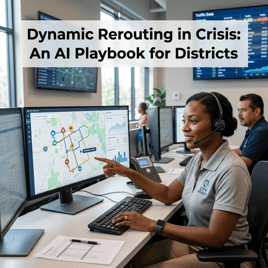 happens. A water main breaks on a primary artery, or a sudden, unpredictable ice storm turns the morning commute into a skating rink. In the old days, and by "old days," we mean just a few years ago, this triggered a frantic scramble of radio calls, physical maps, and a lot of "best-guess" navigation.
But in 2026, we don't have to rely on luck. Crisis management in student transportation has evolved. Thanks to Artificial Intelligence, school districts are moving away from reactive chaos and toward proactive, data-driven safety.
If you’re still managing emergencies with a clipboard and a prayer, it’s time to look at the AI playbook for dynamic rerouting.
The Chaos Factor: Why Manual Routing Fails in a Crisis
When a road closes unexpectedly, the ripple effect is massive. One closed bridge can add 20 minutes to six different routes. That doesn’t just mean kids are late for class; it means drivers are rushing, parents are blowing up the phone lines, and school bus safety is compromised.
Manual rerouting is slow because humans can only process so many variables at once. You have to consider:
- The size/weight of the bus (can it fit under that low overpass on the detour?).
- Turnaround constraints.
- The exact location of every student on the modified path.
- Real-time traffic congestion on the alternative routes.
AI doesn’t get "stressed." It processes these thousands of variables in milliseconds to find the safest, most efficient path forward.
Step 1: Real-Time Data Integration
The foundation of any AI rerouting playbook is data. You can't reroute what you can't see. Modern systems integrate directly with local traffic authorities, weather services, and GPS telematics.
When a "crisis" occurs, be it a fallen tree or a multi-car accident, the AI detects the drop in average speed or the official road closure notification immediately. Instead of waiting for a driver to call it in over the radio, the system is already looking for a way around.
Integrating GPS systems allows the software to know the exact position of every bus in the fleet, ensuring that the reroute is sent to the right vehicle at the right time.
Step 2: Instant Safe-Route Recalculation
This is where the "dynamic" part of AI rerouting happens. Once a blockage is identified, the AI runs hundreds of simulations. It isn't just looking for the shortest path; it’s looking for the safest path.
For example, the shortest detour might involve a sharp left turn across a three-lane highway, a maneuver most transportation directors try to avoid. The AI playbook prioritizes "right-hand turns only" or "no mid-block U-turns" even during a crisis. It ensures that the emergency response doesn’t create a new safety hazard.
Step 3: Managing the "Human" Element
A crisis isn't just about buses and roads; it’s about people. When routes change, parents get anxious. If a bus isn't at the stop at 7:10 AM as expected, the front office is going to get a call.
The AI playbook automates the communication loop. As soon as a dynamic reroute is pushed to a driver’s tablet, an automated notification can be sent to parents via a mobile app. This reduces the "where is the bus?" panic.
If you're facing pushback on implementing these types of technologies, we’ve put together some talking points to confront parental concerns that help explain how tracking and AI are actually their best friends during a weather emergency.
Step 4: The Driver’s Interface
We can't expect drivers to navigate a new, complex route while also managing a bus full of students and peering at a small phone screen. The reroute must be delivered through an intuitive, voice-guided interface on a mounted tablet.
The AI-driven playbook ensures that the driver gets turn-by-turn directions that are specifically tailored for a school bus. This includes warnings for low-hanging branches on detour side streets or tight corners that a 40-foot bus simply can't navigate. By taking the "navigational cognitive load" off the driver, we let them focus on what matters most, the students.
Step 5: Post-Crisis Data Analysis
Every crisis is a learning opportunity. Once the ice melts or the road reopens, the AI records how the reroute performed.
- Did the detour take longer than predicted?
- Did we encounter a new "bottleneck" we didn't know about?
- How much fuel was saved by avoiding the idling traffic?
This data is fed back into the system, making the "Playbook" even smarter for the next time. This level of transportation management turns a one-time emergency into a long-term improvement in district efficiency.
Why Districts Are Making the Switch
Recent research shows that organizations using AI-driven dynamic rerouting see a significant reduction in operational costs, sometimes up to 30% during periods of high disruption. But for school districts, the "ROI" isn't just about dollars; it’s about student safety and peace of mind.
Using student ridership collections in tandem with dynamic rerouting ensures that even if a bus has to take a detour through a different neighborhood, we know exactly which student boarded and where they are at all times.
Summary: Your AI Crisis Playbook
To wrap it up, a modern district crisis playbook should include:
- Automated Incident Detection: Using real-time traffic feeds to spot trouble before the driver does.
- Safety-First Algorithms: Ensuring detours follow "bus-safe" parameters (no dangerous turns or weight-restricted bridges).
- Unified Communication: Instantly updating parents and school admins via integrated apps.
- Driver Empowerment: Providing clear, distraction-free navigation to the frontline staff.
- Continuous Improvement: Analyzing the data post-crisis to refine future responses.
The "crisis" part of school transportation will never go away, as the weather and traffic are unpredictable. But with AI rerouting, the "chaos" part is optional.
Ready to see how your current system stacks up?
Don't wait for the next storm to realize your routing software is stuck in the past. Check out our BusBoss Competitive Analysis to see how we help districts navigate the unexpected with ease. Or, if you're ready to start building your own AI playbook, schedule a demo today.

PRESIDENT
Sonia has been involved with BusBoss since the late 1990’s, and has personally overseen many projects for various customers ranging from large urban and suburban districts to smaller rural school districts from all over the country.
 (484) 941-0820