

bus route optimization, Dispatch Software, asset school bus tracking system, best gps device for school bus, driver navigation, easy gps tracker for school bus
If you’ve spent any time in a school district’s transportation office lately, you know the vibe. It’s early Monday morning,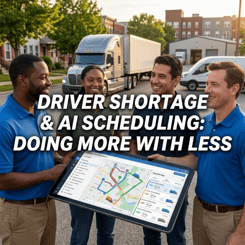 the phone is ringing off the hook, and three drivers just called in sick. But here’s the kicker, you were already short five drivers to begin with.
The "driver shortage" isn't just a buzzword anymore; it’s a daily operational crisis. Across the globe, the transit sector is facing a gap of roughly 2.4 million workers. In the U.S., the competition for CDL holders is fierce, with private delivery giants and long-haul trucking companies offering signing bonuses that can make a school district's budget weep.
So, how do we keep the wheels turning when there aren't enough hands on the steering wheels? The answer isn't just "working harder"; it’s working a lot smarter. By combining route consolidation with AI scheduling, districts are learning how to do more with significantly less.
Why the Old Way of Scheduling is Broken
For decades, school bus routing was done with a map, a highlighter, and a very stressed-out coordinator who had the entire district's geography memorized. When a driver quit, that coordinator would manually move a few stops around and hope for the best.
But human brains have limits. We can’t account for 500 different variables like changing traffic patterns, student ridership fluctuations, and vehicle maintenance schedules all at once. This leads to "ghost routes" (buses running half-empty) and "deadhead" miles (buses driving long distances without any students on board).
When you’re short on staff, you can’t afford even one wasted mile. This is where the transition to high-tech solutions becomes a necessity rather than a luxury. If you’re wondering where your district stands, checking out a competitive analysis of routing software can help you see what modern tools are actually capable of.
Route Consolidation: The Art of the "Smart Squeeze"
Route consolidation sounds intimidating. Parents often hear it and think, "My kid is going to be on the bus for two hours." But when done correctly through AI, consolidation isn’t about making routes longer; it’s about making them denser and more logical.
AI-driven route consolidation looks at the entire district as a single puzzle rather than individual routes. It identifies overlapping paths and merges them based on real-time data.
Key Benefits of AI Consolidation:
- Eliminating Under-Utilized Routes: If two buses are running at 40% capacity in the same neighborhood, AI can merge them into one 80% capacity route that still meets all time constraints.
- Strategic Bell Times: AI can model "what-if" scenarios. What if the high school started 15 minutes later? Could we then use those same drivers for the elementary routes more effectively?
- Dynamic Stop Logic: Instead of a bus stopping at every corner because "that’s how we’ve always done it," AI suggests central hubs that reduce the number of stops and the overall idle time of the engine.
AI Scheduling: Giving Time Back to Your Team
Scheduling is the logistical backbone of your operation. When you have fewer drivers, their time becomes your most precious resource. AI scheduling doesn't just put a name next to a route; it optimizes the driver’s entire day.
Research shows that AI platforms can automate up to 60% of the scheduling and timetabling work. This allows your office staff to focus on safety and parent communication rather than drowning in spreadsheets. Furthermore, AI can reduce overtime costs by 15-30% by ensuring that hours are distributed equitably and efficiently.
Managing Split Shifts and Flexibility
One of the biggest hurdles in recruiting drivers is the "split shift", four hours in the morning, a long break, and four hours in the afternoon. It’s a tough sell for someone looking for a steady 9-to-5.
AI can help create more flexible "swing shifts" or consolidated work blocks. By analyzing the data, the software might find opportunities for drivers to handle mid-day special education routes or administrative tasks, creating a full eight-hour workday that is much more attractive to potential hires.
Fighting Driver Burnout
We often talk about the shortage in terms of "missing people," but we also need to talk about the people who are still there. Your current drivers are likely overworked and stressed. Driver fatigue is a major safety concern that often stems from poorly planned, "emergency" schedules that don't allow for proper breaks.
AI scheduling takes the "human error" and "emergency pressure" out of the equation. It builds schedules that respect rest requirements and minimize the stress of rushing to meet impossible deadlines. When drivers feel that their schedule is predictable and fair, retention rates improve. In fact, some organizations have seen a 20% decrease in turnover simply by implementing better scheduling technology.
Real-World Efficiency: The "Deadhead" Problem
"Deadheading" is the miles a bus travels without students usually from the depot to the first stop, or from the school back to the yard. When you have a driver shortage, every minute a driver spends behind the wheel without a student is a minute wasted.
AI optimization looks for "interlining" opportunities. This is when a driver finishes a middle school drop-off and is immediately directed to a nearby elementary start point, minimizing the distance traveled empty. By cutting down these "empty" miles, you can often cover the same number of students with 10-15% fewer buses and drivers.
If you want to see the literal dollar value of these efficiencies, you can play around with a transportation cost calculator. It’s often eye-opening to see how much money (and driver time) is being "burned" on inefficient paths.
Making the Transition
Moving to an AI-driven model isn't something that happens overnight, but the "wait and see" approach is no longer viable. The driver shortage isn't going away, and the districts that thrive will be the ones that embrace technology to bridge the gap.
If you’re just starting this journey, you probably have a lot of questions. We’ve put together a list of the top 4 FAQs about routing software to help demystify the process.
The Takeaway
The driver shortage is a massive challenge, but it’s also an opportunity to modernize. By using AI scheduling and route consolidation, you can:
- Reduce the number of drivers needed without sacrificing student safety.
- Improve the work-life balance of your existing staff to prevent further turnover.
- Save significant budget on fuel, maintenance, and overtime.
- Provide better service to parents through more predictable and reliable routing.
You don't need a massive fleet to benefit from these tools, you just need the right data. Whether you're a small rural district or a large urban one, the goal remains the same: getting those kids to school safely and on time, even when the odds are stacked against you.
Ready to see how much you could be saving?
Don't guess, calculate. Check out our 10 Questions Guide to find the right routing fit for your district, or dive straight into the numbers with our Route Optimization Calculator. Let’s get your team the support they deserve!
Schedule a BusBoss Demo Today!

PRESIDENT
Sonia has been involved with BusBoss since the late 1990’s, and has personally overseen many projects for various customers ranging from large urban and suburban districts to smaller rural school districts from all over the country.
 (484) 941-0820