

bus route optimization, Dispatch Software, asset school bus tracking system, best gps device for school bus, driver navigation, easy gps tracker for school bus
Play blog summary Listen
For a small transportation department, dispatch may involve a few calls, a paper route sheet, and a shared map. At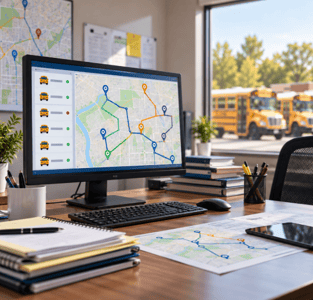 larger scale, those methods create delays and confusion. A dispatcher may need to respond to a driver absence, a bus breakdown, a road closure, a late school dismissal, and a parent inquiry at the same time.
This is why real-time dispatch software scaling requires more than adding user accounts or GPS devices. The entire operation must be able to handle more buses, more route changes, more data, and more people acting on the same information.
A platform that works well at 50 buses can struggle at 150 buses if it was not designed for large fleet operations. The system may slow down when many users log in at once. Route changes may not reach drivers quickly. GPS updates may appear several minutes late. Dispatchers may rely on phone calls to confirm whether a change was received.
For school transportation directors, the goal is simple. Every person involved in transportation should have the information they need, when they need it, without creating extra work for the transportation team.
Why dispatch becomes harder as a fleet grows
Scaling from 50 buses to 150 buses does not simply create three times as much work. It creates more interactions between routes, drivers, vehicles, schools, students, and families.
A larger fleet often includes:
- More drivers and substitute drivers
- More schools with different bell schedules
- More special transportation requirements
- More route changes during the school day
- More GPS signals and vehicle events
- More dispatchers working at the same time
- More families requesting accurate arrival information
A small issue can spread quickly. If one bus is removed from service, the dispatcher may need to identify another vehicle, assign a driver, review capacity, adjust the route, send instructions to the driver, update student information, and notify affected families.
Without connected school transportation technology, each step may happen in a different system. That increases the chance of duplicate work and missed updates.
The technical challenges of dispatch system scalability
The technical side of dispatch system scalability is easy to overlook during a software evaluation. A platform may appear effective during a demonstration with a limited number of users. The more important question is how it performs during the busiest 30 minutes of the school day.
Transportation directors should evaluate five areas.
1. Concurrent users
A large dispatch operation may include dispatchers, supervisors, school administrators, drivers, and support staff accessing the system at the same time. The platform should allow multiple authorized users to work without locking records or creating conflicting versions of a route.
ROUTEpatrol Web is designed to support networked transportation work through a web browser. This allows multiple people to work on routing and scheduling tasks while sharing current route information.
2. GPS data volume
Every active bus can send frequent location updates. A system must process those updates and display them in a way that is useful to dispatchers. A map filled with hundreds of buses is not enough. Dispatch needs to see which buses are moving, late, off route, stopped, or unavailable.
TRIPpatrol provides real-time vehicle tracking, route history, vehicle positions, and deviation alerts. These tools help dispatchers move from general awareness to specific action.
3. Route calculation demands
Large districts may need to plan regular education routes, special education routes, athletic trips, field trips, and temporary service changes. Route planning software must handle these variables without forcing staff to wait for every calculation or maintain separate spreadsheets.
4. Data synchronization
Dispatch depends on current information. Student addresses, route assignments, bus numbers, driver assignments, stop times, and vehicle status must remain aligned across the systems used by the district.
LiveSYNC helps connect BusBoss with a district student information system. It can move student additions, withdrawals, address changes, and route information between systems. This reduces manual entry and supports better ridership data accuracy.
5. Access and security
More users create a greater need for role based access. Drivers do not need the same information as dispatchers. Parents should see information about their own children, not the full district fleet. School administrators may need route and arrival information without access to sensitive operational settings.
Scalable software should support clear permissions, secure connections, and a record of important changes.
Real-time vehicle tracking must support decisions
GPS tracking has limited value if it only shows where buses were several minutes ago. Dispatchers need information that supports decisions during active routes.
A useful tracking system should help answer questions such as
- Which buses are approaching a delayed school?
- Which routes have deviated from their planned path?
- Which vehicles are stopped longer than expected?
- Which bus can help cover a route if another vehicle is removed from service?
- Which students may be affected by a delay?
This is where the connection between GPS data and route information matters. A dot on a map does not explain which students are on board or whether the bus is following the correct run.
STUDENTpatrol connects vehicle location with student ridership information. It can provide live bus load information, boarding and exit events, and alerts for students attempting to board the wrong bus or use the wrong stop.
This supports student ridership verification systems and gives transportation teams better information during emergencies, route changes, and daily reviews.
Driver tablet sync is a safety requirement
A route change is not complete when the dispatcher saves it. The change is complete when the driver receives it, understands it, and can follow it safely.
At small scale, a dispatcher may call one driver and explain a change. That approach becomes difficult when several buses need new instructions at the same time. It also creates a recordkeeping problem because phone calls do not always show which information was provided or when it was received.
The ROUTEpatrol Tablet App gives drivers route details, turn by turn navigation, student information, and ridership tools. It can also reflect route modifications sent from the transportation office.
Good driver tablet sync should include
- A clear connection between the assigned driver, vehicle, and route
- Route updates that reach the correct tablet
- A visible notice when a new instruction is available
- Student information that reflects the current assignment
- Support for substitute drivers who may not know the route
- A process for handling weak cellular service or a temporary lost connection
The tablet should reduce distractions, not create them. Driver instructions need to be short, visible, and organized around the next safe action.
The app can also support student boarding verification by collecting boarding and exit information. This gives dispatchers a better understanding of who is on the bus when a route is changed or an emergency occurs.
A four step process for real-time bus rerouting
When a disruption occurs, large fleet operations need a repeatable process. The following four steps help transportation teams respond without losing control of the larger network.
1. Detect the disruption instantly
The disruption may be a driver absence, vehicle issue, traffic delay, road closure, weather event, or unexpected school change. GPS alerts, driver messages, school notifications, and dispatch observations should flow into one operational view.
2. Reassign and adjust using intelligent software
The dispatcher should be able to identify available vehicles and drivers, review capacity, and adjust the affected route. DISPATCHpatrol supports day specific route changes, route combinations, route splits, driver absences, and buses taken out of service.
The key is to change the active operation without damaging the permanent routing plan.
3. Push instructions directly to driver tablets
Once the route is adjusted, the new information should go directly to the correct driver tablet. This reduces verbal relays and helps the driver work from one current set of instructions.
4. Keep parents and schools informed
Families and schools need accurate information about delays, bus locations, and changes. PARENTpatrol provides live bus locations, estimated arrival information, delay notifications, and updates related to student boarding and exit events.
This four step process helps connect dispatch, drivers, schools, students, and families during the moments when communication matters most.
Route change management at large scale
Route changes should be controlled rather than improvised. A strong process separates planned routes from temporary operational changes.
Transportation directors should establish rules for
- Who can approve an emergency route change
- Which changes can be made by a dispatcher
- How driver assignments are confirmed
- How student capacity is checked
- How schools receive updates
- How parents are notified
- How the change is documented for later review
This is especially important when districts operate several schools, transportation zones, or contracted services. Without clear governance, a well intended change can create enterprise district misuse. That may happen when a platform is configured for one department but used across multiple operational groups without shared standards, permissions, or training.
The solution is not to limit useful tools. The solution is to define how each team uses them and ensure that every change has a clear owner.
Operational scaling challenges beyond software
Technology cannot solve every operational problem. Large fleet operations also require consistent procedures and staff preparation.
Common scaling challenges include
- Training new dispatchers and substitute drivers
- Keeping vehicle and driver assignments current
- Standardizing route naming and status codes
- Maintaining accurate student records
- Coordinating district staff with contractors
- Responding to system maintenance challenges
- Reviewing route performance after disruptions
A platform should support these processes with reports and clear workflows. It should not force transportation staff to create a second tracking system outside the platform.
For example, ROUTEpatrol Web can help teams review route performance and work together on transportation planning. TRIPpatrol can help compare planned routes with actual vehicle movement. Together, these tools support both daily response and long term route improvement.
How to evaluate fleet management software for growth
When reviewing fleet management software, avoid focusing only on the feature list. Test the workflows that will matter during the busiest part of the school day.
Ask vendors to demonstrate the following scenarios
- A driver calls out 20 minutes before departure
- A bus becomes unavailable during an active route
- A road closure affects several routes
- A substitute driver needs a route on a new tablet
- A student address changes during the school day
- A parent needs an accurate arrival update
- Several dispatchers make changes at the same time
- A district needs to review what happened after an incident
Also ask how the system handles backups, user permissions, support requests, data retention, device management, and system maintenance challenges.
The best platform is not necessarily the one with the most features. It is the one that helps your team complete critical tasks accurately when the operation is under pressure.
The role of ridership data in scalable dispatch
Real time dispatch becomes more effective when it includes student information. Knowing a bus location is useful. Knowing the bus location, assigned route, expected students, and actual boarding activity is more useful.
STUDENTpatrol supports student ridership verification systems by connecting boarding information with bus and route records. This can improve response during a missing student investigation, a wrong bus event, or an emergency evacuation.
Better ridership data also supports route tuning. Transportation teams can review which routes are consistently full, which stops are rarely used, and where student assignments change often. That information can support safer planning and more efficient use of vehicles.
Summary and next steps
Real-time dispatch software scaling is both a technology decision and an operating model decision. A platform that works at 50 buses may struggle at 150 buses if it cannot manage concurrent users, continuous GPS updates, route calculations, driver tablet sync, and frequent route changes.
A scalable solution should help your team
- See the fleet in real time
- Connect vehicle data with route and student information
- Send route updates directly to drivers
- Manage temporary changes without damaging permanent plans
- Improve student boarding verification
- Support ridership data accuracy
- Keep schools and families informed
- Review performance after each disruption
BusBoss connects routing, dispatch, GPS tracking, student ridership, driver tablets, and parent communication through an integrated transportation management environment. Learn more about BusBoss school transportation technology or schedule a demonstration to see how the system can support your district as the fleet grows.

PRESIDENT
Sonia has been involved with BusBoss since the late 1990’s, and has personally overseen many projects for various customers ranging from large urban and suburban districts to smaller rural school districts from all over the country.
 (484) 941-0820