

bus route optimization, Dispatch Software, asset school bus tracking system, best gps device for school bus, driver navigation, easy gps tracker for school bus
Play blog summary Listen
A billing system change can look like a software purchase on a budget worksheet. In a shared service district or a district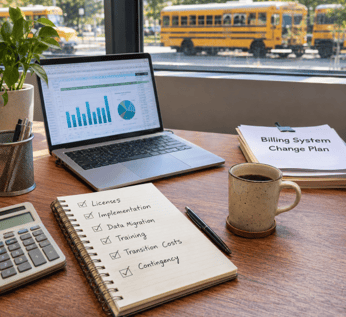 working with contractors, however, the purchase is only one part of the cost. The larger challenge is preserving confidence in the figures while established records, processes, and relationships move to a new system.
The change is a transfer of trust midstream. Districts need a budget that accounts for setup, parallel work, record retention, and time spent answering questions when the old and new calculations differ. Here is a practical way to plan for those costs without treating every district’s situation as the same.
Direct costs
Start with the costs that vendors can usually describe in a proposal. Ask for each item separately so the budget shows what is included and what is not.
- Licenses or subscription. This is the visible cost that often arrives first. Confirm whether it covers the expected number of users, participating districts, contractors, and the functions needed for district transportation billing.
- Implementation and configuration. Budget for mapping the district’s actual billing rules into the system. That may include split custody, partial route ridership, administration fees, and the way shared costs are allocated. A standard setup may not reflect local agreements.
- Historical record migration. Include the work needed to transfer or preserve prior term records. Records should remain available so staff can explain an earlier invoice or adjustment after the change.
- Training. Plan for everyone who touches the billing process, including transportation staff, finance staff, and contractor partners. Training should cover both routine processing and how to investigate a difference.

Transition costs
The transition is where budgets often fall short. These expenses can be easy to miss because they may appear as staff time rather than a vendor charge.
- Parallel processing. Budget to process a billing period in both systems until the results reconcile. This period is often unbudgeted because it is treated as a brief technical step, even though it requires staff to maintain two records and review both outputs.
- Billing reconciliation. Set aside time to compare calculations and supporting details line by line before cutover. This work is often overlooked when the budget focuses on installation rather than proving that the new process matches the district’s rules.
- Slower first cycles. Allow extra staff hours for the first billing runs. New screens, changed responsibilities, and questions about exceptions can slow work, but that extra time is rarely visible in the software quote.
- Contractor coordination. Give partners time to review sample invoices and confirm that their records align with the new system’s output. This is often missed because the district may assume that contractor participation begins only after launch.
Protect the records behind the figures
Historical billing records are the district’s memory. If a change leaves old records trapped in a system that staff can no longer access or interpret, the district may face added work the first time someone questions a past charge.
Before signing, confirm in writing what records can be exported, what format they will be in, how long the former system will remain accessible, and who is responsible for retaining the archive. Include invoices, adjustments, approvals, and the detail needed to reproduce calculations. For a district, these details matter as much as the new system’s features.
Hold a contingency for the first cycles
Experienced districts do not budget a change to the penny. They hold a contingency for the first two billing cycles because those cycles can reveal an overlooked agreement, a record that needs correction, or an exception that was not included in testing. The amount should reflect local complexity and the district’s tolerance for risk, not an assumed universal percentage.
Make the budget case clearly
Use a checklist when preparing the submission. The aim is to make the full cost and the reason for it easy for finance leaders and the board to understand.
- Separate one time and recurring costs. Show setup and conversion apart from subscription, support, or other ongoing costs. This lets the board see the lasting commitment.
- Give transition work its own line. Do not spread parallel processing or reconciliation invisibly across general staff costs.
- Name the parallel period. State how many billing cycles the district plans to compare and estimate the staff hours needed to complete the review.
- Confirm the records plan. Document which historical information will move, what will remain archived, and how staff can retrieve it later.
- Explain the dispute risk. Identify how a clear, reproducible billing record can reduce confusion when a district or contractor questions a charge. Include measures such as cost per route where they help explain how costs are allocated.
Where DISTRICTpatrol fits
For districts evaluating shared billing support specifically, Shared Billing & Contractor Payments is designed for consolidating shared costs, calculating billings across multiple districts, and accounting for administration fees. Ask how it fits your existing agreements, records, and approval steps, and confirm the scope of any change with your own terms in view. The BusBoss products overview provides additional company product information.
The name Shared Billing & Contractor Payments describes the budgeting challenge clearly, but the district should still confirm the scope and cost of its own implementation before setting a final budget.
The takeaway
Budget a billing system change as more than a software line. Licenses and setup matter, but transition labor, record continuity, reconciliation, and contractor coordination are what protect trust in the numbers. Separate these costs, name the checks required before cutover, and keep a contingency for the first cycles.
To discuss your district’s needs and see how BusBoss products may fit, schedule a demo.

PRESIDENT
Sonia has been involved with BusBoss since the late 1990’s, and has personally overseen many projects for various customers ranging from large urban and suburban districts to smaller rural school districts from all over the country.
 (484) 941-0820
