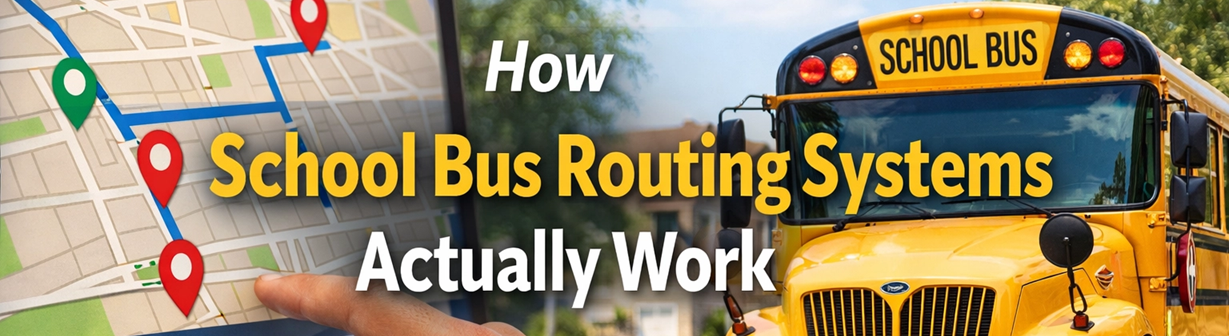
If you've ever wondered how a school district gets hundreds of kids to dozens of schools using a limited fleet of buses, and somehow makes it all work every single morning, you're not alone. School bus routing is part science, part art, and increasingly, part algorithm.
Modern routing systems have come a long way from paper maps and highlighters. Today's platforms use sophisticated mathematical models, real-time GPS data, and automated logic to build routes that balance efficiency, safety, and legal requirements. But how does it all actually work under the hood?
Let's break down the technology, the math, and the real-world processes that power school bus routing systems.
Before any routing software can generate a single bus route, it needs data. Lots of it.
Student Information
Every routing system starts with a roster of students: where they live, which school they attend, their grade level, and any special needs that affect transportation. This data typically flows in from a district's Student Information System (SIS) and includes:
Geographic Information System (GIS) Data
Modern routing platforms rely heavily on GIS mapping layers. This isn't just Google Maps, it's a detailed spatial database that includes:
The combination of student data and GIS mapping forms the input layer. Without clean, accurate data, even the most advanced algorithm will produce unusable routes.
This is where it gets interesting. School bus routing is a version of what computer scientists call the Vehicle Routing Problem (VRP), a notoriously complex optimization challenge. The goal is to visit a set of locations (student stops) using a limited number of vehicles (buses) while minimizing distance, time, and cost.
Dijkstra's Algorithm: Finding the Shortest Path
You've probably heard of Dijkstra's algorithm, even if you don't know it by name. Developed in 1956 by Dutch computer scientist Edsger Dijkstra, it's one of the most fundamental pathfinding algorithms in existence.
Here's the simple version: Dijkstra's algorithm calculates the shortest path between two points in a network (like a road grid). It does this by:
In routing software, the "cost" isn't just distance: it can be weighted by time, traffic, road type, or even turn difficulty. This allows the system to avoid suggesting a route that's technically shorter but crosses a dangerous intersection or requires a difficult U-turn.
The Traveling Salesman Problem (TSP)
The Traveling Salesman Problem is the classic challenge in route optimization: given a list of stops, what's the most efficient order to visit them all and return to the starting point?
For school buses, this translates to: "In what order should I pick up these 40 students to minimize drive time and arrive at school by 8:15 AM?"
TSP is what's known as an NP-hard problem, which is a fancy way of saying there's no perfect shortcut. For a small number of stops, you can calculate every possible combination. But once you're dealing with 20+ stops, the number of possible routes becomes astronomical.
Modern routing systems use heuristic algorithms: smart shortcuts that get close to the optimal solution without testing every possible route. Common methods include:
Capacity and Time Window Constraints
Unlike the pure TSP, school bus routing has real-world constraints:
These constraints turn the problem into a Capacitated Vehicle Routing Problem with Time Windows (CVRPTW). The algorithm has to juggle all these variables simultaneously, which is why automated routing is so much more powerful than manual planning.
Manual Routing: The Old Way
For decades, transportation coordinators planned routes by hand. They'd print out maps, draw routes with colored markers, and maintain binders of run sheets. When a new student enrolled, someone would manually figure out which bus had capacity and whether the route could accommodate an extra stop.
Manual routing works: sort of: for small districts with stable enrollment. But it has serious limitations:
Automated Routing: The Algorithm Advantage
Modern platforms like BusBoss automate the heavy lifting. Instead of manually plotting stops, the system:
The result? Routes that would take days to build manually can be generated in minutes. And when data changes: new students, address corrections, school reassignments: the system can re-optimize instantly.
Hybrid Approaches
In practice, most districts use a hybrid model. The software generates initial routes using automated logic, then experienced planners review and tweak them based on local knowledge. Maybe the algorithm suggests a stop on a hill that gets icy in winter. A human planner can override that and move it to a safer location.
This combination of algorithmic power and human judgment tends to produce the best outcomes. As we discussed in The Complete Guide to Modern Student Transportation Technology, the goal isn't to replace expertise: it's to augment it.
No route survives contact with reality unchanged. That's where real-time GPS tracking and dynamic routing come in.
GPS Tracking and Telemetry
Every bus equipped with a GPS device transmits live location data to the central system. This allows dispatchers to:
Platforms like StudentPatrol GPS Tracking make fleet visibility effortless, turning what used to be radio check-ins into a live, map-based dashboard.
Dynamic Re-Routing
When something goes wrong: a bus breaks down, a driver calls in sick, a road is closed due to an accident, modern systems can adjust on the fly. Dispatchers can:
Some advanced systems use predictive algorithms that analyze historical traffic patterns and weather data to suggest proactive route changes before delays occur.
Driver Communication
Real-time routing only works if drivers are looped in. Modern systems push updates directly to in-cab tablets or smartphones, so drivers always have the latest stop lists, turn-by-turn directions, and student information. This eliminates the need for paper run sheets and reduces errors caused by outdated information.
As detailed in Routing Software Keeps Drivers Updated, seamless communication between the office and road is essential for operational resilience.
Let's walk through a realistic scenario to see how all these pieces work together.
Step 1: Data Sync
It's mid-August, and the district's SIS contains updated enrollment data for the upcoming school year. BusBoss syncs automatically overnight, pulling in:
Step 2: Geocoding and Validation
The system geocodes every address and flags anomalies:
The transportation coordinator reviews and corrects flagged records.
Step 3: Automated Route Generation
With clean data in place, the system runs its optimization engine. Within 20 minutes, it generates:
Step 4: Human Review and Refinement
Experienced planners review the computer-generated routes. They make adjustments based on:
Step 5: Go-Live and Monitoring
On the first day of school, GPS-enabled buses hit their routes. Dispatchers watch the dashboard as buses roll. The system flags:
Over the next few weeks, the system collects performance data: actual vs. planned times, consistent delay points, ridership patterns. Coordinators use this data to fine-tune routes for improved efficiency.
One of the biggest mistakes districts make is thinking of routing software as a standalone tool. In reality, it's part of an interconnected ecosystem.
SIS Integration
When routing software syncs with the Student Information System, data flows automatically. Enrollment changes, address updates, and school assignments propagate into the routing platform without manual data entry. This eliminates duplicate work and reduces errors.
Parent Communication Platforms
Real-time route data powers parent-facing apps that show bus locations and send arrival notifications. When routing changes happen, those updates flow through to parents automatically. This reduces call volume to the transportation office and improves the parent experience, as explored in School Transportation from the Eyes of a Parent.
Maintenance and Fleet Management
GPS data feeds into preventive maintenance systems, tracking mileage and engine hours for each vehicle. When a bus is due for service, the routing system knows to avoid assigning it to long routes.
HR and Scheduling Systems
Driver availability, certifications, and route assignments all need to sync. Modern platforms integrate with HR systems to ensure only qualified drivers are assigned to special education routes or other specialized runs.
"The algorithm will solve everything."
Not quite. The algorithm is powerful, but it can't account for every local nuance. Human expertise is still essential to review and refine routes.
"Automated routing means fewer staff."
Not necessarily. Automation shifts the work from manual plotting to strategic oversight, data management, and continuous improvement. Good routing coordinators become even more valuable because they can focus on optimization rather than busywork.
"Once routes are set, they're done."
Routes are living documents. Student moves, enrollment changes, road construction, and driver shortages all require adjustments. Modern systems make those changes manageable, but they still require active management.
"Manual routing is just as good if you're experienced."
Manual routing can produce decent routes, but it can't match the speed, consistency, or scalability of algorithmic optimization. And when a key planner retires, their institutional knowledge walks out the door. Automated systems preserve best practices in code.
Understanding how routing systems work isn't just academic; it has real operational and financial implications.
Budget Impact
Efficient routing means fewer buses on the road, lower fuel costs, reduced maintenance, and less driver overtime. Districts using optimized routing regularly report 10–15% reductions in operational costs.
Safety and Accountability
Real-time visibility means faster response when something goes wrong. GPS verification ensures drivers follow approved routes. Student tracking (via RFID or barcode scanning) confirms who got on and off each bus.
Scalability
As districts grow or consolidate, manual routing breaks down. Automated systems scale effortlessly, handling thousands of students across multiple tiers without requiring proportional increases in staff.
Compliance and Reporting
State reporting requirements often demand detailed transportation data: miles driven, students served, and route efficiency metrics. Modern systems generate these reports automatically, turning what used to be a week-long project into a one-click export.
What algorithm does school bus routing software use?
Most modern school bus routing systems use variations of the Capacitated Vehicle Routing Problem with Time Windows (CVRPTW) algorithm. This combines shortest-path algorithms (like Dijkstra's) with heuristic methods such as genetic algorithms or simulated annealing to optimize routes under real-world constraints like bus capacity, ride time limits, and school bell schedules.
How does GIS data improve school bus routing?
GIS (Geographic Information System) data provides detailed spatial information about road networks, speed limits, turn restrictions, and hazard zones. This allows routing software to calculate realistic travel times, avoid dangerous intersections, respect legal constraints, and geocode student addresses to precise map locations for accurate route planning.
What's the difference between manual and automated routing?
Manual routing involves transportation coordinators plotting routes by hand using maps and spreadsheets: a time-intensive process that relies on individual expertise. Automated routing uses algorithms to generate optimized routes in minutes based on student data, GIS mapping, and district rules. Most districts use a hybrid approach: automated generation followed by human review and refinement.
Can routing software adjust routes in real time?
Yes. Modern systems integrate with GPS tracking to monitor bus locations and compare actual performance to planned routes. When disruptions occur (breakdowns, traffic, road closures), dispatchers can reassign stops, reroute buses, and push updates to driver tablets in real time, maintaining service continuity.
How long does it take to implement a school bus routing system?
Implementation timelines vary based on district size and data quality, but most deployments take 2–6 months. This includes data migration, staff training, route building, and testing. Districts with clean SIS data and experienced coordinators can often go live faster, while those needing significant data cleanup or workflow redesign may need additional time.
Does routing software reduce the number of buses needed?
Optimized routing typically improves fleet utilization, often allowing districts to serve the same number of students with 5–10% fewer buses. However, results vary based on geography, bell schedules, and existing efficiency. The software helps you maximize the fleet you have and make data-driven decisions about future fleet sizing.
School bus routing systems are far more sophisticated than most people realize. Behind every morning bell and afternoon pickup is a complex interplay of algorithms, data pipelines, real-time GPS feeds, and human judgment.
The best systems combine powerful mathematical optimization with practical flexibility. They automate the tedious parts: geocoding, pathfinding, constraint checking, while empowering experienced coordinators to apply local knowledge and common sense.
Whether your district is running legacy software, managing routes manually, or evaluating new platforms, understanding how routing systems actually work gives you the foundation to make better decisions about technology investments, staff training, and operational strategy.
Ready to see how modern routing technology can transform your district's transportation operations? Explore BusBoss comprehensive routing platform and discover how automated optimization, real-time GPS tracking, and seamless integrations can reduce costs, improve safety, and free your team to focus on what matters most. Visit our extensive FAQ or explore our blog for more insights on student transportation technology.



 Orbit Software, Inc.
424 King Street
Pottstown, PA 19464

 (484) 941-0820