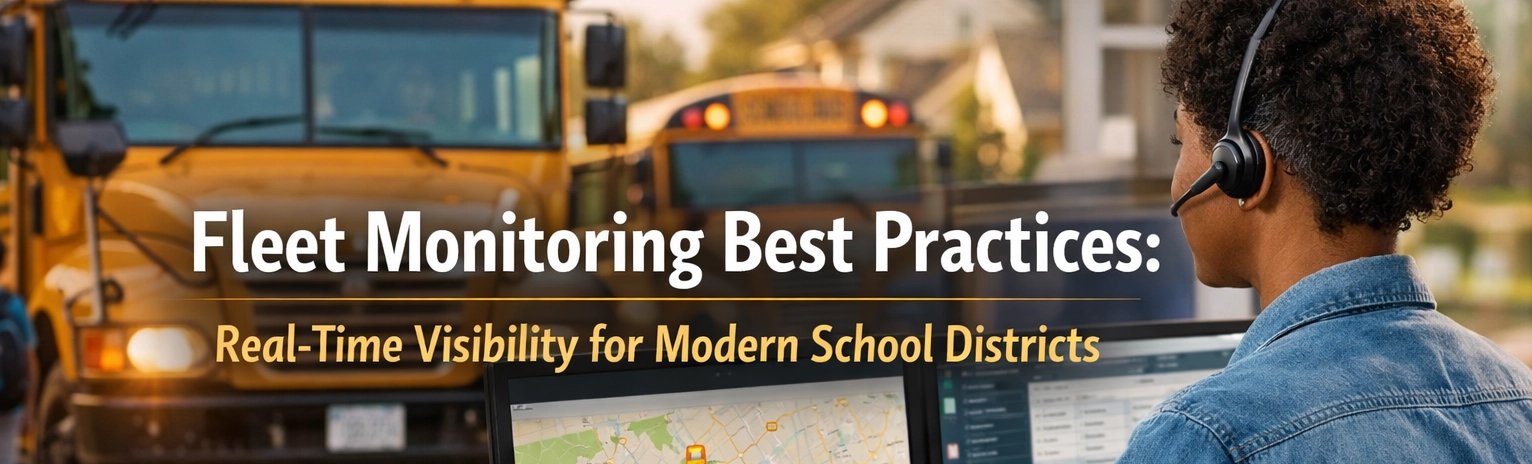
Managing a school bus fleet in the 2020s is a vastly different challenge than it was even a decade ago. Gone are the days when "on-time" was determined by a radio check and a clipboard. Today, modern school districts are expected to operate with surgical precision, providing parents, administrators, and drivers with absolute transparency.
Real-time visibility is no longer a luxury for large urban districts; it is a foundational requirement for any transportation department aiming to ensure student safety and operational efficiency. When you can see where every bus is, how every driver is performing, and the mechanical health of every engine in real-time, you move from a reactive "firefighting" mode to a proactive, data-driven strategy.
In this comprehensive guide, we’ll explore the best practices for fleet monitoring and how your district can leverage these tools to prevent operational failures before they occur.
At the heart of any fleet monitoring system is GPS. However, not all GPS systems are created equal. For a school district, "passive" tracking, where data is downloaded at the end of the day, is virtually useless for daily operations.
Modern districts require active, real-time tracking that updates every 2–3 seconds. This level of granularity allows dispatchers to see a bus moving across the map in real-time, rather than jumping from point to point every few minutes.
Why Real-Time Location Matters
While GPS tells you where the bus is, AI-powered dashcams tell you how it is being driven. Driver behavior is one of the most significant variables in fleet safety.
Recent incidents, such as the widely reported case of a Tennessee school bus driver using a phone behind the wheel, highlight the need for constant, automated oversight. AI dashcams go beyond simple video recording; they use computer vision to detect over 15 high-risk behaviors, including:
These systems provide in-cab alerts, allowing drivers to self-correct in the moment. Simultaneously, safety managers receive video snippets of the incident, enabling them to provide targeted coaching. This proactive approach significantly reduces the risk of collisions and onboard emergencies, such as fires, by improving vehicle handling and awareness.
Operational failure often stems from the vehicle itself. A bus breaking down on a busy highway isn't just an inconvenience; it’s a major safety risk and a logistical nightmare. Telematics systems integrate with the vehicle’s engine control module (ECM) to provide real-time diagnostics.
Best Practices for Telematics Monitoring:
The biggest mistake a district can make is "siloing" its data. If your GPS tracking is in one software, your routing in another, and your maintenance logs in a third, you lose the "big picture" visibility.
A centralized fleet management platform like BusBoss integrates these disparate data streams into a single dashboard. This allows for more sophisticated analysis. For example, you can see how a specific route's terrain affects fuel consumption or how a driver’s behavior correlates with maintenance costs.
When choosing a system, knowing what to look for in school transportation software providers is essential. The provider should offer seamless integration and prioritize cybersecurity to protect sensitive student location data.
To maintain a high standard of fleet monitoring, districts should monitor specific KPIs. These metrics provide a snapshot of your fleet’s health and efficiency:
|
|
Description |
Goal |
|
PM Compliance Rate |
Percentage of vehicles receiving preventive maintenance on time. |
> 95% |
|
Vehicle Downtime % |
The percentage of the fleet that is unavailable for service. |
< 5% |
|
Cost Per Mile (CPM) |
Total operational cost divided by total miles driven. |
Consistent/Decreasing |
|
On-Time Performance |
Percentage of pickups and drop-offs occurring within the window. |
> 98% |
|
Idling Time |
Total time engines spend running while the vehicle is stationary. |
Minimize |
Real-time visibility extends to the students themselves. Many modern districts are implementing RFID or barcode scanning systems. When a student scans their card as they board or exit the bus, the system logs the time and location.
This data is invaluable for:
What is the difference between GPS and telematics?
While GPS focuses on the location and movement of the vehicle, telematics is a broader term that includes GPS data plus internal vehicle diagnostics, such as engine health, fuel usage, and driver behavior.
How does real-time monitoring improve driver retention?
By providing drivers with objective data and in-cab alerts, you empower them to improve their skills. Furthermore, dashcam footage can often exonerate drivers in the event of a false claim by a motorist or parent, fostering a culture of trust and support.
Is student data safe in these systems?
Security is a top priority. Leading software providers use encryption and strict access controls to ensure that student location and identity data remain private. For more details, see our guide on protecting student data from cybersecurity threats.
Can fleet monitoring help with driver shortages?
Yes. By optimizing routes and reducing downtime, districts can do more with fewer vehicles and drivers. Additionally, improved safety and automated reporting reduce the administrative burden on drivers, making the job more manageable. Many districts, like those in South Carolina, have used technology to combat driver shortages.
Fleet monitoring is no longer just about tracking dots on a map; it’s about building a robust, transparent, and resilient transportation system. By implementing real-time visibility tools: GPS, AI dashcams, and telematics, and integrating them into a single management platform, school districts can prevent operational failures, protect their students, and optimize their budgets.
As we look toward the future of school transportation, including automation and increased sustainability, the data generated by today’s monitoring systems will be the foundation upon which tomorrow’s innovations are built.
Take the next step in securing your fleet. Contact BusBoss today to see how our integrated software solutions can provide the real-time visibility your district needs.


 Orbit Software, Inc.
424 King Street
Pottstown, PA 19464
 (484) 941-0820