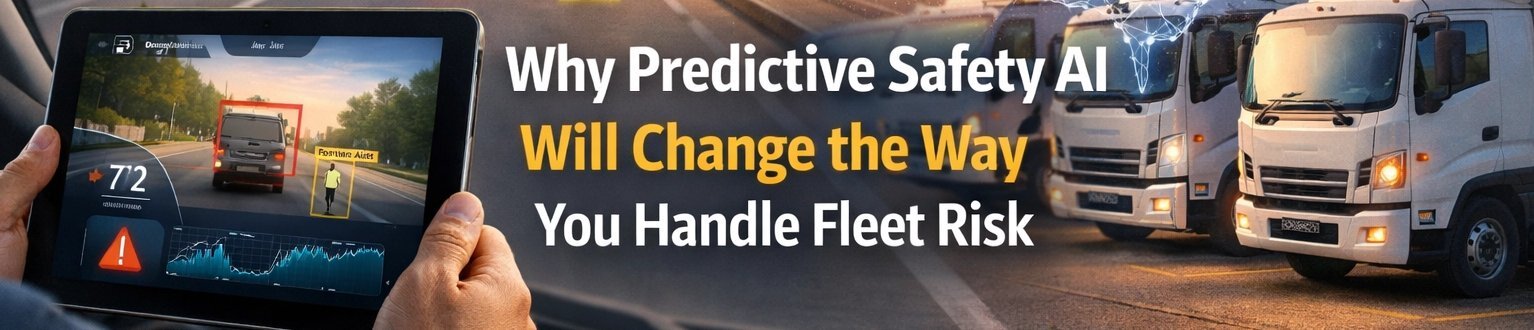
If you’ve spent more than a week working in school transportation, you know the "morning rush" feeling. It’s that low-level hum of anxiety that starts at 5:30 AM. You’re checking weather reports, managing driver call-outs, and praying that the day goes by without a radio call reporting a fender bender, or worse.
For decades, managing fleet risk in school districts has been a reactive game. Something goes wrong, we investigate why it happened, and then we try to make sure it doesn't happen again. We look at the dashcam footage after the incident. We check telematics reports after the speeding ticket.
But what if you could see the accident coming before the driver even turned the key?
That is the promise of Predictive Safety AI. It’s moving us away from "what happened?" toward "what’s about to happen?" and it’s about to fundamentally change how we keep students safe.
In the traditional model of fleet safety, we are essentially historians. When a parent calls to complain about a driver’s behavior, or when a bus is involved in a scrape, we go back in time. We download footage, we look at GPS breadcrumbs, and we reconstruct the event.
While this is necessary for accountability, it’s not particularly helpful for prevention. The future of school transportation is shifting toward automation and proactive safety. Predictive AI doesn't wait for a crash to trigger an alert. Instead, it continuously analyzes a massive stream of data, real-time telematics, vehicle sensors, and even environmental factors, to identify high-risk patterns.
Think of it like a weather forecast for your fleet. You don't wait for the rain to hit your face to know you need an umbrella; you check the forecast and prepare. Predictive AI is a forecast for driver behavior and mechanical health.
Most fleet managers look for the obvious: speeding, harsh braking, and swerving. These are the "loud" risks. But the most dangerous risks are often "silent."
AI-driven systems are now capable of detecting subtle indicators that a human supervisor, or even a basic GPS tracker, would miss. For example, predictive AI can identify:
By identifying these "invisible" flags, districts can intervene with coaching or schedule changes before a mistake is ever made.
One of the biggest hurdles in fleet management is the "feedback loop." If a driver has a bad habit on Monday, they might not hear about it until their performance review on Friday. By then, the context is lost.
Predictive Safety AI enables real-time coaching. If the system detects a pattern of tailgating or late braking, it can provide an in-cab alert to the driver. It’s a gentle nudge that says, "Hey, you're getting a little close," or "Your focus seems to be wavering."
This isn't about "Big Brother" watching over their shoulder; it's about providing the same kind of support a co-pilot would. When drivers feel supported rather than scrutinized, retention improves. And in an era of severe driver shortages, keeping the drivers you have is just as important as finding new ones.
Risk isn't just about how the bus is driven; it’s about the machine itself. A breakdown on a busy highway isn't just an inconvenience; it’s a massive safety risk for the students on board.
Traditional maintenance is based on mileage or time intervals. You change the oil every 5,000 miles because that’s what the manual says. But what if the alternator is about to fail at 4,200 miles?
Predictive AI uses "digital twins" and sensor data to monitor the actual health of engine components in real-time. It can predict a failure weeks before it happens, allowing your shop to pull the bus for a quick fix on a Saturday rather than dealing with a fire or emergency situation on a Tuesday morning. This keeps your fleet on the road and your students out of harm's way.
Let’s talk about the bottom line. School district budgets are tighter than ever, and insurance premiums for fleets are skyrocketing.
Insurance companies love predictive AI. When you can prove to your carrier that you are using technology that has been shown to reduce distracted driving and collisions by up to 80%, you have a massive lever for negotiating lower premiums.
Furthermore, in the event of a "he-said, she-said" incident, having a comprehensive data trail that shows your driver was operating safely and the AI did not detect any risk patterns can be a powerful tool for exoneration. It protects the district from "nuclear verdicts" and fraudulent claims.
A common misconception is that "AI" means you need to replace your entire fleet with high-tech "smart buses." That’s simply not true. Most predictive safety platforms can be retrofitted onto existing buses using simple hardware or integrated directly into your existing route planning software.
The goal is to create a unified tech stack. When your routing software talks to your safety AI, you get a 360-degree view of your operation. You can see how properly used software keeps drivers updated and how those updates correlate with safer driving behaviors.
The transition to Predictive Safety AI is more than just a tech upgrade; it’s a cultural shift. It moves the transportation department from a "firefighting" mindset to a "fire prevention" mindset.
The Key Takeaways:
At the end of the day, our job is to ensure that every student who gets on a bus in the morning makes it home safely in the afternoon. Predictive AI is simply the best tool we’ve ever had to fulfill that promise.
Ready to see how the latest tech can protect your district?
Managing risk shouldn't feel like a guessing game. If you're ready to move beyond reactive management and see how integrated software can streamline your safety protocols, we're here to help.
Contact BusBoss today for a personalized demo, and let’s talk about how we can make your fleet the safest it’s ever been.


 Orbit Software, Inc.
424 King Street
Pottstown, PA 19464
 (484) 941-0820