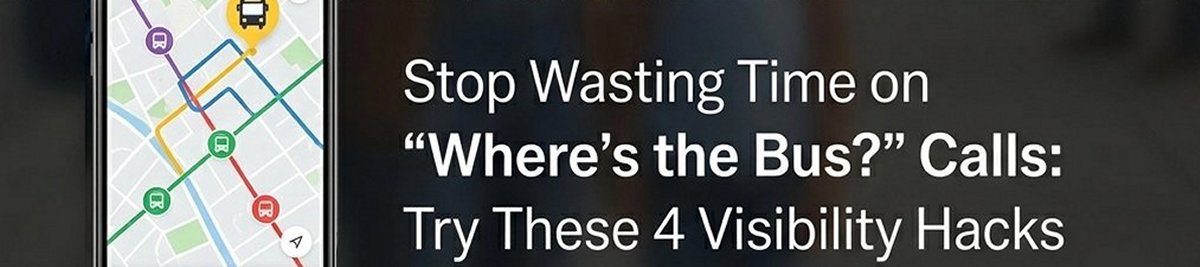
It’s 7:15 AM. You’ve barely had your first sip of coffee, and the office phone is already lighting up like a Christmas tree. On the other end of the line is a frantic parent, shivering at a street corner, asking the one question every transportation director knows all too well: "Where is the bus?"
If this sounds like your typical morning, you aren’t alone. For decades, the "Where’s the Bus?" call has been the bane of school transportation departments. These calls don't just eat up your staff's time; they create a ripple effect of stress, pulling dispatchers away from critical safety tasks and leaving parents feeling anxious and out of the loop.
The good news? We’re living in 2026. You shouldn't have to play phone tag to tell someone where a 15-ton yellow vehicle is located. By implementing a few key "visibility hacks" centered around GPS tracking and parent-facing technology, you can slash those inbound calls by up to 80% and give your team their mornings back.
Let’s dive into the four visibility hacks that will change your department forever.
You can’t share information you don’t have. The foundation of any visibility strategy is a robust, integrated GPS system. Many districts still rely on "ghost routing," where the software shows where the bus should be, rather than where it actually is.
When you integrate live GPS tracking into your routing software, you move from guesswork to ground truth. This isn't just about knowing the bus is on Main Street; it’s about knowing it’s idling at a stoplight or stuck behind a delivery truck. According to research on school bus safety, GPS doesn't just help with location; it also promotes safer driving habits by monitoring speed and hard braking.
The Hack: Don’t just let your dispatchers see the map. Ensure your GPS data refreshes every few seconds. This high-frequency data is the "engine" that powers every other visibility tool you provide to parents.
If a parent can track an Amazon package or a $12 pizza in real-time, they expect to be able to track their most precious cargo. This is where a dedicated parent app becomes your department's best friend.
By providing a secure mobile interface, you effectively outsource the "Where’s the bus?" question to the parents themselves. Instead of calling you, they simply check their phone. A good parent app should provide:
This level of transparency builds immense trust. When parents feel informed, they feel safe. You can learn more about how student tracking systems provide this peace of mind while streamlining your internal operations.
The most effective way to reduce calls is to answer the parent's question before they even think to ask it. This is where automated notifications come into play.
Imagine a world where a parent gets a push notification or a text message when the bus is exactly two blocks away. They no longer have to stand outside in the rain or snow for twenty minutes "just in case." They can wait inside until the alert pops up.
Key types of alerts to implement:
Location is great, but timing is what parents actually care about. Seeing a bus icon three miles away doesn't help a parent much if they don't know how long it takes to travel those three miles in heavy traffic.
Visibility hack number four involves using predictive algorithms. Modern routing software like BusBoss doesn't just look at distance; it looks at historical data and real-time traffic conditions to provide an "Estimated Time of Arrival" (ETA) that is actually accurate.
When parents see that the ETA is 7:42 AM and the bus pulls up at 7:42 AM, the "Where's the bus?" calls disappear entirely. They stop questioning the system because the system proves itself reliable every single day.
For many districts, the transition to this level of tech can feel daunting. However, when you look at the costs versus the savings, the reduction in administrative hours and the increase in fleet efficiency usually pay for the software upgrades in short order.
While reducing the volume of calls is the immediate goal, the benefits of high visibility go much deeper:
Transitioning from a reactive "call-center" environment to a proactive "visibility-first" department doesn't happen overnight, but the roadmap is clear:
By implementing these four visibility hacks, you’re not just stopping the phone from ringing: you’re modernizing your entire transportation culture. You’re moving from a department that "just drives buses" to one that provides a high-tech, reliable service that parents can trust.
Ready to see how BusBoss can help you silence the morning phone rush?
Don't let another school year go by buried in "Where's the Bus?" calls. Our team at Orbit Software Inc. has spent over 20 years perfecting bus routing and tracking solutions tailored for K-12 districts.
Schedule a free software demo today, and let’s get your visibility strategy on the right track!


 Orbit Software, Inc.
424 King Street
Pottstown, PA 19464

 (484) 941-0820