With fuel and labor expenses projected to consume up to 65% of total district operational budgets by 2026, the traditional paper ledger is no longer a tool for survival. You already know that managing school transportation budget demands more than just a calculator; every cent lost to a manual data entry error or an inefficient route is a resource taken away from student programs. It's a heavy burden to stand before a school board without clear cost-per-mile reporting or a transparent way to prove your department’s efficiency. You need a strategic roadmap that prioritizes both fiscal health and student safety.
This guide will help you master these financial complexities using data-driven strategies that reduce overhead without compromising the safety of your precious cargo. We'll provide a clear framework for categorizing every expense, proven methods to demonstrate ROI to your board, and the exact steps to automate your accounting. We've compiled these insights to replace guesswork with the precision that 25 years of industry expertise provides. By the end of this article, you'll have the tools to protect your bottom line while ensuring every child arrives at school ready to learn.
Managing school transportation budget isn't just about balancing a spreadsheet; it's the strategic allocation of resources to ensure safe, efficient pupil transit. In 2026, transportation directors face a landscape defined by 4.2% annual inflation and fuel price volatility that often fluctuates by $0.50 per gallon in a single quarter. The "Precious Cargo" priority remains the north star for every district. To understand the complexity of these operations, one can look at an overview of student transportation to see how global standards influence local fiscal decisions.
The traditional "last year + 5%" budgeting model is failing. It doesn't account for the 12% rise in vehicle maintenance costs seen since 2024. Relying on historical data alone ignores the shift toward electric fleets and the increasing complexity of modern routing. Effective strategies for managing school transportation budgets require a forward-looking approach that anticipates change rather than reacting to it. A healthy budget rests on three foundational pillars:
The expiration of final COVID-era relief funds in late 2024 left a gap that districts are still struggling to fill in 2026. Many departments are now forced to find internal efficiencies to maintain service levels. Specialized transport for Special Education and McKinney-Vento students now accounts for 22% of some district budgets, often requiring smaller, more expensive vehicle runs that demand precise management. The Safety-First Budgetary Principle is the non-negotiable floor for all fiscal decisions.
Districts are also dealing with a 15% increase in driver wages compared to 2023. This is a necessary expense to combat the ongoing labor shortage, but it puts immense pressure on other line items. Administrators can't afford to guess. They need reliable data to justify every expense to a school board that is increasingly focused on the bottom line. It's no longer enough to be "close enough" with the numbers.
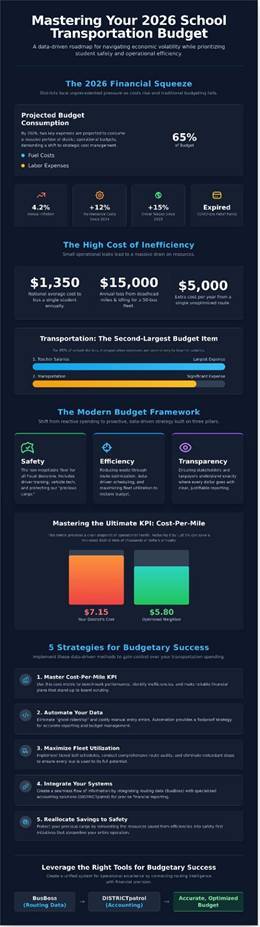
By 2026, the national average cost to bus a single student has climbed to $1,350 annually. Inefficiency hides in the details. Deadhead miles (miles driven without students) and excessive idling time can cost up to $15,000 per year for a mid-sized fleet of 50 buses. These small leaks add up to a massive drain on resources that could be better spent on student programs or driver retention. Transportation remains the second-largest line item for 85% of school districts, trailing only teacher salaries.
When routes aren't optimized, buses run longer than necessary. This increases wear and tear, leading to premature vehicle replacement. A single unoptimized route can cost a district $5,000 extra per year in fuel and labor alone. By identifying these "hidden leaks," transportation managers can reclaim their budgets and ensure that every cent is directed toward the safe delivery of students. Reliability is the goal; efficiency is the tool that makes it possible.
Effective budgeting for school districts has shifted from simple annual estimates to complex, data-driven forecasting. When managing school transportation budget priorities, directors must separate fixed costs, such as insurance and vehicle depreciation, from variable costs like fuel and hourly labor. This distinction allows for more accurate adjustments when student populations shift or fuel prices spike.
The primary Key Performance Indicator (KPI) for any transportation department is the Cost-Per-Mile. This metric provides a clear snapshot of operational health. If your district spends $7.15 per mile while similar neighboring districts average $5.80, it signals a need for route consolidation or better maintenance oversight. Reducing this figure by just 5% can save a mid-sized district tens of thousands of dollars annually. Understanding the nuances of state-level transportation budget components, including subsidy formulas and reporting requirements, is essential for maximizing the funds returning to your local coffers.
Labor remains the most volatile component. With 91% of school districts reporting driver shortages in recent surveys, budgeting now requires aggressive allocations for recruitment and retention. You can't just budget for base hourly pay; you must account for sign-on bonuses, which often range from $1,500 to $3,000, and the rising costs of CDL training and certification compliance.
Fuel costs can swing a budget by 20% in a single semester. While some districts use fuel hedging to lock in rates, others focus on consumption optimization through better routing. Maintenance budgeting must prioritize preventative care. A standard oil change and inspection is a minor expense compared to the $10,000 engine overhaul that results from neglect. Utilizing fleet maintenance programs software helps track these intervals automatically, ensuring that "emergency" repairs don't cannibalize your year-end surplus.
Modern transportation departments view software as an investment that pays dividends in efficiency rather than a sunk cost. Routing software, GPS tracking, and parent communication apps provide the data necessary for managing school transportation budget goals with precision. By moving toward a Software as a Service (SaaS) model, districts can turn unpredictable IT upgrades into a fixed, predictable annual line item. This shift ensures your team always has access to the latest safety features and map updates without a massive upfront capital hit.
Long-term planning also requires a robust Capital Expenditure (CapEx) strategy. Most school buses have a service life of 12 to 15 years or 250,000 miles. A "staggered" replacement schedule, where you retire 7% to 10% of your fleet annually, prevents the budget shock of needing to buy twenty buses in a single year. This methodical approach ensures your fleet stays modern and safe.
Because your precious cargo comes first, every dollar saved through efficiency is a dollar that can be reinvested into student safety. If you want to see how data can transform your financial planning, you can explore a bus routing software demo to identify specific areas for cost reduction in your current operation.
Manual data entry is a silent drain on district resources. Administrators often spend 15 to 20 hours each week manually reconciling paper trip logs and driver timesheets. This labor-intensive process doesn't just waste time; it introduces human error into the financial record. When you're managing school transportation budget goals, these small mistakes in mileage or fuel tracking can result in thousands of dollars in annual discrepancies. Automated systems integrate these data points instantly, allowing staff to focus on the safety of their precious cargo instead of chasing down missing receipts.
One of the most significant risks in manual systems is "ghost ridership." Without digital check-ins, route planners often rely on outdated registration lists. This leads to districts running buses at 60% capacity while the ledger shows 100% occupancy. You're essentially paying for fuel, maintenance, and driver hours for students who aren't there. Transitioning to digital SuccessRoute tracking provides a clear ROI by identifying these empty seats. Districts often consolidate routes within the first 90 days of implementation, saving upwards of $50,000 per retired route.
Automated accounting also builds a wall of transparency around your department. Digital logs create an unalterable audit trail that satisfies board members and taxpayers alike. It reduces audit risks by ensuring every gallon of fuel and every maintenance hour is tied to a specific vehicle and route. This level of precision is a critical step in managing school transportation budget requirements for modern school boards.
Spreadsheets are static, but your district is dynamic. Manual mileage tracking carries an average error rate of 3% to 7%, which directly impacts your bottom line. These errors often stem from "Data Silos" where the transportation office and the business office use different software that doesn't share information. This friction causes delays in financial reporting and budget forecasting. Utilizing integrated transportation software bridges this gap, ensuring the road data matches the ledger data in real time. It's the only way to eliminate the "hidden" labor costs of constant data re-entry.
Precision in data collection is the difference between a budget deficit and a surplus. To maximize your funding, you must provide verified proof of eligible ridership and accurate mileage. GIS mapping plays a vital role here by verifying student addresses against hazardous walking zones and district boundaries. This level of detail is essential for securing state-level transportation funding and ensuring no eligible dollar is left on the table.
Districts using automated routing often see a 5% to 15% increase in reimbursement accuracy because every mile and every student is accounted for with GPS precision. By removing the guesswork, you ensure the district receives every dollar it's entitled to under state law. This financial accuracy allows for more predictable planning and better long-term vehicle replacement cycles.
Efficiency in your district's fleet starts with data. You can't expect to succeed at managing school transportation budget goals if you're relying on paper maps or outdated spreadsheets. To protect your bottom line while ensuring your precious cargo arrives safely, you need a proactive strategy. These five steps provide a framework for reducing waste without compromising service quality.
Route density is the most critical metric for financial health. It measures the number of students transported per mile of travel. When density increases, your cost per student drops significantly. Managing school transportation budget demands flexibility, especially when handling "Spring Break" variations or mid-year alternate routing. Instead of manual adjustments that lead to budget spikes, using school bus routing software allows you to simulate changes and maintain high density year-round. This precision ensures you aren't paying for "ghost" miles that serve no one.
The shift to electric is a major fiscal challenge. A new ESB often costs $350,000, which is roughly three times the price of a diesel model. However, ESBs offer 60% to 70% lower fuel and maintenance costs over their 12-year lifespan. To bridge the gap, districts should target 2026 grant cycles and federal subsidies like the EPA Clean School Bus Program. You must also budget for infrastructure; a single Level 3 fast-charging station can range from $20,000 to $50,000, depending on your current grid capacity.
Every mile saved is a dollar that can stay in the classroom. By focusing on route density and predictive technology, you turn your transportation department into a model of efficiency. It's about making smarter choices so that your resources always support the students first.
Contact our experts to start optimizing your district's fleet today.
Managing school transportation budget effectively requires more than just a passing glance at fuel receipts and maintenance logs. DISTRICTpatrol serves as our specialized accounting solution designed specifically to handle the complexities of school transit finances. It bridges the gap between the garage and the business office, ensuring that every dollar is tracked with precision. Since 1998, BusBoss has refined how these financial metrics interact with daily operations. By integrating routing data directly into your financial reports, you eliminate the 20% margin of error often found in manual data entry processes.
The integration between routing and accounting is where true efficiency happens. BusBoss automatically syncs mileage, driver hours, and vehicle wear-and-tear data with DISTRICTpatrol. You won't have to manually reconcile driver timecards with scheduled route lengths. The software does it for you, reducing administrative overhead by approximately 15 hours per week for the average transportation department. This automation ensures that your financial records reflect the reality of the road, not just an estimate from a spreadsheet.
Financial accuracy isn't a luxury; it's a requirement for maintaining public trust. Our "A+ Software Checkpoints" function as a rigorous internal audit system within the platform. These checkpoints ensure that every expense, from a $500 tire replacement to a $75,000 bus lease payment, is tied to a specific, optimized route. This granular level of detail prevents "budget creep," where small, unmonitored costs eventually lead to a massive year-end deficit. Districts using these checkpoints consistently see a 12% improvement in budget adherence within their first fiscal year of implementation.
When you stand before the school board, generalities won't win you the funding you need. BusBoss provides the visual data and hard numbers required to justify budget requests. You can show exactly how a $50,000 investment in route optimization software translates into a $120,000 saving in annual fuel and maintenance costs. You aren't just asking for more money; you're presenting a verified ROI. When you can prove that your department is a responsible steward of taxpayer funds, the path to budget approvals becomes much smoother.
"Live" budget dashboards provide transportation directors with an instant snapshot of their fiscal health. You can see fuel consumption trends or overtime spikes the moment they occur. During public hearings, these reports act as your primary defense. They demonstrate that our "Precious Cargo" promise isn't just a slogan. It’s a commitment where every dollar spent is a dollar invested in student safety and reliable service. You'll have the confidence to answer any question about managing school transportation budget with real-time data.
A comprehensive audit is the first step toward reclaiming your budget. Our team brings 25+ years of specialized experience to help you identify where your routes are leaking money. We analyze stop density, idling times, and deadhead mileage to find immediate savings. Most districts discover they can reallocate up to 8% of their current budget simply by optimizing existing paths. Schedule your BusBoss demo today to see how we streamline your transportation budget.
The landscape of 2026 demands a shift from reactive spending to proactive fiscal management. You've seen how moving away from manual spreadsheets eliminates common errors that drain district resources. By implementing automated routing and integrated accounting, directors finally achieve the transparency needed for managing school transportation budget goals without sacrificing student safety. BusBoss brings 25+ years of experience to your fleet; we ensure every route is optimized for maximum efficiency. Our comprehensive DISTRICTpatrol accounting integration provides real-time visibility into your spending. This allows you to track every dollar spent on your district's most precious cargo with absolute precision. Districts nationwide trust our proven systems to streamline operations and protect their bottom line. It's time to replace guesswork with data-driven precision that supports your long-term educational mission. You don't have to navigate these complex financial shifts alone when expert tools are ready to help. Start building a more resilient, cost-effective future for your students today.
Request a Live Demo of BusBoss Today
Labor costs, including driver salaries and benefits, represent the largest portion of a school transportation budget. In most districts, personnel expenses account for 65% to 70% of the total annual spend. Rising competition for CDL holders has forced many departments to increase hourly wages by 15% or more since 2022 to maintain adequate staffing levels and ensure every route is covered.
School districts typically budget between $1,000 and $1,500 per student for annual transportation services. According to 2023 industry benchmarks, the national average sits near $1,180 per pupil. These figures fluctuate based on district density; rural areas often see costs 25% higher than urban counterparts because of increased mileage and fuel consumption required to reach distant households.
Implementation of school bus routing software often yields a positive return on investment within the first 12 months. By optimizing routes, districts frequently reduce their fleet requirements by 5% to 10% and cut total mileage by 15%. When it's time for managing school transportation budget goals, these reductions lead to immediate savings on fuel and driver labor hours that exceed the initial software licensing fees.
The most effective way to lower fuel expenses is to implement a strict "no-idling" policy and use GPS-based route optimization. Eliminating just 15 minutes of daily idling per bus can save a district $400 per vehicle annually based on current diesel prices. Additionally, optimizing routes to reduce "deadhead" miles by 10% provides a direct and measurable decrease in monthly fuel invoices.
State reimbursement typically follows a formula based on the number of students transported or the total miles driven on approved routes. In states like Pennsylvania or New York, districts may receive back 50% to 90% of their eligible transportation expenses. Accurate data reporting is essential; failing to document a single route correctly can result in a 5% loss of potential funding during annual audits.
By 2026, the ROI for electric school buses will rely heavily on federal grants like the EPA Clean School Bus Program, which offers up to $345,000 per vehicle. While an electric bus costs roughly three times more than a diesel model, it reduces energy costs by 80% and maintenance expenses by 60%. Most districts see a break-even point within 8 to 10 years without subsidies.
To justify new software, present the board with data on projected mileage reduction and improved student safety. Explain how the system protects your "precious cargo" through real-time GPS tracking and automated parent notifications. Showing a 12% reduction in operational costs through better managing school transportation budget strategies provides the fiscal evidence boards need to approve the investment and move forward.
Fixed costs remain constant regardless of how many miles the fleet travels, including items like insurance premiums, administrative salaries, and bus depreciation. Variable costs fluctuate based on usage, such as fuel, tires, and hourly driver wages. In a typical district, fixed costs account for 30% of the budget, while variable expenses make up the remaining 70%, making route efficiency the primary lever for savings.


 Orbit Software, Inc.
424 King Street
Pottstown, PA 19464

 (484) 941-0820