In 2024, school districts across the country saw transportation expenses climb by an average of 12%, forcing many administrators to search for new ways to reduce school transportation costs without cutting essential student programs. You're likely facing intense pressure from your school board to trim the fat, yet manual routing and rising labor costs make every mile feel more expensive than the last. It's a frustrating cycle that leaves little room for error when the safety of your students is on the line.
This strategic guide provides a clear roadmap to slash fuel consumption and lower your total cost per student while maintaining the high safety standards your community expects. We've compiled 25 years of logistical expertise to help you move from reactive planning to proactive management with total confidence. We will explore automated routing software, real-time GPS tracking, and the specific reporting metrics you need to prove your department's efficiency at the next budget meeting. By the end of this guide, you'll have a 2026-ready plan to protect your budget and your precious cargo.
School districts entering the 2026 academic year face a 14% rise in total operating expenses compared to 2024 levels. Administrators often ask how to reduce school transportation costs while diesel prices remain volatile and labor markets stay tight. Traditional budget cuts usually target extracurricular trips or older vehicle replacements; however, these short-term fixes fail because they don't address the structural inefficiencies of the routing system itself. Cutting a few field trips won't balance a budget leaking thousands of dollars through poor route logic.
Primary drivers of transportation inflation include skyrocketing maintenance and specialized labor. Maintenance costs for a single vehicle now average $12,500 annually. This surge is partly because modern school bus design incorporates complex electronics, collision-avoidance sensors, and specialized emissions tech that demand expert technicians. At the same time, insurance premiums for student transportation rose by 11% in 2025. These fixed costs mean that districts can't simply "spend less" without changing how they operate.
Every decision must protect the precious cargo on board. Safety isn't negotiable. Yet, fiscal responsibility requires a data-driven approach to eliminate "dead miles." These are miles driven when a bus is empty, often accounting for up to 20% of a district's total mileage. Underutilized capacity is another silent budget killer. Running a 72-passenger bus for only 15 students is a logistical failure that wastes fuel, driver hours, and vehicle longevity. Balancing the safety mandate with a shrinking budget requires precision, not just broad cuts.
Relying on paper logs or legacy spreadsheets creates a massive administrative burden. Human error in routing leads to overlapping paths where two buses serve the same neighborhood. This redundancy wastes fuel and driver time. Finding how to reduce school transportation costs requires identifying "ghost stops" where students no longer board. In 2025, one mid-sized district discovered that 12% of their scheduled stops were empty, costing them $45,000 in unnecessary idling over one semester.
The 2026 market shows fuel price swings of up to $0.60 per gallon within a single month. This volatility makes fixed budgeting impossible. Simultaneously, the driver shortage persists; a 2025 industry survey found that 88% of districts increased overtime payouts to cover vacant routes. Modernizing fleet technology through state grants is the only sustainable path. Districts using federal funding to transition to high-efficiency fleets are seeing a 30% reduction in long-term maintenance needs.
Understanding how to reduce school transportation costs starts with a shift from manual mapping to intelligent pathing. Traditional GPS tools tell you how to get from point A to point B, but they don't account for the complex variables of a school district. Intelligent route optimization uses advanced algorithms to analyze student locations, bus capacities, and traffic patterns simultaneously. Data from industry implementations shows that these algorithms can reduce total fleet mileage by 15% to 20% by creating more logical, streamlined paths.
Efficiency isn't just about the shortest distance. It's about maximizing every square inch of your fleet. Consolidating stops is a primary driver of savings. By moving a stop just 200 feet or combining two low-density stops, you can significantly increase bus occupancy. This reduces the total number of vehicles on the road without extending ride times for your precious cargo. According to a report by the Florida Office of Program Policy Analysis and Government Accountability (OPPAGA), districts can reduce vehicle costs and administrative overhead by aggressively refining these operational efficiencies.
Strategic depot placement is another often overlooked factor. "Deadhead" miles, or the miles driven when a bus is empty, can account for 10% of a district's fuel and maintenance budget. Using optimization software helps you identify where these miles accumulate. If a bus travels 15 miles empty every morning, moving the start point or adjusting the route sequence can eliminate thousands of wasted miles over a 180-day school year. This data-driven approach is the most reliable way to learn how to reduce school transportation costs while maintaining strict safety standards.
Moving from paper maps or basic spreadsheets to automated software is a transformative process. It typically follows a structured 5-step sequence:
GIS integration provides real-time awareness of road closures or new construction, allowing dispatchers to pivot instantly. This level of agility prevents the costly delays that occur when drivers are forced to find their own detours on the fly.
Specialized transportation often costs three times more per student than traditional busing. Managing these high-cost routes requires smart clustering. Instead of sending three separate vans to the same neighborhood, the software identifies opportunities to group students with compatible needs into a single trip. Compliance is non-negotiable, but efficiency is still possible. For McKinney-Vento students, whose addresses may change frequently, automated tools update routes in seconds. This ensures you aren't running half-empty vehicles based on outdated data. Many districts find that integrating specialized routing tools provides the clarity needed to make these tough calls while keeping student safety as the top priority.
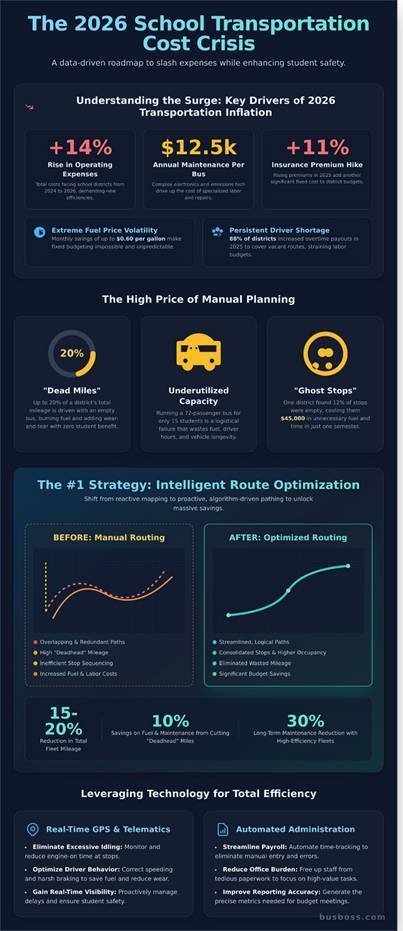
Visibility is the foundation of efficiency. For school districts, understanding how to reduce school transportation costs starts with real-time data. GPS tracking and fleet telematics don't just show where a bus is located; they reveal exactly how a vehicle is being used. When administrators have access to live dashboards, they can eliminate unauthorized stops and route deviations that quietly drain the budget. A 2023 analysis of fleet operations showed that even a 5% reduction in off-route mileage can save a mid-sized district thousands of dollars in fuel and labor costs annually.
Telematics tools offer more than location data. They monitor driver behavior, such as hard braking, rapid acceleration, and speeding. These habits aren't just safety concerns for your precious cargo; they're financial burdens. Aggressive driving can decrease fuel economy by as much as 15% and accelerate the wear on brake pads and tires. By using telematics to provide drivers with constructive feedback, districts promote a culture of safety and mechanical preservation. Many districts are increasingly turning to school bus technology to streamline operations while simultaneously improving driver focus and retention.
Idling is an invisible budget killer. A typical school bus consumes approximately half a gallon of fuel for every hour it spends idling. In a fleet of 60 buses, if every driver idles for 30 minutes during morning warm-ups and another 30 minutes in afternoon pickup queues, the district wastes 30 gallons of fuel daily. At a price of $4.00 per gallon, this adds up to $21,600 over a 180-day school year. Automated alerts notify managers when a bus exceeds a pre-set idle threshold, such as five minutes. This data allows for targeted driver training on fuel-efficient techniques, ensuring that engines run only when necessary.
Managing a fleet requires a long-term perspective on the "total cost of ownership." Software helps track every penny spent on a specific vehicle, from routine oil changes to major transmission repairs. This data-centric approach is one of the most effective ways to reduce school transportation costs over a multi-year period. Most buses reach a critical "economic life" point at approximately 12 years or 150,000 miles. Beyond this threshold, maintenance costs typically spike by 30% or more, often exceeding the annual depreciation cost of a new vehicle. By identifying these high-maintenance "money pits" early, districts can prioritize replacements based on actual repair history rather than simple age.
Safety and savings go hand in hand when it comes to preventive maintenance. Telematics systems sync directly with the bus's engine control module to report fault codes the moment they trigger. Catching a minor coolant leak today prevents a $15,000 catastrophic engine failure next month. This proactive stance ensures that your fleet stays on the road, reducing the need for expensive spare buses and emergency towing services. Implementing these digital checkpoints allows transportation coordinators to manage their departments with total confidence and precision.
Administrative overhead often hides the most significant opportunities for savings. Manual processes don't just take time; they introduce costly human errors. A 2023 industry study found that manual data entry in school offices has an average error rate of 2% to 5%. For a district with a $1 million transportation budget, those small mistakes in payroll or fuel tracking can waste $20,000 annually. Automating payroll and time-tracking through GPS-integrated systems ensures drivers are paid for the exact minutes they're on the road. This eliminates "time creep" and protects the district budget from inaccuracies.
Driver retention is another critical pillar of fiscal responsibility. It costs a district between $5,000 and $8,000 to recruit, background check, and train a single new driver. High turnover rates, which hit 15% in many regions last year, create a cycle of constant spending. Providing staff with reliable technology, such as digital pre-trip inspections and turn-by-turn navigation, reduces the daily stress that leads to resignations. When drivers feel supported by modern tools, they stay longer. This preserves the district's investment in its training and licensing.
Streamlining reporting for the Office of Pupil Transportation (OPT) is equally vital. State and federal compliance often requires hundreds of hours of manual compilation. Modern management software generates these reports with a few clicks. This allows your team to focus on safety audits rather than spreadsheets. Understanding how to reduce school transportation costs requires looking at the hidden hours spent on paperwork that could be automated.
Parent phone calls regarding bus locations can paralyze a transportation office. During the first two weeks of the 2023 school year, many districts reported spending 30 hours per week answering "where is the bus" inquiries. Real-time location apps reduce this call volume by up to 60%. By giving parents direct access to GPS data, you free your staff for high-value tasks like route optimization. This transparency builds community trust while ensuring your office isn't overwhelmed by predictable questions.
Financial leaks often occur when routing data is disconnected from accounting systems. Integrated software ensures that every mile driven for a field trip or athletic event is billed accurately and immediately. Automating these invoices prevents the 10% revenue loss many districts experience due to forgotten or delayed billing for extracurricular activities. DISTRICTpatrol streamlines cost-allocation for multi-school districts by providing a unified platform to monitor and assign transportation expenses to specific school accounts with precision.
Effective management isn't just about moving buses; it's about managing the data behind them. With over 25 years of experience, BusBoss understands that safety and efficiency go hand-in-hand. Implementing these administrative changes is a proven strategy to reduce school transportation costs without compromising the well-being of your students. Every minute saved in the office is a dollar that can be reinvested into the safety of your precious cargo.
Ready to see how much your district can save through better management? Explore our bus routing software demo to start optimizing your administrative workflow today.
BusBoss has served as a trusted partner for school districts for over 25 years. We've spent decades refining the technology needed to protect your students while protecting your bottom line. When administrators ask how to reduce school transportation costs, they're often looking for a quick fix. Real savings come from a methodical approach to routing and data management. Our core system uses high-resolution GIS maps and seamless SIS integration to ensure every bus path is the most efficient one possible. By eliminating redundant stops and overlapping paths, districts frequently find they can reduce their total fleet requirements by 5% to 8% without ever compromising service quality.
We operate under a simple philosophy: your precious cargo comes first. It's a mindset that prioritizes safety, but safety and savings are two sides of the same coin. When a route is optimized to avoid hazardous left-hand turns and high-traffic bottlenecks, it naturally consumes less fuel and experiences less mechanical wear. One district in the Northeast reported a 14% reduction in total mileage within its first year of implementation. These results aren't accidental. They're the product of our SuccessRoute training program. This initiative ensures your entire transportation staff knows how to use our tools to their full potential. We don't just hand you a login; we build your team's expertise so you can maintain those 10% to 15% savings year after year.
Our consulting services go beyond the software interface. We conduct professional audits that dive deep into your district's specific geography and student population density. When looking at how to reduce school transportation costs, a professional audit is often the most effective starting point for uncovering hidden efficiencies. For instance, a district with a fleet of 60 buses might save upwards of $75,000 annually simply by re-evaluating its tiering structures or adjusting bell times by 15 minutes. We provide a clear ROI calculation during this process. This gives you the hard data you need to justify the investment to your school board. You'll see exactly how many months it will take for the system to pay for itself through reduced fuel consumption and lower driver overtime costs.
Every district faces unique challenges, from driver shortages to complex special education requirements. We've designed our platform to be flexible enough to handle these variables without sacrificing ease of use. Seeing the software handle your specific data is the best way to understand its value. We invite you to see our route optimization features in a real-world context. Our team will walk you through the interface and show you how to identify the biggest cost-saving opportunities in your current plan.
Getting started is straightforward. We offer quotes that are strictly tailored to your fleet size and the complexity of your district. There are no hidden fees or unnecessary modules. You'll get exactly what you need to streamline your operations and gain confidence in your planning. You can Request a Live Demo of BusBoss Today to see how we can help you achieve your financial goals while keeping student safety as the top priority.
Managing a school district's budget in 2026 requires more than just careful planning; it demands absolute precision. You've seen that route optimization remains the most effective way to eliminate wasted mileage and unnecessary idling time. By integrating real-time GPS data and streamlining administrative workflows, your team can finally master how to reduce school transportation costs without compromising the safety of your students. These strategies aren't just theoretical; they're essential for operational survival in today's tightening fiscal landscape.
BusBoss brings 25+ years of experience to the table, providing tools trusted by hundreds of school districts across the US. Our proprietary SuccessRoute training and support ensure your staff isn't just using software, but mastering a system designed for long-term fiscal health. We understand that your precious cargo comes first. Our methodical approach helps you protect your students while protecting your bottom line. It's time to turn these strategies into measurable results that benefit your entire community. You don't have to navigate these complex changes alone when proven expertise is available.
Request a Live Demo and Start Reducing Your Transportation Costs
Yes, most districts see a full return on investment within 12 to 18 months of implementation. By automating complex routes, the software identifies overlaps that manual planning misses, often reducing the total fleet size by 7% or more. This reduction in active vehicles saves on fuel, maintenance, and driver salaries immediately while ensuring your precious cargo remains safe.
Districts typically reduce their annual mileage by 10% to 15% through strategic route optimization. For a mid-sized district operating 50 buses, a 10% reduction in mileage can save over $150,000 annually in fuel and vehicle wear. This is one of the most effective strategies to reduce school transportation costs without compromising service quality.
Not necessarily; cost savings often come from smarter stop placement rather than simply removing them. Consolidating stops so they're at least 0.25 miles apart can improve bus dwell time and fuel efficiency. By using data to place stops at centralized, safe locations, you can reduce the number of times a bus idles and accelerates, which accounts for 20% of unnecessary fuel consumption.
Yes, insurance providers often offer premium discounts ranging from 5% to 12% for districts that implement active GPS tracking. Since GPS monitors driver behavior and speed in real-time, it significantly reduces the statistical risk of accidents. Lowering your risk profile makes the district more attractive to underwriters, leading to lower annual premiums and fewer liability claims.
Labor and benefits represent approximately 60% to 70% of a typical school transportation budget. Fuel is usually the second largest expense, but driver shortages have pushed wages 15% higher since 2021. Optimizing routes helps manage these costs by ensuring drivers aren't working unnecessary overtime and that every hour spent on the road is productive and necessary.
Transparency and data-driven communication are the best ways to manage parent concerns. When a district in Pennsylvania shifted to centralized stops in 2022, it used heat maps to show parents that student safety wasn't compromised. Providing clear evidence that the changes allow the district to reinvest $200,000 back into the classroom helps build community support for the transition.
Electric buses can save a district up to $6,000 per year in fuel and 60% in maintenance costs over a 12-year lifespan. While the initial purchase price is higher, federal grants like the EPA Clean School Bus Program provide up to $375,000 per bus to offset costs. Over time, the lack of oil changes and engine repairs makes them a viable way to reduce school transportation costs.
You should conduct a formal route audit at least once every 12 months. Student populations shift by an average of 10% to 15% annually due to new move-ins and graduations. A yearly review ensures your routes remain efficient and that you aren't sending half-empty buses into neighborhoods where the student density has dropped significantly since the previous term.


 Orbit Software, Inc.
424 King Street
Pottstown, PA 19464

 (484) 941-0820