
The morning bell rings, and so does the phone. Then it rings again. And again. For any school transportation department, this constant stream of calls-"Where is the bus?" "Why is it delayed?"-can be overwhelming. This cycle of reactive problem-solving not only consumes your staff's valuable time but also ties up phone lines, potentially delaying the response to a genuine emergency. The key to creating a more efficient and less stressful environment is to strategically reduce parent calls school transportation departments manage daily. It’s about shifting from putting out fires to preventing them from starting in the first place.
Imagine a transportation office where the phones are quiet, not because of a problem, but because parents already have the answers they need. This guide is designed to help you achieve that. We will explore the root causes behind the most common parent inquiries and provide proven, actionable strategies to address them head-on. From implementing proactive communication plans to leveraging modern bus tracking technology, you will learn how to empower parents with self-service information, improve satisfaction, and free your team to focus on optimizing routes and ensuring the safety of your precious cargo. It’s time to regain control and build a system founded on confidence and clarity.
Before you can effectively implement a solution, you must first diagnose the source of the problem. A constantly ringing phone is a symptom, not the root cause. The reality of managing complex student transportation logistics is that most parent calls are not unique; they fall into predictable, manageable patterns. By categorizing these inquiries, your department can identify the primary drivers and deploy targeted, effective solutions.
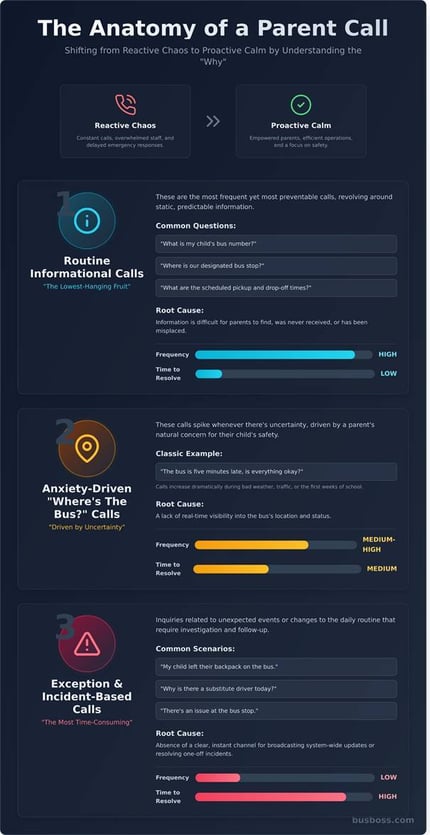
This strategic approach is the key to shifting your team from a constant state of reaction to a position of proactive control. It allows you to anticipate needs, streamline communication, and ultimately reduce parent calls school transportation departments field every day. We've identified three primary categories that encompass the vast majority of these calls.
These are the most frequent yet most preventable calls your office receives. They revolve around static, predictable information that should be readily available to parents. Common examples include:
The root cause is simple, this critical information is either difficult for parents to find, was never received, or was misplaced. Addressing this category is the lowest-hanging fruit for immediate and significant call reduction.
Driven by a parent's natural concern for their child's safety, these calls spike whenever there is uncertainty. The classic example is, "The bus is five minutes late, is everything okay?" This anxiety stems directly from a lack of real-time visibility into the bus's location and status. These calls increase dramatically during inclement weather, traffic delays, or the chaotic first few weeks of school, placing a significant strain on your staff when they are already managing difficult conditions.
This category covers inquiries related to unexpected events or changes to the daily routine. Calls might include, "My child left their backpack on the bus," or "Why is there a substitute driver today?" The core issue is the absence of a clear, instant channel for broadcasting system-wide updates or resolving one-off incidents. While often less frequent than other types, these calls can be the most time-consuming and complex for your team to resolve, requiring investigation and follow-up.
While modern technology offers powerful tools for streamlining operations, its effectiveness is limited without a solid communication strategy. Before implementing any new software, it's crucial to build a foundation of trust and transparency with parents. By establishing clear expectations and providing accessible information from the start of the school year, you can preemptively answer common questions and manage parent concerns. This proactive, non-technical approach is the single most effective way to reduce parent calls school transportation departments receive, creating a more efficient and less stressful environment for everyone.
Your staff likely answers the same set of questions every single day. The first step is to transform this reactive work into a proactive resource. Compile a list of the top 20-25 questions your team fields and develop clear, concise answers to create a "single source of truth" for parents. Districts can model their efforts on established parent communication resources to ensure they cover all critical areas. Publish this FAQ in an easy-to-find location on your website.
Empower parents by clearly defining how and when they should contact the transportation office. Communicating these protocols at the beginning of the school year and reinforcing them in newsletters helps manage expectations and ensures your team can focus on priority issues. An organized system demonstrates professionalism and a commitment to serving the community effectively.
Your district's website is your most valuable communication tool. It should be the central, reliable hub for all transportation information. Most parents will access this page on their phones, often while on the go, so a mobile-friendly design is non-negotiable. Ensure the page is clean, easy to navigate, and puts the most critical information front and center to help reduce parent calls school transportation offices handle daily.
While optimizing routes and training staff are crucial, modern technology offers the most direct path to a quieter office. A dedicated parent communication app moves beyond simply managing problems; it eliminates them at the source by addressing the root causes of parent calls, uncertainty and a lack of information. By providing a single, secure source of real-time truth, you empower parents to find answers themselves. This builds confidence, fosters trust, and transforms the transportation office from a reactive call center into a proactive, efficient operation. The goal is to make calling the office the last resort, not the first instinct.
Many calls are for basic, static information that rarely changes. A parent portal provides secure, on-demand access to student-specific details like their assigned bus number, designated stop location, and scheduled pickup and drop-off times. This digital hub also serves as a central repository for transportation-related documents and forms, eliminating frantic searches and calls for lost papers. See how PARENTpatrol puts this essential information directly into parents' hands, 24/7.
The single most frequent and anxiety-driven call is, "Where is my child's bus?" Live GPS tracking is the definitive answer. By displaying the bus's exact location on a user-friendly map, parents can see for themselves if a bus is on schedule, approaching the stop, or delayed in traffic. This transparency instantly counters the worry that drives minute-by-minute check-in calls. This feature alone is one of the most powerful tools available to reduce parent calls school transportation departments receive daily, giving parents peace of mind and giving your team back their time.
Unexpected events like mechanical issues, widespread weather delays, or bus substitutions can trigger a flood of inbound calls. A parent app with push notification capabilities turns this reactive scenario on its head. Your team can broadcast instant, targeted alerts to all parents on an affected route, informing them of the situation before they have a chance to worry and call. This proactive approach is a cornerstone of effective communication strategies with parents, turning a potential crisis into a managed, informational update with a single outbound message.
A powerful parent communication tool is only effective if families use it. Implementing new technology without a clear strategy can lead to confusion and low adoption, failing to deliver the expected results. A phased rollout and a clear communication plan are critical for success. To truly reduce parent calls that the school transportation department receive, the focus must be on making the onboarding process as simple as possible for busy parents. Follow this proven plan to ensure a smooth, confident transition for both your staff and the families you serve.
The foundation of a successful launch is selecting a system built for your district's needs. Look for a platform that integrates seamlessly with your existing routing software to ensure data accuracy and operational efficiency. Prioritize a system with a user-friendly, intuitive interface for both parents and administrators. Most importantly, ensure your provider offers robust training and ongoing technical support to manage any challenges with confidence.
Proactive communication builds excitement and sets expectations. Announce the new app or parent portal weeks in advance to give families time to prepare. Your campaign should include:
Your internal team is your first line of support. Ensure your office staff are experts on the platform so they can confidently assist parents and troubleshoot common issues. Train them to gently redirect callers to the app for future inquiries, reinforcing it as the primary source of information. This proactive approach is essential to reduce parent calls school transportation offices handle daily. Identify tech-savvy staff or parent volunteers to act as "champions" who can help others in the school community.
A successful launch is an ongoing process. Track download and registration metrics to gauge adoption rates and identify any barriers. After the first month, send a simple survey to gather parent feedback on their experience. Use this valuable input to create new FAQ content, refine your communication, and continuously improve the process. This commitment to optimization ensures the long-term success of your investment.
Our team of experts supports your district through every step of this process, from implementation to parent communication. Request a Demo to learn how BusBoss can help you streamline operations and enhance safety for your precious cargo.
The path to a quieter phone line isn't about ignoring calls, but preventing them at the source. This journey begins with establishing a foundation of proactive communication and culminates in leveraging powerful technology that provides parents with the real-time information and confidence they need. By implementing a comprehensive strategy, you can significantly reduce parent calls school transportation departments manage daily, freeing up your team to focus on what matters most, the safety of your precious cargo.
For over 25 years, BusBoss has been the trusted partner for districts seeking this transformation. Our comprehensive suite integrates routing, GPS, and parent communication tools, all backed by dedicated support and training for your entire team. We provide the tools to eliminate guesswork and build confidence with every route.
Ready to see the difference? Request a Live Demo to see how BusBoss can reduce your parent calls. Take the first step toward a more efficient and streamlined operation today.
The overwhelming majority of parent calls stem from uncertainty, primarily the question, "Where is the bus?" These inquiries spike during delays caused by traffic, inclement weather, or substitute drivers. Parents need accurate, real-time information to ensure their child is safe and to manage their own schedules. Providing this data proactively through an app directly addresses their core concern and builds confidence in your transportation services.
A parent app enhances safety by providing a direct line of sight to the school bus. Real-time GPS tracking allows parents to monitor the bus's location, reducing the time their precious cargo spends waiting at a stop. Push notifications for bus arrivals, delays, and substitutions eliminate uncertainty. Some systems can even confirm when a student boards or exits the bus, providing a complete and secure record of their journey to and from school.
Adoption rates for parent communication apps are consistently high, often exceeding 80-90% within the first year of implementation. The key to this success is the app's clear value proposition, convenience, and peace of mind. When districts effectively communicate the safety and real-time information benefits, parents are highly motivated to download and actively use the tool to stay connected with their child's daily commute.
Ensuring equitable communication is essential. A robust parent communication platform should offer multiple access points to accommodate all families. In addition to a smartphone app, look for solutions that include a secure web portal accessible from any desktop or public computer. For families with no internet access, features like automated SMS text message alerts or voice call notifications for critical updates ensure no one is left uninformed about their child's transportation.
Seamless integration is critical for accuracy and efficiency. A parent app functions as the communication endpoint of your transportation management system. It uses secure APIs to pull live data directly from your routing and GPS software, including route assignments, stop locations, and real-time vehicle coordinates. This ensures the information parents receive is always accurate and current, without requiring your staff to manage multiple, disconnected systems or perform duplicate data entry.
Yes. Modern parent communication platforms provide granular control over messaging. This allows transportation administrators to send targeted push notifications with precision. You can communicate a mechanical delay to the parents on a single route, notify an entire school of a weather-related schedule change, or send a district-wide announcement. This capability ensures relevant information reaches the right audience without creating unnecessary confusion or concern for other parents.
The return on investment is multifaceted. While the primary goal is to reduce parent calls school transportation offices receive, the benefits extend much further. It significantly boosts operational efficiency by freeing up dispatchers and administrative staff to focus on critical safety and logistics tasks. Furthermore, it dramatically improves parent satisfaction and trust by providing transparency and proactive communication, strengthening the relationship between the district and the community it serves.



 Orbit Software, Inc.
424 King Street
Pottstown, PA 19464

 (484) 941-0820