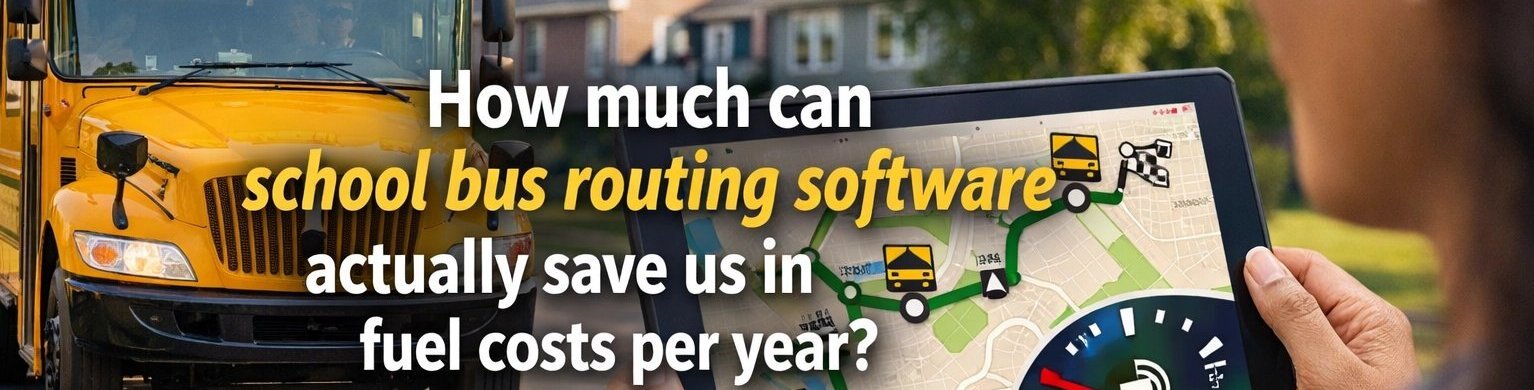
If you’re a K-12 Transportation Director, you know the drill. Every year, you sit down with the budget, and every year, the line item for "Fuel" looks a little more like a horror movie script. Prices fluctuate, routes grow longer as new housing developments pop up, and somehow, the "efficient" routes you planned five years ago just aren’t cutting it anymore.
We get it. At BusBoss, we talk to districts every day that feel like they’re literally burning money out of their tailpipes. The big question is always: “If we invest in school bus routing software, what’s the actual ROI on fuel?”
While every district is different, the data is pretty clear. Optimizing your routes isn’t just about making things "neater"; it’s about a massive reduction in unnecessary mileage and idle time. Let’s dive into the real numbers and see how much cash you could be keeping in your district’s pocket.
Most manual routing systems (or those "legacy" systems that haven’t been updated since the 90s) rely heavily on institutional knowledge. You have a router that knows the neighborhood like the back of its hand. But even the most experienced router can’t account for the trillions of mathematical permutations involved in a multi-tier busing system.
When routes aren’t mathematically optimized, you end up with:
You don’t have to take our word for it. Research into school bus fleet optimization shows some staggering potential. A simulation model specifically focused on optimizing bus routes for fuel efficiency found that districts could see potential annual fuel savings ranging from 10% to 23.5%.
To put that into perspective, let’s look at a medium-to-large district:
Even for smaller districts with a fleet of 20 or 30 buses, a 15% reduction in mileage can easily save tens of thousands of dollars, often enough to pay for the software itself in the first year.
So, how does the software actually do it? It’s not magic; it’s just better math and real-time data.
1. Smart Route Optimization
Our algorithms don’t just look at point A and point B. They look at the entire web of your district. By properly using transport software, you can consolidate stops and re-sequence paths so that every mile driven is a necessary one. This reduces the total mileage of your entire fleet, which is the most direct way to lower fuel consumption.
2. Reducing Idle Time
Idling is the silent budget killer. A school bus can burn half a gallon to a gallon of fuel per hour just sitting still. When drivers don’t have clear, optimized paths, or when they are waiting at schools because the timing is off, those minutes add up. BusBoss integrates with GPS tracking to provide real-time data on idle times, allowing you to identify "hot spots" where fuel is being wasted and adjust schedules accordingly.
3. "Right-Sizing" the Fleet
Sometimes the best way to save fuel isn’t to drive more efficiently, it’s to drive fewer buses. BusBoss helps you run "what-if" scenarios. Can you handle your current student load with 48 buses instead of 50? By increasing the "load factor" (safely) and optimizing the timing of your tiers, you might be able to take entire vehicles off the road. Removing just one bus from the daily rotation saves thousands in fuel, maintenance, and labor.
4. Turn-by-Turn Navigation
Driver error is a real factor in fuel waste. When a driver takes a wrong turn or misses a stop, they have to double back. Not only is this a safety concern, but it’s also a fuel drain. Our systems provide clear, turn-by-turn directions that keep drivers on the most efficient path possible, every time.
While fuel savings are the most visible "win," the benefits of routing software create a ripple effect throughout your entire department.
In Alpharetta, Georgia, a pilot program using advanced routing technology demonstrated that optimized routes reduced unscheduled stops by 40% and increased average bus speeds by 18%. While the specific dollar amount varies by district, the trend is universal: less stopping and starting, and more consistent speeds lead to significantly better fuel economy.
You can check out some of our case studies to see how districts similar to yours have overhauled their operations.
If you’re still using paper maps or a system that doesn't talk to your GPS, you are almost certainly overspending on fuel. In an era where school budgets are under the microscope, routing software is one of the few investments that pays for itself through direct, measurable savings.
Think about it this way: if you could shave just 5% off your total mileage this year, what would that do for your budget? Now, what if you could shave off 15%?
Ready to see how much your district could save?
Don't let your budget go up in smoke. Let’s look at your current routes and find the hidden savings together.
Contact the BusBoss team today for a personalized demo, and let’s start cutting those fuel costs.


 Orbit Software, Inc.
424 King Street
Pottstown, PA 19464
 (484) 941-0820