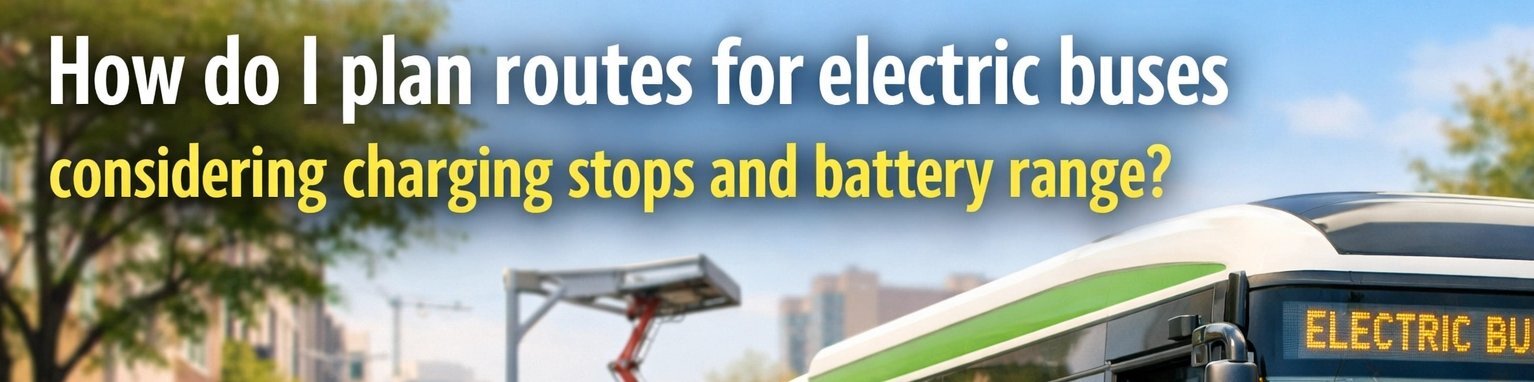
Let’s be honest, moving from a fleet of reliable old diesels to a fleet of Electric School Buses (ESBs) feels a bit like switching from a flip phone to a high-end smartphone. It’s exciting, it’s cleaner, and it’s definitely the future, but the way you "charge" and manage it is a whole different ballgame.
As a K-12 Transportation Director, your primary goal hasn't changed getting students to school and back safely and on time. But when you throw battery range, charging infrastructure, and kilowatt-hours into the mix, the math gets a little more complicated. You can’t just "fill 'er up" in ten minutes at the corner station anymore.
Planning routes for electric buses requires a shift from sequential planning (first the route, then the schedule) to integrated planning. You have to look at the route, the charging stops, and the battery range all at the same time.
Here’s your practical guide to mastering the electric transition without the range anxiety.
On paper, an electric bus might promise 120 or 150 miles on a full charge. But as anyone who has ever used a cell phone in a blizzard knows, batteries are sensitive. To plan effectively, you have to account for the "range thieves."
Before you map a single turn, you need to know your "effective range": the distance a bus can travel in the worst possible conditions while still maintaining a 20% safety buffer.
In the old days, you’d design a route based on student locations and then figure out which bus was available. With electric buses, the route and the vehicle's state of charge (SoC) are permanently linked.
Recent research suggests that the most effective way to plan is to optimize routes, charging station placement, and schedules simultaneously. Instead of just trying to find the shortest path, you are trying to find the path that minimizes the total cost of energy and vehicle wear.
When you use advanced transportation routing software, you can input battery constraints directly into the system. This allows the software to flag routes that are too long for a single charge or identify where a mid-day "top-off" is necessary.
One of the biggest advantages of the K-12 schedule is the mid-day gap. Most school buses sit idle between 9:00 AM and 2:00 PM. This is your prime charging window.
However, you shouldn't just plug in every bus the second it returns to the yard. You need to consider Time-of-Use (TOU) energy pricing. Many utility companies charge significantly more for electricity during "peak demand" hours (usually mid-day and early evening).
To keep costs down, you’ll want to:
While most charging happens at the central bus depot, "opportunity charging" along the route can be a game-changer for longer, more rural routes.
If your district covers a wide geographic area, placing a fast-charger at a high school or a shared municipal lot can allow a bus to grab a 20-minute "snack" of power while waiting for a sports team or between tiers. This integrated placement minimizes "deadhead" miles, the miles driven without students just to get back to a charger.
The person behind the wheel has a massive impact on battery range. Sudden acceleration and hard braking waste energy. On the flip side, smooth driving and proper use of regenerative braking can extend a route’s feasibility.
Consider implementing safe driving incentives that specifically reward "energy-efficient" driving. Not only does this save your battery, but it also creates a smoother, safer ride for the students.
Training is key here. Your drivers need to understand that an ESB doesn't drive exactly like a diesel. They are quieter, have different torque profiles, and require a bit of finesse to maximize efficiency.
Special education routes often require more stops and idle time for lift operation, which can impact battery life differently than standard routes. When revolutionizing special education transportation, ensure your battery range calculations account for the power used by auxiliary equipment like wheelchair lifts and climate control for students with medical needs.
Field trips present another challenge. A 50-mile trip to a museum is one thing, but a 50-mile trip that involves three hours of idling in a parking lot is another. Using GPS tracking for field trip management helps you monitor battery levels in real-time, so you aren't surprised by a bus that doesn't have enough juice to get home.
Transitioning to an electric fleet is expensive, but there is help available. From federal EPA grants to state-level incentives, there are many ways to find funding for student safety technology and green energy initiatives.
Once the buses are on the road, the data you collect is gold. Every mile driven provides information on how your battery range is performing against your plan. Use this data to constantly refine your routes. If a certain route consistently returns with 40% battery, maybe it can be combined with another short run. If another route is consistently cutting it close to 10%, it’s time to re-evaluate the charging stop or the vehicle assignment.
Planning for electric buses doesn't have to be a headache. It’s just a different way of thinking about your fleet's "fuel." By integrating your charging needs directly into your routing strategy, you can enjoy the benefits of a quieter, cleaner fleet while ensuring your students never miss the first bell.
Ready to see how smart routing software can take the stress out of your electric transition? Contact the experts at BusBoss today, and let’s build a more efficient future together.


 Orbit Software, Inc.
424 King Street
Pottstown, PA 19464

 (484) 941-0820