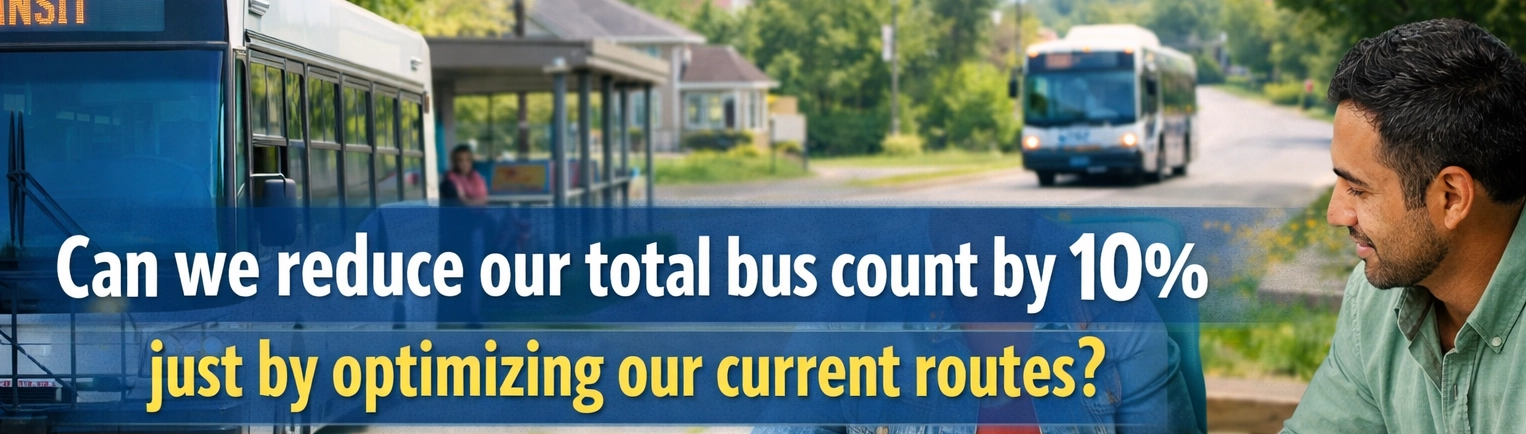
If you’re a K-12 Transportation Director, you probably spend a good chunk of your week staring at a map, a spreadsheet, or a mounting pile of driver resignation letters. You’ve likely asked yourself: “Is there a world where I don’t need as many buses as I have right now?”
It sounds like a pipe dream, especially when your community is growing, or your special education needs are becoming more complex. But the reality is that many districts are operating with "legacy routes", routes that were designed ten years ago and have only been tweaked around the edges since.
The question isn't just about saving money; it’s about survival in an era where the school bus driver shortage is a daily crisis. If you could cut your total bus count by 10% through optimization, you wouldn't just be saving on fuel and maintenance: you’d be solving your driver shortage overnight.
But is a 10% reduction actually realistic? Let’s look at the math, the logic, and how BusBoss tools make it happen.
To understand how to cut 10%, we first have to admit where the waste lives. In many districts, buses are running at 50% to 60% of their actual capacity.
Let’s do some quick back-of-the-napkin math. Suppose you have a fleet of 50 buses. Each bus has a theoretical capacity of 72 students (three to a seat for elementary). However, due to "comfortable" routing, you’re only averaging 45 students per bus.
That’s exactly a 10% reduction in your fleet.
You didn't change the number of kids. You didn't change the school bell times. You simply looked at the "dead space" on those buses and tightened the logic. Optimization software like BusBoss doesn't just look at dots on a map; it looks at the load counts, stop times, and travel paths to ensure every seat is a working asset, not just empty vinyl.
You might be wondering why we suggest 10% instead of a more aggressive 20% or 30%. While some districts have achieved massive cuts, 10% is often the most achievable benchmark because it accounts for the "real-world" constraints you deal with every day:
When we talk about how a transportation routing software system lowers costs, we’re talking about finding that 10% within these constraints. BusBoss uses advanced algorithms to "spiderweb" out from the school, identifying overlapping paths that a human eye, or a static map, simply can't see.
The biggest enemy of a 10% reduction is the phrase, "But we've always done it this way."
Legacy routes are created when a district adds a stop here and a stop there over several years. Eventually, you have a route that zig-zags across town, doubling back on itself, and passing three other buses from the same district.
Optimization software performs a "clean sheet" analysis. It looks at your student data (often integrated with systems like Pearson PowerSchool) and builds the most efficient paths from scratch.
When you let the software run "What-If" scenarios, you might find that by shifting three stops from Route A to Route B, you can eliminate Route C. That’s the power of automated optimization.
If you really want to hit that 10% (or more), you have to look at multi-tier routing. This is the practice of having one bus complete an elementary route, then immediately start a middle school route, followed by a high school route.
If your bell times are staggered correctly, your "bus count" isn't determined by the total number of students in the district: it’s determined by the largest single tier.
BusBoss helps you analyze your bell times to see if a 15-minute shift in the middle school start time could allow five more buses to perform double or triple duties. This is the single fastest way to reduce your total bus count without actually reducing the service you provide to families.
Reducing your fleet by 10% isn't just about the vehicles. It’s about the massive reduction in operational overhead. When you cut 5 buses out of a 50-bus fleet, you’re also cutting:
We know that "optimization" can sound like a scary, high-tech word that involves a lot of data entry. That’s why we’ve built our tools to be user-friendly for the people who actually do the work.
With BusBoss, you’re not just getting a map; you’re getting a suite of tools designed for properly using transport software. Our system allows you to:
One concern we often hear from Transportation Directors is the pushback from parents. "If you optimize the routes, my child's stop might move!"
This is why communication between parents and transportation is so critical. When you can show the community that optimization is allowing the district to keep more money in the classroom (or keep student fees low), they are much more likely to support a few minor changes to stop locations.
Furthermore, optimized routes are often safer routes. By reducing the number of buses on the road and ensuring they don't make unnecessary U-turns or back up in tight cul-de-sacs, you are inherently increasing the safety of your operation.
The short answer? Yes.
The long answer? It requires a shift from "management" to "optimization." If you are managing your routes based on where they were last year, you are likely leaving money (and buses) on the table. By leveraging the math of capacity utilization and the logic of multi-tier routing, a 10% reduction in bus count is a very conservative and achievable goal for most K-12 districts.
Ready to see how the math works for your specific district? Check out our case studies to see how other districts have streamlined their operations, or contact us today for a personalized demo of the BusBoss routing suite.
Key Takeaways:
Let's get those buses off the road and those budgets back in the black. Stop by our About Us page to learn more about our commitment to smarter, safer school transportation.


 Orbit Software, Inc.
424 King Street
Pottstown, PA 19464

 (484) 941-0820