Presenting a major software investment to your school board can feel like an uphill battle. You recognize the potential for optimized routes, enhanced student safety, and more efficient operations, but decision-makers often see a significant line item on the budget. The critical question they will ask is, "What's the return?" Calculating the school bus software ROI is the key to answering with confidence, but it requires a comprehensive view that goes beyond simple fuel savings to include every dollar saved and every risk mitigated.
This guide was created to demystify that process. We provide a clear, step-by-step framework to help you build a powerful business case for your district. You will learn to identify and quantify direct cost savings in fuel, maintenance, and administrative time. We'll also help you articulate the immense value of intangible benefits like improved safety protocols and increased parent satisfaction, giving you the data-driven argument needed to secure approval and modernize your transportation for the safety of your precious cargo.
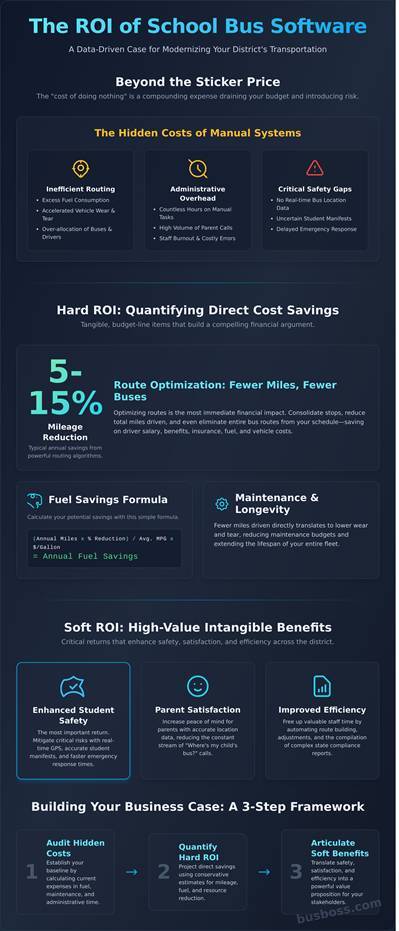
When evaluating transportation technology, it's easy to focus on the initial software cost. However, a true financial assessment begins with understanding the significant, ongoing expenses of maintaining a manual system. The "cost of doing nothing" is rarely zero; in fact, it's a compounding expense that drains budgets, consumes staff resources, and introduces unnecessary risks. To accurately calculate the Return on Investment (ROI) for a new system, you must first establish a baseline by auditing the hidden costs you are already incurring.
Manual and outdated routing methods directly inflate your operational budget. Without optimization technology, your district is likely spending more than necessary on fundamental costs. These inefficiencies manifest in several ways:
Your team's time is one of your most valuable assets, yet manual processes consume countless hours that could be dedicated to more strategic initiatives. This administrative drain is a critical factor in your school bus software ROI calculation. Consider the hours your staff spends on tedious, repetitive tasks: manually building and adjusting routes, fielding a constant stream of parent calls about bus locations, and struggling to compile data for complex state compliance reports. These activities not only reduce productivity but can also lead to staff burnout and costly errors.
Beyond the measurable financial costs are the critical safety risks inherent in manual systems. When an emergency occurs, the lack of real-time data can have serious consequences for your precious cargo. Manual management creates dangerous blind spots, including:
While you can't put a dollar value on student safety, mitigating these risks is a powerful, and perhaps the most important, return on any technology investment.
When building a business case for new technology, nothing speaks louder than direct, quantifiable savings. These "hard ROI" calculations represent the tangible, budget-line items your school board and administrators understand and prioritize. They form the most compelling financial argument for your investment. By focusing on conservative, defensible estimates, you can confidently project the financial impact and calculate a clear school bus software ROI.
Below is a framework for estimating savings in three core areas of your transportation department.
The most immediate financial impact comes from route optimization. Powerful routing algorithms can typically reduce a district's total annual mileage by 5-15%. This efficiency gain allows you to model scenarios that consolidate stops and, in many cases, eliminate entire routes from your daily schedule. Removing even one bus route saves significant costs associated with a driver's salary and benefits, insurance, fuel, and the vehicle itself.
Optimized routes are the single biggest factor in reducing fuel costs. With fuel often being a major component of national school transportation expenditures, even small improvements yield substantial savings. Beyond shorter routes, integrated GPS tracking helps managers identify and correct other sources of waste, such as excessive idling time at stops or inefficient driving behaviors like speeding. You can estimate your savings with a simple formula:
(Total Annual Miles x % Mileage Reduction) / Fleet Avg. MPG x Price Per Gallon = Annual Fuel Savings
Fewer miles driven directly translates to lower wear and tear on every vehicle in your fleet. This reduction has a powerful ripple effect on your maintenance budget and long-term capital planning. The true value of a strong school bus software ROI is realized through:
While the previous section focused on quantifiable cost savings, the complete picture of school bus software ROI includes powerful, non-monetary returns. These 'soft' benefits are centered on the core mission of any school transportation department: ensuring the safety of your precious cargo. By mitigating risk, streamlining daily operations, and improving communication, routing software delivers value that extends far beyond the budget.
Modern routing platforms provide unparalleled visibility into daily operations, giving you the confidence that every student is safe and accounted for. With real-time ridership tracking, you know precisely which students are on which bus at any given moment, drastically reducing the risk of lost students or unauthorized drop-offs. This digital oversight also allows for monitoring driver behavior to ensure adherence to safety protocols. This data-driven approach complements physical safeguards, aligning with official recommendations for advanced school bus safety technology from organizations like the National Transportation Safety Board (NTSB). In an emergency, this means providing first responders with exact GPS locations and student manifests instantly.
The value of recovered time is a cornerstone of soft ROI. Manual route planning that once took weeks or months can be optimized and completed in a matter of days. This efficiency extends throughout the year, freeing your team from tedious tasks to focus on strategic management and student care.
A modern transportation system builds trust with parents and the wider community. Parent-facing apps with real-time bus tracking and accurate ETAs provide peace of mind and reduce anxiety. In fact, many districts report a significant reduction in inbound calls to the transportation office after implementation. Proactive notifications about delays or route changes demonstrate transparency and a commitment to student well-being, reinforcing the district's reputation as a safe, modern, and reliable institution. This improved communication is a critical component of your overall school bus software ROI.
Transforming your operational data and the previously discussed benefits into a compelling financial argument is the final step. This section provides a practical, step-by-step framework to build a presentation that clearly demonstrates the value and fiscal responsibility of investing in routing software. By combining hard numbers with qualitative improvements, you can present a narrative that resonates with financial decision-makers and addresses their key concerns with confidence.
To accurately project savings, you must first establish your current operational costs. A precise baseline is the foundation of a credible analysis. Gather clear, verifiable data from the most recent fiscal year, including:
With your baseline established, you can project future savings. We recommend applying conservative reduction percentages to ensure your forecast is both achievable and defensible. For instance, districts often see mileage reductions between 8-15%; using the lower end of this range builds credibility. Calculate projected annual savings across fuel (based on mileage reduction), maintenance (tied to fewer miles driven), and administrative labor. For a precise estimate tailored to your district's unique needs, request a personalized ROI analysis from our experts.
The final calculation brings your business case together into a clear, universally understood metric. Presenting a comprehensive school bus software ROI is simple with the right formula. Use clear visuals like charts and graphs to illustrate the financial impact over time.
ROI Formula:
ROI % = ((Annual Savings - Software Cost) / Software Cost) * 100
Also, calculate the payback period to show how quickly the software pays for itself:
Payback Period (in years):
Software Cost / Annual Savings
This data-driven approach demonstrates that investing in a system like BusBoss isn't an expense-it's a strategic investment in efficiency and safety that often delivers a positive return within the first 1-2 years.
As we've explored, moving beyond manual transportation management is a strategic investment in your district's future. The benefits extend far beyond the initial sticker price, delivering significant hard savings on fuel and maintenance while unlocking invaluable soft returns in student safety, parent satisfaction, and operational efficiency. Calculating your school bus software ROI provides the clear, data-driven evidence needed to build a compelling business case and modernize your fleet with confidence.
You don't have to build this case alone. With over 25 years of experience, BusBoss is the trusted partner for hundreds of school districts across the country. We understand that your precious cargo comes first, and our comprehensive training and support ensure your success from day one. Our team is dedicated to helping you streamline operations and manage routes with confidence.
Ready to see the data in action? Request a Live Demo to see how BusBoss can impact your bottom line. Take the next step toward a safer, more streamlined, and cost-effective transportation system for your community.
Most school districts begin to see a positive return on investment within the first 6 to 18 months. Immediate savings are often realized through route optimization, which reduces fuel consumption, mileage, and driver overtime. Over time, further gains come from improved fleet maintenance scheduling and more efficient administrative workflows. The initial investment is quickly offset by these tangible, ongoing operational efficiencies, ensuring the safety and timeliness of your precious cargo's transportation.
Absolutely. While larger districts may see greater dollar-amount savings, smaller districts often achieve a proportionally significant ROI. The benefits of optimized routes, reduced administrative hours, and enhanced student safety are universal. For a smaller team, automating tasks like state reporting and parent communications frees up valuable time for other critical responsibilities. A 10-15% reduction in fuel costs and mileage provides a substantial return, regardless of fleet size.
The most significant factors influencing your school bus software ROI are route optimization, administrative efficiency, and enhanced safety. Districts that can substantially reduce mileage, fuel costs, and driver hours through optimized routing see the fastest returns. Furthermore, streamlining administrative tasks-such as student data management, state reporting, and parent inquiries-recoups countless staff hours. Finally, improved safety measures can lower insurance premiums and mitigate the significant costs associated with accidents.
Yes, a comprehensive and accurate ROI calculation must account for all initial and ongoing costs. This includes the software subscription or license fee, as well as the costs of data conversion, system implementation, and staff training. A trusted software partner will provide a clear breakdown of all investments to ensure you have a true picture of the long-term financial benefits. Proper training is essential to maximizing your return by ensuring your team can leverage the software’s full potential with confidence.
A parent communication app delivers a significant "soft" ROI by drastically reducing administrative workload. It minimizes the volume of inbound calls from parents asking about bus locations or delays, freeing up dispatchers and office staff to focus on critical safety and operational tasks. This improved communication builds trust with parents, while the reclaimed staff time translates directly into improved productivity and a more streamlined, efficient transportation department focused on student safety.
For most districts, a cloud-based Software as a Service (SaaS) model represents a superior long-term investment. SaaS solutions typically have a lower upfront cost and a more predictable total cost of ownership, as they eliminate the need for expensive server hardware and dedicated IT maintenance. Automatic updates ensure you always have the latest security and feature enhancements without manual intervention. This allows your IT team to focus on other district priorities while ensuring reliable, secure access to your routing data.


 Orbit Software, Inc.
424 King Street
Pottstown, PA 19464
 (484) 941-0820