
Is the relentless rise in fuel prices putting your transportation budget under unprecedented strain? As a director, you face the difficult challenge of cutting operational costs without ever compromising the safety of your precious cargo. The pressure is immense, but significant savings are well within your reach. The key lies in a strategic, multi-faceted approach to improving your fleet's school bus fuel efficiency. This isn't about making impossible cuts; it's about implementing smarter, proven strategies that deliver a clear return on investment and streamline your entire operation with confidence.
This comprehensive guide moves beyond theory to provide actionable tactics you can implement immediately. We will explore how to foster fuel-conscious driving habits, establish cost-effective preventative maintenance schedules, and build a powerful business case for route optimization technology. Prepare to discover practical, proven methods to significantly reduce your fleet's fuel consumption, gain control over your budget, and achieve measurable results-all while upholding the highest standards of safety for every student you serve.
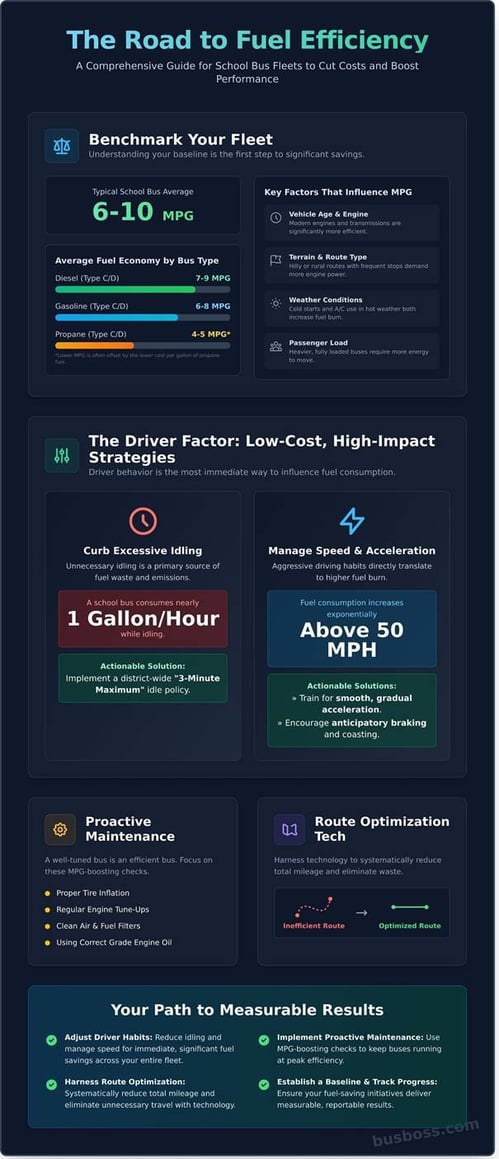
To optimize your fleet's performance, you first need a reliable benchmark. Understanding where your buses stand against national averages is the critical first step in identifying opportunities for improvement and cost savings. While the typical school bus in the United States averages between 6 and 10 miles per gallon (MPG), this figure is not a one-size-fits-all metric. Achieving excellent school bus fuel efficiency depends on a variety of factors unique to your district's operations.
Even a marginal improvement, gaining just half a mile per gallon, can translate into thousands of dollars in fuel savings annually when multiplied across an entire fleet. This process begins with a clear understanding of average performance baselines.
Fuel economy varies significantly based on the bus type (A, C, or D) and the fuel it uses. Modern diesel engines remain the most common and often provide a strong balance of power and efficiency. Below are typical MPG estimates based on data from government and industry sources.
*Note: While propane buses have a lower MPG, the lower cost per gallon of propane often results in significant overall cost savings compared to diesel or gasoline.
Your fleet's specific MPG is influenced by a combination of fixed and variable factors. To accurately assess your performance, you must account for the unique conditions your buses operate under every day. Key variables include:
While route optimization software and vehicle maintenance are foundational pillars of an efficient fleet, the single most immediate and impactful factor in your daily fuel consumption is the person behind the wheel. Empowering your drivers with the right knowledge and habits is a low-cost, high-return investment in your district's operational budget. Focusing on driver behavior is the fastest way to achieve measurable gains in school bus fuel efficiency and reduce operational waste.
Unnecessary idling is one of the most significant sources of fuel waste in any fleet. As a rule of thumb, a typical school bus consumes nearly one gallon of diesel fuel for every hour it idles. Establishing a clear, district-wide policy, such as a '3-minute maximum' idle time, creates a consistent standard. This practice not only cuts fuel costs but also reduces harmful emissions, aligning with the goals of initiatives like the EPA Clean School Bus program. Using GPS and telematics data allows you to pinpoint drivers with high idle times, providing concrete data for supportive coaching and reinforcement.
Aggressive driving habits directly translate to higher fuel burn. Fuel consumption increases exponentially at speeds above 50 mph, making speed management critical. Train drivers to adopt smoother habits:
Modern telematics systems can flag harsh braking and rapid acceleration events, providing objective performance data to guide driver training and improve overall safety while carrying your precious cargo.
To create lasting change, formalize your efforts into a structured program. A successful program transforms fuel-conscious driving from a suggestion into a core part of your operational culture. Key components include:
While route optimization software provides significant fuel savings, what happens on the road is only half the story. A proactive maintenance schedule is a non-negotiable cornerstone of any successful school bus fuel efficiency program. Moving beyond simple repairs, this approach focuses on preventative checks that directly impact MPG, ensuring every vehicle in your fleet operates at peak performance and reduces long-term operational costs.
Underinflated tires are a silent drain on your fuel budget. They increase rolling resistance, forcing the engine to work harder to maintain speed. According to industry data, fuel economy can drop by 1% for every 10 PSI a tire is underinflated. Implementing mandatory, documented pre-trip tire pressure checks for all drivers is a simple, cost-effective policy that delivers immediate returns and enhances vehicle safety.
The engine is the heart of your vehicle, and its health is directly tied to fuel consumption. To manage your fleet with confidence and keep it running efficiently, focus on these critical areas:
Every extra pound a bus carries requires more fuel to transport. Conduct regular audits of your vehicles to remove unnecessary weight, such as old equipment, unused supplies, or accumulated debris. While the impact of roof-mounted items on aerodynamic drag may seem minor, their effect is cumulative over thousands of miles. A lighter, more streamlined bus is fundamentally a more efficient and cost-effective one.
A robust maintenance program transforms fleet management from a reactive expense to a proactive investment. A well-tuned bus is not just more fuel-efficient; it’s a safer, more reliable vehicle for transporting your precious cargo.
While driver training is important, the single most powerful lever for reducing fuel consumption is optimizing where your buses drive, not just how. Manual routing often relies on established paths that seem shortest but are riddled with hidden inefficiencies. Modern route optimization software moves beyond simple distance calculations, analyzing countless variables to build routes that are systematically designed for maximum school bus fuel efficiency. It finds savings opportunities that are simply impossible for the human eye to spot across a complex district.
The core function of routing software is to eliminate wasted mileage. Advanced algorithms analyze every student's stop simultaneously to create the most condensed and logical travel paths possible. This process systematically removes unnecessary backtracking, redundant street travel, and inefficient sequencing. The impact is immediate and significant. For example, cutting just 10 miles per day from a single bus route saves over 1,800 miles annually. Across a mid-sized fleet, this translates into tens of thousands of dollars in direct fuel savings each year.
Fuel isn't only consumed when a bus is moving. Idling-whether waiting to turn or at a bus stop-is a major source of waste. Route optimization software is programmed to minimize these costly delays. It can prioritize right-hand turns to avoid long waits in oncoming traffic, and sequence stops for smoother, more continuous travel. By optimizing student loads and stop placements, the software also reduces the time your buses spend idling while waiting for your precious cargo to board, further enhancing fuel economy.
True optimization is not a one-time event; it's a continuous process of improvement. By integrating real-world GPS data, transportation managers can compare planned routes against the actual paths driven. These "planned vs. actual" reports are invaluable for identifying unauthorized detours or recurring traffic delays that waste fuel. This data-driven feedback loop allows you to constantly refine your routes, ensuring your district achieves and maintains peak operational efficiency.
See how BusBoss software finds hidden fuel savings in your routes.
In transportation management, a core principle holds true, you can't manage what you don't measure. Optimizing routes and training drivers are powerful steps, but without concrete data, their impact remains an assumption rather than a fact. A systematic approach to tracking and reporting transforms your fuel-saving initiatives from anecdotal successes into a data-driven strategy that proves value and justifies future investments.
Before you can demonstrate improvement, you must define your starting point. Calculate your fleet's current average miles per gallon (MPG) and the total fuel expenditure per month. This data becomes the critical benchmark against which all future progress is measured. For more granular insights, segment this data by bus model, age, or route type (e.g., urban vs. rural) to identify specific areas with the greatest potential for improvement.
To gain a comprehensive view of your fleet's performance, focus on a few critical key performance indicators (KPIs). Consistent monitoring of these metrics provides the evidence needed to validate your strategies for improving school bus fuel efficiency.
Data is most powerful when it's shared. Generate clear, concise monthly reports to present to stakeholders and school boards. Showcase the direct cost savings achieved through route optimization, reduced idling, and better driving habits. These reports provide tangible proof of improved school bus fuel efficiency and build a compelling case for further investment in technology. By demonstrating a clear return on investment (ROI), you can more easily secure the budget for advanced tools like the BusBoss routing software that automate and enhance these optimization efforts.
Improving school bus fuel efficiency is not about a single quick fix; it's a comprehensive strategy that yields substantial returns. As we've explored, empowering drivers with fuel-saving techniques and implementing proactive maintenance schedules are critical, low-cost starting points. However, to truly maximize savings and streamline operations, these manual efforts must be amplified by smart technology. This integrated approach forms the foundation of a modern, fiscally responsible transportation department.
For over 25 years, BusBoss has been the trusted partner for school districts seeking to manage their fleets with confidence. Our comprehensive software for routing, GPS, and fleet management is the technology solution that ties everything together, delivering a proven ROI by significantly reducing mileage and slashing fuel costs. Don't just manage your routes-optimize them for peak efficiency and safety.
Discover how much you can save. Request a BusBoss demo today.
Take control of your fuel budget and reinvest those savings where they matter most-in the education and safety of your precious cargo.
The average miles per gallon (MPG) for a conventional diesel school bus typically falls between 6 and 10 MPG. This figure can vary significantly based on the bus's age, engine type, size, and local terrain. Driving habits and frequent stops also play a critical role in actual fuel consumption. Optimizing routes to minimize idling and unnecessary mileage is a key strategy for improving this average and managing operational costs with confidence and precision.
An idling school bus can consume a significant amount of fuel, typically between 0.5 and 1 gallon per hour, depending on the engine size and use of accessories like air conditioning. Over a school year, this adds up to substantial fuel costs and unnecessary emissions. Implementing strict anti-idling policies and using routing software to reduce wait times are direct, effective strategies for transportation departments to cut waste and improve budget efficiency and air quality.
Absolutely. While newer models offer advanced technology, the fuel efficiency of older school buses can be significantly improved through targeted action. Key strategies include meticulous, regular maintenance of the engine and drivetrain, ensuring tires are always properly inflated, and using low-viscosity lubricants. Additionally, implementing driver training programs that focus on smooth acceleration and braking can yield immediate fuel savings. These operational adjustments are cost-effective methods to extend the value of your existing fleet assets.
Using the air conditioning system places a considerable load on the bus's engine, which can reduce fuel economy by as much as 10% to 25%. In hot climates, this can represent a major operational expense. While A/C is often essential for the safety and comfort of your precious cargo, its impact can be managed. Efficient routing that minimizes on-road time and reduces idling periods helps to offset the increased fuel consumption from A/C usage.
Advanced routing software like BusBoss calculates the optimal route by analyzing multiple variables simultaneously. It considers not just the shortest distance, but also factors in traffic data, speed limits, the number of turns (especially left turns), and topographical data to avoid steep inclines. By processing these complex factors, the system identifies routes that minimize mileage, reduce engine strain, and cut down on idling, creating a comprehensive plan for maximum school bus fuel efficiency.
While diesel engines typically offer a higher MPG rating, propane autogas is often significantly less expensive per gallon. This price difference usually results in a lower cost-per-mile for propane buses, despite them consuming more fuel to travel the same distance. The choice often depends on a district's specific goals, factoring in fuel infrastructure, maintenance costs, and emissions reduction targets. Both fuel types benefit enormously from optimized routing to maximize their inherent efficiencies.



 Orbit Software, Inc.
424 King Street
Pottstown, PA 19464

 (484) 941-0820