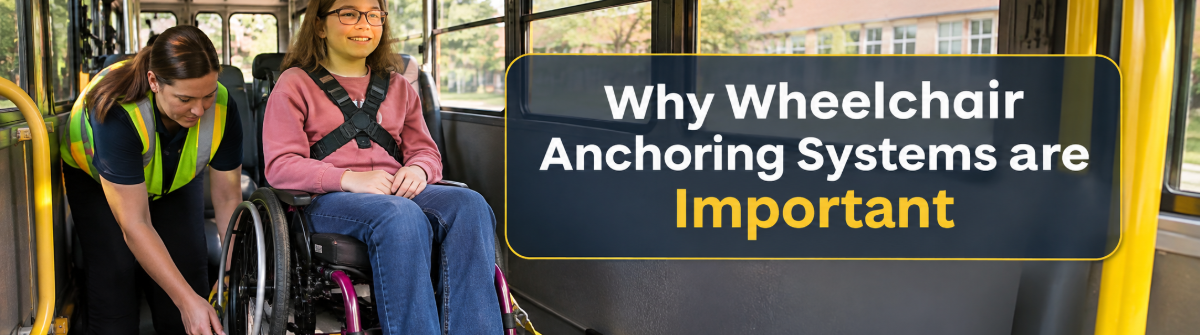
For students who ride in wheelchairs, wheelchair securement is the system the entire ride depends on. The chair must stay in place, and the student must be supported by the proper occupant restraint. Safety research indicates that correctly used equipment can reduce the risk of a wheelchair shifting during sudden braking or a crash.
Securement may receive less attention than other safety measures because it affects fewer students. Yet it carries a significant responsibility for transportation directors. This article covers why securement matters, how the main systems differ, and what districts need to do to keep procedures dependable.
A securement system is only one part of school bus safety. Its effectiveness also depends on correct positioning, equipment compatibility, and staff practice. In special needs transportation, a consistent procedure matters because a student may rely on staff for every step.
Districts may use different equipment across their vehicles. The important point is to understand what each system does, what it requires from staff, and whether it is compatible with the wheelchair being transported.
WC18 and WC19 refer to industry standards relevant to wheelchair travel in motor vehicles. WC18 addresses securement and occupant restraint systems, while WC19 concerns wheelchairs designed and tested for use as seats during vehicle travel. A WC19 wheelchair does not replace the vehicle’s securement system. Districts should verify which standards apply to their equipment and confirm compatibility with manufacturers and relevant state or local requirements.
Reliable school transportation management requires more than buying equipment. Directors need a repeatable process that covers instruction, inspection, records, and standards verification. Each part helps prevent a different kind of breakdown.
Keep the records practical and current. A useful entry identifies the student’s requirements, the equipment needed, and who should be contacted if the plan cannot be followed. Protect the information and share it only with staff who need it to perform their duties.
Securement quality depends on having the right chair on the right vehicle, with staff who know the student’s requirements. Substitutions, spare vehicles, and new staff are common points where a sound procedure can break down. A reminder in a student record is not enough if the substitute bus has different equipment or the staff member has not practiced using it.
School bus dispatch software can help staff review vehicle assignments, but it cannot confirm that a chair is secured correctly. In an urgent change, real-time bus dispatch can help a dispatcher share a revised assignment. The replacement vehicle still needs compatible equipment and a trained crew. School bus fleet coordination should include a way to check both before a change is finalized.
Tools should support, not replace, local procedures. DISPATCHpatrol supports day of assignment changes, while ROUTEpatrol Web and BusBoss Enterprise can support vehicle and route visibility. ROUTEpatrol Tablet App provides route details and can present pertinent student information. STUDENTpatrol, PARENTpatrol, TRIPpatrol, and LiveSYNC can support other information and communication needs. None of these tools replaces a physical securement check.
A districtwide software rollout can help organize records and assignment information, but implementation challenges should be addressed before launch. Decide who updates securement instructions, how staff see current information, and what happens when a vehicle or crew changes.
Use these questions as a self check. Each one points to a practical way to find gaps before they become routine.
Wheelchair anchoring systems are important because they help keep a wheelchair in position and allow the student’s separate restraint to serve its intended purpose. But equipment alone does not create a dependable process. Staff need equipment specific training, regular checks, current student records, and a clear way to verify compatibility when assignments change.
For school transportation directors, the takeaway is straightforward. Treat securement as a documented daily responsibility, not a one time equipment decision. Review your procedures, ask staff to demonstrate them, and close gaps in training, inspection, or records. To see how BusBoss tools can support your broader transportation workflow, schedule a demo.


 Orbit Software, Inc.
424 King Street
Pottstown, PA 19464

 (484) 941-0820