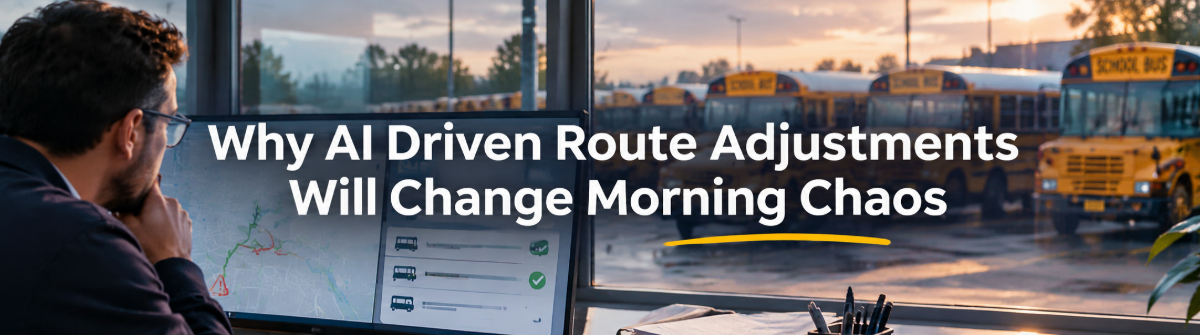
A road closure appears before dawn. A driver calls out. The forecast shifts from light rain to ice. By the time the first buses are preparing to leave, a transportation director may be weighing several changes that affect different schools, drivers, and families.
That is the kind of morning when artificial intelligence can sound like a promise of effortless answers. It is not. The practical value of AI driven route adjustments is narrower and more useful. They can shrink the time between a disruption appearing and a workable option reaching a dispatcher for review.
This article explains what these adjustments can do, what information they rely on, where human judgment remains essential, and how to assess whether your district is ready to use them.
In a school setting, an adjustment is more than a new line on a map. It should account for the affected stops, students, vehicles, and timing, then present options a dispatcher can evaluate.
The goal is not to create an ideal answer in isolation. It is to make reasonable alternatives visible before staff have to build each one from scratch. For a district, stronger route efficiency means an option should account for the effect on the rest of the morning, not just the first bus affected.
The usefulness of a suggestion depends on the information behind it. If core details are missing or out of date, the system may produce an answer that looks tidy but creates extra work in the yard.
These inputs also shape the quality of any estimate. When records and updates are reliable, predictive analytics can help highlight patterns and compare possible responses. When the underlying information is weak, the prediction may simply add confidence to an incorrect assumption.
A system cannot know whether a proposed change will be acceptable to a particular community. It cannot weigh the history between a district and a contractor. It cannot decide which service level to protect when competing needs collide.
Those decisions depend on policy, local knowledge, student needs, and conversations with schools and families. The dispatcher’s judgment stays in the loop by design. AI can surface an option and show its likely operational effects. A qualified person must still decide whether to use it.
This distinction matters when evaluating products. Ask whether staff can review the assumptions and alternatives, not just accept a recommended answer. A useful system supports judgment. It does not hide the tradeoffs behind a score.
Consider the same morning disruption with two different ways of responding. The difference is not that one process removes the dispatcher. It is whether the dispatcher starts with a blank page or a set of options to review.
The point is to reduce avoidable steps, not to promise that every disruption will be resolved instantly. Actual response depends on the quality of the information, the type of event, available vehicles, and district procedures.
BusBoss tools illustrate parts of this workflow. DISPATCHpatrol supports changes such as reassigning a route for a driver absence or an out of service vehicle. The ROUTEpatrol Tablet App gives drivers route information on a tablet. TRIPpatrol can help staff compare planned and actual travel, while PARENTpatrol provides families with bus location updates and notifications. These are operational tools. Their presence does not mean that every adjustment is generated by AI.
Before considering new capabilities, look at how your own operation handles an ordinary disruption. These questions can reveal whether a system will help your team or simply expose gaps in the process.
These questions connect technology decisions to school transportation management. They also help surface implementation challenges early, when the district can address them through training, data cleanup, and a clear review process.
AI driven route adjustments are an enhancement to an operation built on dependable records and clear procedures. They are not a substitute for creating that foundation. Districts are more likely to find value when information is maintained, dispatchers understand how changes are approved, and drivers have a dependable way to receive instructions.
A districtwide software rollout should include the people who will manage and use the process, not just the system configuration. Start with a limited set of common disruptions, test the records and message flow, and review what happened with dispatchers and drivers. Expand only when the team can explain how an option was created and how to correct it when it does not fit.
Tools such as ROUTEpatrol Web support route records and ongoing adjustments. LiveSYNC can keep student information aligned between BusBoss and a district information system. Explore the BusBoss product overview to see how the tools fit together, then assess which functions match your district’s process.
AI driven route adjustments can help shorten the gap between a disruption and a usable response. Their value depends on current records, accurate vehicle details, live positions, and confirmed delivery of approved changes. They can assemble options and identify patterns, but local staff must weigh the tradeoffs and decide what to do.
Start by reviewing how your team handles absences, closures, and delays today. Then assess whether your records and communication steps can support a more responsive process. To discuss how BusBoss tools could fit your district, schedule a demo and bring a disruption scenario your team knows well.



 Orbit Software, Inc.
424 King Street
Pottstown, PA 19464

 (484) 941-0820