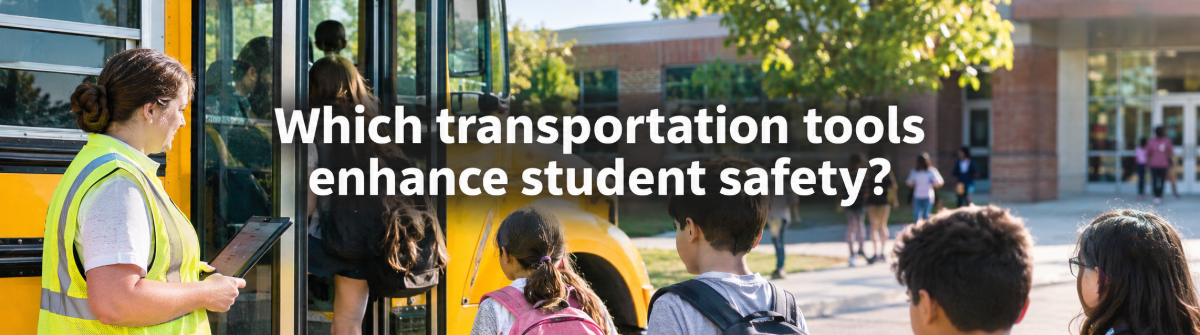
Student safety is often discussed as a feature of one tool. But a bus can follow a carefully designed route, GPS tracking can show its location, ridership tracking can record who is aboard, and school bus communication can send updates, yet the safety outcome depends on whether these records agree when a situation changes.
Each tool answers a different question. Routing asks where students should be and how they can get there safely. Tracking asks where the vehicle is now. Ridership tools ask who is aboard. Communication tells families and schools what is happening. Safety depends on being able to answer all four questions together.
A route can change while the rider list remains unchanged. A bus may be visible on a map but not be the vehicle assigned to that run. A message may describe a trip that dispatch has already replaced. Each mismatch may seem small, but it becomes a safety gap during an incident. A dispatcher needs to know which run is active, which vehicle is serving it, which students are assigned, and which message reached families.
Keeping student and route records current is part of that work. LiveSYNC can keep student and routing information in step between BusBoss and a district student information system. This is one example of how school transportation technology can reduce the chance that staff make a decision from conflicting records.
Run a short exercise with dispatch staff, drivers, and school representatives. Treat it as a real operating check, not a product tour. A small test can reveal whether school bus dispatch software supports real-time bus dispatch while keeping the driver, rider, and family information aligned.
Record whether information updates automatically, who notices a failed update, and how the team confirms the correct record. These checks also help plan a districtwide software rollout and surface implementation challenges before they affect a live run. Clear ownership for each update strengthens school bus fleet coordination and supports reliable school transportation management.
The question is not which tool has the most safety features. Ask whether the four answers stay connected when something goes wrong. Can staff verify the active route, vehicle, student list, and family message from a single incident workflow? Can they see who updated each record and what happens if a device or connection fails?
Review the BusBoss products in the context of your district’s procedures and test the handoffs that matter to your team.
Student safety is supported by more than one tool. Routing, tracking, ridership, and communication each provide a necessary part of the picture. The practical measure is whether all four records match when a bus is delayed, substituted, or rerouted.
Review how your current tools handle those moments, then test the connections with your staff. Schedule a BusBoss demo to see how the tools can support your district’s safety process.


 Orbit Software, Inc.
424 King Street
Pottstown, PA 19464
 (484) 941-0820