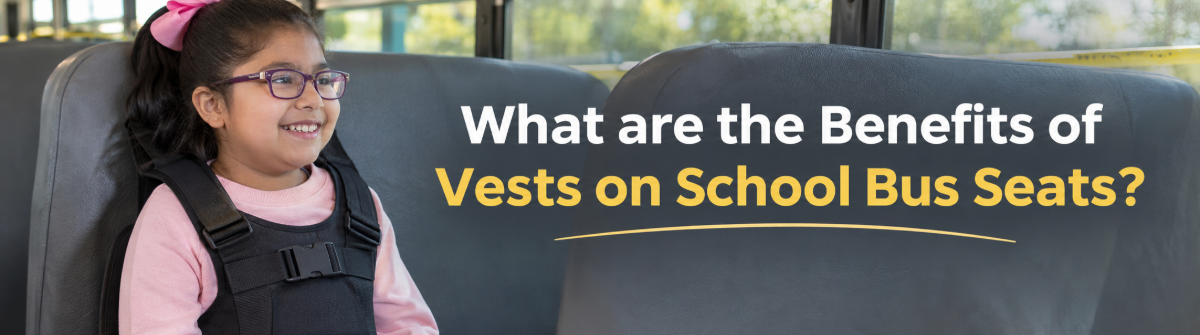
Transportation directors may encounter seat vests when planning rides for younger students or students who need additional postural support. A vest can be one option to consider, but it is not a universal solution or a substitute for proper fit, training, and seat compatibility.
This guide explains what seat vests are, the safety reasoning behind their use, and the practical questions to work through when comparing them with other restraint options. Requirements and appropriate use can vary by student need, vehicle, and state guidance.
A seat vest is a wearable restraint that secures a student’s torso to a bus seat. Depending on the design, it may provide added support for a student who cannot remain safely seated without assistance. Use is generally based on an individual student’s needs, rather than a fleetwide policy.
The vest, seat, anchorage, and student must be considered together. The restraint’s design and correct use matter, so districts should follow the manufacturer’s instructions and applicable state guidance. For student safety, decisions should be made with the appropriate school staff and the student’s support team.
School buses are designed with padded, closely spaced seats that provide compartmentalization. A restraint may change how a student moves and how force travels through the seat during a crash. The National Highway Traffic Safety Administration discusses school bus crash protection and restraint research in its school bus crashworthiness resources. These principles explain possible benefits, not guaranteed outcomes.
A vest is one part of a broader approach that also includes compartmentalization, safe stops, and consistent driver practice.
Choosing a vest requires more than purchasing equipment. Each student and vehicle assignment needs to be reviewed and maintained.
These steps help connect special needs transportation planning with daily practice. A written process also makes it easier for staff to handle substitutions without relying on memory.
Districts may consider compartmentalization alone, lap belts, lap shoulder belts, or vests, depending on the vehicle, route, and student’s needs. Each option interacts differently with the seat and the student. A restraint should not be selected on the assumption that one choice is best for every rider.
The right decision is made for the vehicle and the individual student, with attention to state guidance and manufacturer instructions. A districtwide policy can establish a consistent review process, but it should leave room for individual assessment.
Keep a clear record of which student uses which restraint on which vehicle. This helps staff check assignments when a bus or rider changes, and it matters most when a substitution puts a different driver or aide on the run. The restraint requirement belongs in the student’s support plan, and the assignment record should carry it forward so the substitute arrives knowing what to expect.
For broader school transportation management, ROUTEpatrol Web and DISPATCHpatrol can support daily route and dispatch coordination. LiveSYNC can help keep student information aligned across connected systems. STUDENTpatrol supports student visibility, while PARENTpatrol keeps families informed. These tools can contribute to coordination, but they do not replace restraint instructions or individual support plans.
Restraint selection and use remain decisions for the student’s support team and district procedures. Software can carry the record, but the review of each student’s needs belongs with the people who know that student.
Seat vests may provide restraint or postural supp ort when selected, fitted, installed, and used appropriately. Their value depends on the student, the seat, the equipment, and the staff practices around them. Consider vests alongside other options, verify state guidance, and keep individual assignments documented.
To see how BusBoss supports broader transportation coordination, schedule a demo.


 Orbit Software, Inc.
424 King Street
Pottstown, PA 19464

 (484) 941-0820