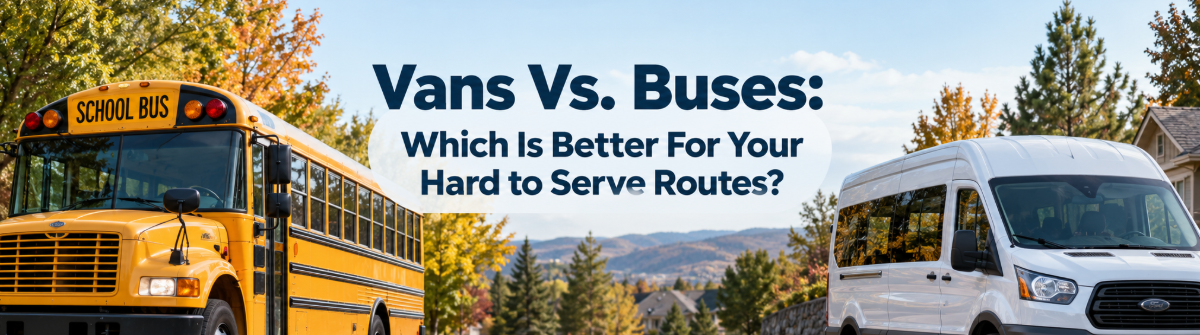
Vans Vs. Buses: Which Is Better For Your Hard to Serve Routes?
A standard school bus can be a poor fit for some roads and neighborhoods. When a route is hard to serve, the usual response may be to accept a difficult fit or assign whichever vehicle and driver are available. Neither approach answers the central question. Which vehicle best serves this route and its riders?
The answer depends on the route, not a districtwide preference for vans or buses. Consider the streets, student density, ride length, rider needs, available drivers, operating costs, and required records. This decision framework can help transportation directors compare options and build a school transportation fleet suited to local conditions.
What makes a route hard to serve
- Street geometry Cul de sacs, dead ends, narrow lanes, and approaches without a legal bus path can make turns or safe stops difficult for a standard bus.
- Surface and season Roads that degrade in mud, snow, or freeze thaw conditions can affect traction, clearance, and the ability to reach a stop reliably.
- Student density Few students spread over many miles can leave a large vehicle underused, while many students in tight streets can make loading and maneuvering difficult.
- Ride duration Long rides test passenger comfort and student behavior, especially when a vehicle has limited space or makes frequent stops.
- Rider needs Door to door service, lifts, tie downs, or a quieter ride may require vehicle features a standard bus does not have.
- Access constraints Weight limits, height clearances, and posted restrictions on specific streets can rule out a vehicle even when it appears to fit.
What a smaller vehicle changes
- Constrained street access A smaller vehicle may fit narrower streets and tighter turns, making it easier to reach specific stops. It does not make a restricted road legal or remove the need to verify safe turning and loading space.
- Driver availability In many cases, a smaller vehicle may be easier to staff. Licensing requirements depend on state rules and vehicle capacity, so verify the exact requirements with the state and the district’s transportation office. A smaller vehicle does not remove screening, training, or other driver qualifications.
- Operating costs Fuel and maintenance costs may be lower for a smaller vehicle, but savings are not guaranteed. Purchase price, mileage, repair needs, staff time, and vehicle utilization all affect the total cost.
- Cabin environment A smaller cabin may provide a quieter ride for some sensitive riders. It does not automatically meet a rider’s support needs or eliminate the need for an aide.
- Individualized service A suitable van can provide door to door service where a full size bus cannot safely stop. That flexibility does not ensure the vehicle has required accessibility features or enough room for passengers and equipment.
What a school bus still does better
- Purpose built protection School buses are built for student transport, with features such as compartmentalized seating, higher seating, and construction standards designed for that use. These features matter when choosing a vehicle for daily student service. Check the vehicle’s specifications and applicable requirements rather than assuming that any bus or van offers equivalent protection. NHTSA provides school bus regulations guidance.
- Capacity A bus can carry more students in one trip. When riders are concentrated along a route, its capacity can reduce the number of vehicles and separate trips required.
- Visibility and signage A marked school bus is recognizable to other road users. This can be a deciding factor when students board and exit at public stops, though visibility does not replace safe stop selection or driver procedures.
- Daily durability A school bus is designed for regular school service. If a route operates every school day and carries a group of students, that intended use can weigh in favor of a bus over a vehicle designed for general passenger travel.
The decision inputs for each route
Answer these questions for the specific route. Keep the responses tied to its actual roads, riders, and schedules.
- Can the street network legally and safely carry the vehicle? Check road restrictions, clearances, turning space, surfaces, and safe loading locations. If a full size bus cannot travel the route legally and safely, consider an eligible smaller vehicle or a different stop location.
- How many students travel, and how concentrated are they? A larger group boarding near one another may point toward a bus. A small number of widely separated students may support a smaller vehicle if the additional mileage and staff time remain reasonable.
- What do riders need from the vehicle itself? Document access, seating, securement, equipment, supervision, and ride comfort needs. The best fit is the vehicle that can meet those needs consistently, not simply the one that can reach the address.
- Who is available to drive it, and under what licensing rules? Confirm local licensing and endorsement requirements for the vehicle and driver. If the district cannot staff a vehicle reliably, its theoretical advantages may not translate into dependable service.
- What does each option cost to run? Compare fuel, maintenance, staff time, aides, mileage, and the effect of extra trips. A smaller vehicle may cost less per mile but more per student if it carries very few riders.
- What records must the route produce? Identify the information needed for assignments, stops, rider accommodations, service reviews, and district reporting. Choose a vehicle and process that can produce and maintain those records accurately.
The hybrid reality
Most districts have a mix of vehicle types, and a mixed fleet is often the practical result of applying these questions across different routes. The management challenge then becomes maintaining a clear record of what each vehicle can serve. A route record should reflect vehicle size, capacity, access limits, and accessibility features.
Strong school bus fleet coordination supports school transportation management by connecting those vehicle details to route and rider assignments. Without that link, a route may look workable on paper but be assigned to a vehicle that cannot serve it.
How software supports the decision
- Maintain vehicle attributes Record capacity, accessibility features, and other limits for each vehicle. ROUTEpatrol Web can help staff work with route and student information while testing whether assignments reflect the vehicles available.
- Test before committing Compare vehicle choices against a route before changing the regular assignment. The tools in BusBoss Enterprise support route review with GPS information, helping staff compare scheduled and actual travel. This makes vehicle routing decisions more grounded in local conditions.
- Track cost by route and vehicle Compare mileage, estimated fuel use, maintenance, and staff time to make tradeoffs visible. FLEETpatrol supports fleet maintenance records, which can inform the maintenance portion of a cost review.
- Keep rider and stop records together Maintain the assignment and the service details staff need. LiveSYNC can transfer information between BusBoss and a district student information system. STUDENTpatrol and PARENTpatrol can support rider and family visibility, while TRIPpatrol provides GPS information for reviewing vehicle travel.
A district using school bus dispatch software can connect planned vehicle assignments with daily dispatch decisions. With real-time bus dispatch, staff can make informed assignments when an available vehicle changes, provided its attributes and the route record are current. A districtwide software rollout should include staff training and clear ownership of vehicle data. These steps can reduce implementation challenges and support consistent school bus fleet coordination. DISPATCHpatrol and the ROUTEpatrol Tablet App can help communicate route information to dispatchers and drivers.
Summary and next step
The best answer to van vs bus is not one vehicle for every route. A bus may be the better fit when passenger capacity, purpose built protection, and daily durability matter most. A smaller vehicle may be appropriate when road access, low density, or individualized service makes a bus impractical, as long as it meets local requirements and rider needs.
Use the route’s actual conditions to make the decision, then review the assignment as ridership, roads, costs, and vehicle availability change. For a closer look at how BusBoss supports route and vehicle records, schedule a demo.



 Orbit Software, Inc.

 (484) 941-0820