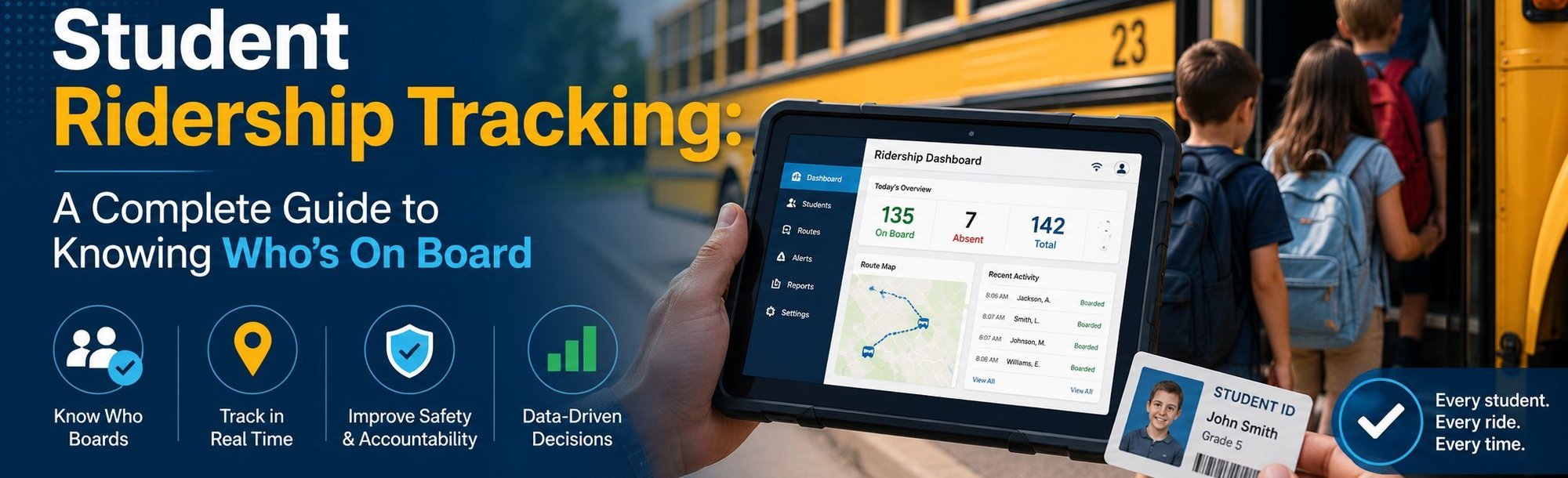
The morning bell rings, and the buses pull away. For many transportation coordinators, however, that’s when the real uncertainty begins. Frantic parent phone calls, inaccurate headcounts for state reporting, and the constant worry of a child on the wrong bus-these daily anxieties highlight a critical need for a better system. Without effective student ridership tracking, managing the safety of your precious cargo can feel like a constant challenge, leaving your team reacting to problems instead of preventing them.
Fortunately, modern technology provides a definitive solution. A robust tracking system offers more than just a simple scan-on, scan-off process; it delivers the real-time visibility and accurate data needed to manage your fleet with absolute confidence. It’s about replacing guesswork with certainty and providing peace of mind for administrators, drivers, and parents alike. In this complete guide, you will discover how to leverage this essential technology to confirm every student is on the correct bus, streamline communication, and build a safer, more efficient transportation system for your entire district.
In school transportation, the stakes are incredibly high. The core mission is to ensure every student arrives at school and returns home safely, every single day. For decades, districts relied on paper rosters and manual headcounts, but these traditional methods are no longer adequate for the complexities and safety demands of modern operations. Every child on board is precious cargo, and ensuring they are accounted for requires a system built on accuracy, visibility, and immediate communication. This is where modern student ridership tracking becomes an essential tool for risk management.
The high-stakes nature of student transportation means there is no room for error. A single mistake-a child getting on the wrong bus or getting off at the wrong stop-can have serious consequences. Furthermore, today's connected parents expect a higher level of transparency and communication than ever before. Accurate ridership data is also critical during emergencies, providing first responders with an exact manifest of who was on a specific bus at a specific time.
Relying on clipboards and radio check-ins creates significant operational gaps and safety risks. These outdated processes are not just inefficient; they are prone to errors that can have serious consequences. When a parent calls asking, "Is my child on the bus?", a manual system can only provide a guess, not a definitive answer.
Implementing an accurate system shifts a district's transportation department from a reactive to a proactive model. The evolution of school transportation technology addresses these challenges directly. Just as the integration of GPS tracking devices on school buses revolutionized fleet management, ridership tracking provides granular, real-time data on the students themselves. This transition delivers confidence and security to everyone involved in a student's daily journey.
At its heart, a student ridership tracking system operates on three core components: a unique student identifier (like an ID card), an on-bus scanning device, and a central software platform. The process is straightforward and powerful. As a student boards or exits the bus, they present their identifier to the scanner. This action creates a secure digital record-capturing who, when, and where, which is instantly transmitted to the transportation department's dashboard. This provides administrators with a real-time, accurate log of every student's location within the transit system.
While the goal is universal, school districts can choose from several identification technologies, each with distinct advantages for managing their precious cargo safely and efficiently.
This is the most common and reliable method for K-12 transportation. Students carry a durable card containing a passive Radio-Frequency Identification (RFID) or Near Field Communication (NFC) chip. A simple tap on the on-bus reader is all that is needed to log the event. Because the cards are passive, they require no battery and are extremely durable. The primary benefits are speed and accuracy, allowing students to board quickly and keep routes on schedule. The main consideration is the cost associated with issuing and replacing lost cards.
A highly cost-effective alternative, this method utilizes QR codes or barcodes printed directly onto existing student ID cards or displayed within a mobile app. On-bus scanners or tablets with cameras read the code to log the student's ridership status. While the low implementation cost is a major advantage, this method can be slower than RFID and requires a clear line-of-sight. Worn or damaged codes can also cause scanning errors. The data from these scans is what powers modern parent-facing tools, such as the NYC School Bus App, which sends real-time alerts when a student boards or exits their bus.
For maximum flexibility and as a reliable failsafe, many systems include a manual check-in option. Using a tablet, the bus driver or an aide can manually select students from a digital roster as they board. These systems often display student photos for positive visual confirmation, adding another layer of security. This method integrates perfectly with driver-facing routing apps and serves as an indispensable backup when a student forgets their ID or an automated scanner is unavailable.
Ultimately, what unifies all these methods is the integration of GPS. Every scan or manual entry is instantly timestamped and geotagged with the bus's precise location. This fusion of data provides the critical context of where each event occurred, creating an indisputable digital record essential for modern student ridership tracking and ensuring accountability from stop to school and back again.
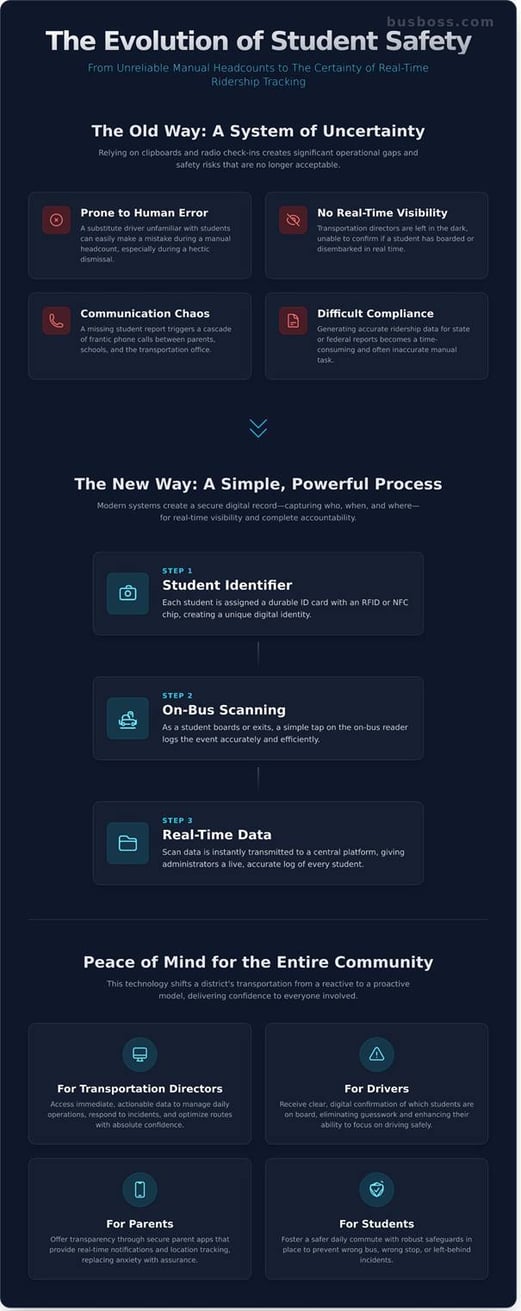
While ensuring student safety is the primary driver for adopting a student ridership tracking system, its true power is realized when the benefits extend to your budget and daily operations. When ridership data is integrated directly with your routing software, it transforms from a simple log into a strategic asset. This integration creates a seamless communication channel between your office, drivers, and parents, fostering confidence and unlocking new efficiencies across your entire transportation department.
Knowing exactly which students are on which bus at any given moment provides an unparalleled level of security. An integrated system creates a complete digital audit trail, logging every scan as students board and disembark. This real-time visibility is critical for managing daily transport and indispensable during an emergency.
See how BusBoss puts safety first. Request a Live Demo.
A modern ridership system streamlines countless administrative tasks and improves communication. By providing parents with real-time information through dedicated apps, you can drastically reduce the volume of inbound calls asking, "Where's the bus?" The system used for Orange County Public Schools ridership tracking, for example, gives parents GPS-based bus locations and notifications, proactively answering their most common questions. This allows your team to focus on managing routes with confidence instead of fielding constant inquiries.
Accurate data is the foundation of a financially sound transportation department. A robust student ridership tracking system provides the hard numbers needed to justify budgets, maximize funding, and negotiate from a position of strength. Vague estimates are replaced with verifiable metrics, ensuring you receive every dollar you are entitled to.
When evaluating a student ridership tracking system, it's critical to look beyond the basic promise of tracking and focus on features that solve real-world transportation challenges. Not all solutions are created equal. The most effective systems are those that provide actionable information, enhance safety protocols, and streamline daily operations for every stakeholder involved, from administrators in the office to parents at the bus stop.
Prioritize a solution that offers seamless integration with your existing technology stack and provides a user-friendly experience for staff, drivers, and families. The goal is to create a single, reliable source of truth that boosts efficiency and gives you complete confidence in the safety of your precious cargo.
Visibility is the cornerstone of effective transportation management. A powerful system provides a centralized command center where your team can monitor operations with confidence. Key dashboard features should include:
Manual data entry is inefficient and a common source of errors. A top-tier ridership tracking solution must integrate directly with your core systems. This capability ensures data integrity by automatically syncing with your routing software for the most up-to-date stop assignments and pulling student information directly from your Student Information System (SIS). This creates a unified ecosystem, eliminating data silos and providing accurate, reliable information across your entire department.
Effective communication is essential for a safe and smooth-running operation. Look for a system that includes dedicated mobile apps for parents and drivers. A parent-facing app, like PARENTpatrol, delivers peace of mind with push notifications for bus arrivals and delays. A driver-facing app, such as ROUTEpatrol, empowers drivers by showing a list of expected riders at each stop, complete with student photos for visual confirmation, ensuring the right student gets on the right bus every time.
Adopting a new system for student ridership tracking is a significant step toward enhancing safety and operational efficiency. However, a successful rollout depends on a methodical plan that goes beyond the technology itself. A strategic approach ensures smooth adoption, builds confidence among all stakeholders, and maximizes your return on investment from day one. Following a clear checklist transforms a complex project into a manageable process.
The foundation of a successful implementation is laid long before the first scanner is installed on a bus. Proactive planning prevents common roadblocks and aligns your entire team on the project’s goals, ensuring your district is ready for a seamless transition.
Clear and consistent communication is critical for gaining buy-in from parents, drivers, and staff. By addressing concerns proactively and highlighting the benefits for your precious cargo, you can build the trust and cooperation needed for a smooth launch.
A phased rollout minimizes disruption and allows for real-world adjustments. Your commitment to the system’s success must extend beyond the initial launch, supported by a reliable technology partner who understands the unique demands of school transportation.
Implementing a comprehensive student ridership solution is a multifaceted project, but you don't have to navigate it alone. Choosing a partner like BusBoss with proven experience in guiding districts through this process is key to a seamless transition. Let our experts guide your implementation. Talk to a BusBoss specialist.
Moving beyond manual headcounts is no longer a luxury-it’s a foundational requirement for a safe and efficient school transportation department. As we've explored, the right technology provides real-time visibility into who is on board, streamlines complex state reporting, and gives parents and administrators invaluable peace of mind. Implementing a robust student ridership tracking solution is a critical investment in your district’s operational excellence and, most importantly, in student safety.
Choosing the right partner is as crucial as the technology itself. With over 25 years of dedicated experience in student transportation, BusBoss delivers more than just software. We provide a comprehensive, fully integrated solution combining routing, GPS, and ridership, all backed by dedicated support from initial implementation to your daily operations. We are committed to your success every step of the way.
Ready to see how it works? Request a Live Demo to see how BusBoss ensures your precious cargo is always accounted for. Take the definitive step toward unparalleled safety and accountability for your district today.
Our systems are designed with contingencies to ensure student safety is never compromised. If a student forgets or loses their card, the bus driver can manually log their boarding and alighting using the onboard tablet interface. This action is immediately recorded in the system. The transportation office can then quickly issue a temporary pass or a permanent replacement card, ensuring a seamless and secure process with no disruption to daily transportation management and accountability.
Protecting your students' data is our highest priority. All information is secured using advanced encryption, both during transmission and when stored on our servers. Access to sensitive data is strictly controlled and limited to authorized personnel, in full compliance with privacy regulations like the Family Educational Rights and Privacy Act (FERPA). We implement robust security protocols to ensure that the information of your precious cargo remains confidential and secure at all times.
No, these systems are designed exclusively for managing and securing school transportation. The RFID readers and GPS tracking hardware are installed only on school buses. The system’s function is to log when a student boards or exits a specific bus at a designated stop or school location. It does not monitor or track student movements within the school building, ensuring the scope of tracking is strictly limited to the journey to and from school.
The cost to implement a student ridership tracking system is tailored to the unique needs of each district. Key factors include the total number of buses, the number of students requiring RFID cards, and selected software features. We work with you to build a cost-effective package that meets your safety and efficiency goals. For a precise quote, we recommend contacting our team for a personalized consultation based on your district’s specific requirements.
Driver training is straightforward and designed for rapid adoption with minimal disruption. The onboard system is highly intuitive, with most of the process being automated as students scan their cards. Our comprehensive training program typically requires only a few hours to ensure drivers are confident and proficient. The focus is on ensuring ease of use, so drivers can remain focused on their primary responsibility, safely transporting students to their destination.
Yes, our system ensures complete reliability, even in areas with limited or no cellular service. The onboard hardware is equipped with "store and forward" technology. This means all scan and location data is securely stored locally on the device. Once the bus re-enters an area with a cellular or Wi-Fi connection, such as the bus depot, the stored data automatically syncs with the central server. This guarantees that no critical student ridership tracking information is ever lost.


 Orbit Software, Inc.
424 King Street
Pottstown, PA 19464
 (484) 941-0820