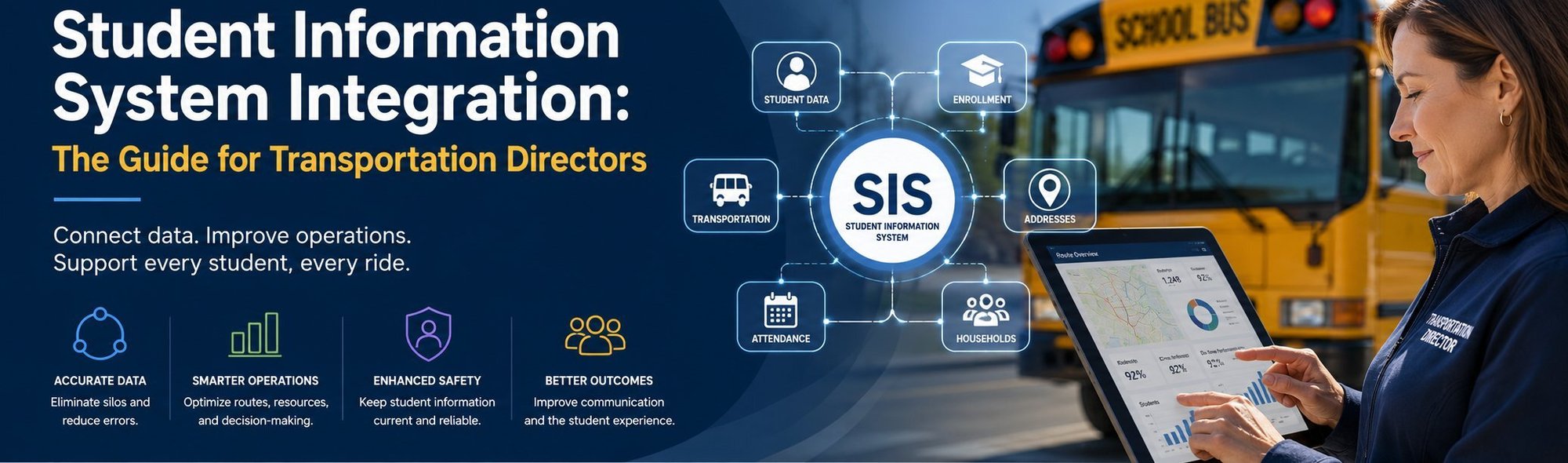
An incorrect student address isn't just a routing headache; it's a critical safety risk for the precious cargo you manage daily. The endless cycle of manual data entry, inconsistent information across platforms, and the constant fear of a typo leading to a missed stop is a heavy burden for any transportation department. What if you could eliminate these errors and manage your routes with complete confidence? The key lies in effective student information system integration, a powerful solution that connects your core student data directly to your routing and transportation management software.
In this guide, we'll show you exactly how this integration works to your advantage. You will discover how to establish a single source of truth that eliminates data discrepancies, automates updates for student information, and enhances overall student safety. We will walk through the steps to streamline your daily operations, improve the accuracy of your bus routes, and simplify the complex process of state reporting. Get ready to transform your department's efficiency and ensure every student's journey is a safe one.
In school district operations, the Student Information System (SIS) is the central command center, housing every critical piece of student data from enrollment to emergency contacts. But when this system operates in a silo, disconnected from other essential software, it creates significant operational friction and safety risks. For those seeking a foundational understanding, this overview explains What is a Student Information System? in greater detail. True student information system integration bridges this gap by creating a seamless, automated connection between your SIS and your transportation software. This transforms a static database into a dynamic, real-time source of truth, ensuring the right student is at the right stop, every single time.
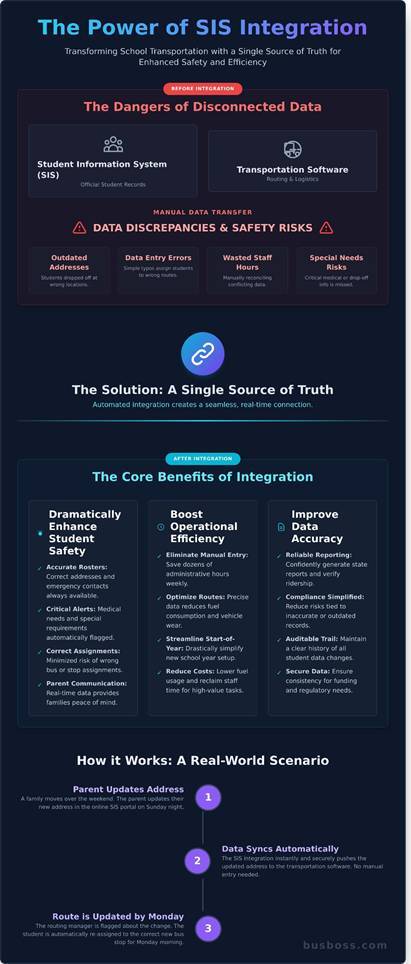
Without integration, transportation departments are often forced to rely on manual data exports and imports. This outdated process is not just inefficient; it's a direct threat to student safety. Every manual step introduces the possibility of human error, leading to dangerous discrepancies between what the school knows and what the bus driver sees. The risks are substantial:
Effective student information system integration eliminates these risks by establishing the SIS as the single, authoritative source of data. When a student's information is updated in the SIS-whether by an administrator or a parent in an online portal-that change is automatically and instantly pushed to your BusBoss routing software. Imagine a family moves over the weekend. The parent updates their address in the SIS on Sunday night. By Monday morning, your transportation software has already received the update, re-assigned the student to the correct new bus stop, and flagged the change for your routing manager. This isn't just about efficiency; it's about upholding your duty of care. By ensuring data is always accurate and up-to-date, you can manage your routes with confidence, knowing your most precious cargo is protected.
Moving beyond abstract concepts, a successful student information system integration delivers tangible, daily improvements that resonate throughout your district. When your transportation software communicates seamlessly with your SIS, you create a unified data ecosystem. This connection is the foundation for transformative gains in safety, efficiency, and data accuracy, impacting everyone from transportation directors and administrative staff to drivers and parents.
The safety of your precious cargo is non-negotiable. Integration ensures that the most critical, up-to-date student information is always in the hands of your transportation team. This direct data link significantly reduces the risks associated with manual data transfer errors.
Your team's time is a valuable resource. By eliminating redundant data management tasks, a proper student information system integration frees your staff to focus on high-value activities like route optimization and strategic planning. This shift from data entry to data analysis drives significant operational improvements.
Accurate data is the bedrock of state reporting, funding applications, and regulatory compliance. An integrated system establishes a single source of truth, ensuring consistency and simplifying audits. This creates a clear, auditable trail of all student data changes, which is essential for maintaining robust student data security and accountability. With reliable data, your district can confidently generate state transportation reports, verify ridership for reimbursement, and reduce the compliance risks tied to outdated or inaccurate records.
Connecting your transportation software to your SIS might sound technically complex, but modern solutions are designed to make the process secure, reliable, and straightforward. The goal of a successful student information system integration is to create a seamless flow of essential data, eliminating manual entry and ensuring your routing plans are always based on the most current information. This immediate data availability is a key advantage, echoing the findings from the U.S. Department of Education on SIS benefits, which highlight improved data quality and reduced administrative burdens for districts.
The connection between your systems is typically established using one of two primary methods, each suited for different operational needs. Understanding these options helps you choose the right approach for your district.
These methods can be configured for a one-way sync, where data only flows from the SIS to the transportation software, or a more complex two-way sync where information can also be sent back to the SIS. For most transportation needs, a one-way sync is the most efficient and common solution.
Protecting student privacy is paramount. A professional student information system integration only shares the specific data points required for safe and efficient transportation planning. Your district maintains full control over what information is exchanged.
Key data points typically include:
To protect this sensitive information, your precious cargo, robust security measures are essential. All data is encrypted both during transfer (in-transit) and when stored (at-rest), making it unreadable to unauthorized parties. Furthermore, role-based access controls ensure that staff members can only view the information necessary for their specific duties. Reputable vendors are fully compliant with federal regulations like FERPA, providing you with the confidence that your student data is always managed responsibly.
Selecting transportation software is more than a technical decision; it’s the beginning of a long-term partnership. The success of your student information system integration hinges on your vendor's expertise, support, and commitment. A reliable partner ensures your systems work in harmony, providing accurate data that keeps your operations efficient and your students safe. Use this checklist to evaluate potential vendors and choose a partner you can trust to manage your district’s most precious cargo.
True integration is more than a simple data transfer. Demand a platform built for deep, reliable connectivity. Look for these non-negotiable features:
Arm your team with the right questions to uncover a vendor’s true capabilities and service philosophy. A confident partner will have direct, transparent answers.
A premier student information system integration is a well-managed project, not a transaction. A trustworthy partner will provide a clear project timeline from discovery to go-live, led by a dedicated project manager who understands your district's goals. This relationship must extend beyond launch, with ongoing maintenance, updates, and responsive support to ensure your system runs optimally for years to come. The goal is a seamless partnership that lets you focus on what matters most, student safety and operational excellence. See how BusBoss makes integration seamless. Request a Live Demo.
As we've explored, connecting your transportation software with your SIS is a foundational element of a modern, safe, and efficient school district. By automating critical data flow, you eliminate manual errors, ensure up-to-the-minute route accuracy, and gain a comprehensive, real-time view of your students. This strategic move empowers your team to focus less on administrative tasks and more on what truly matters, protecting your precious cargo.
Choosing the right partner is paramount. With over 25 years of experience dedicated to student transportation, BusBoss provides a proven solution. Our dedicated implementation and support teams ensure a smooth transition, and our software is fully compatible with leading platforms like PowerSchool, Skyward, and more. A successful student information system integration is within your reach, and we are here to guide you every step of the way.
Ready to see how this powerful connection can transform your operations? Request a Live Demo to see our seamless SIS integration in action. Take control of your data and drive your district forward with confidence.
Our team has extensive experience integrating with a wide range of SIS platforms. The most common systems we work with include industry leaders like PowerSchool, Skyward, Infinite Campus, and Aeries. Our flexible integration architecture is designed to be compatible with nearly any modern SIS that provides API access or secure data export capabilities. This ensures a seamless and reliable connection, giving you confidence in your data's accuracy and the safety of your precious cargo.
A typical integration project is completed within 4 to 8 weeks. This timeline includes initial discovery and planning, technical setup, comprehensive data mapping, and rigorous testing before the final go-live date. The exact duration depends on the complexity of your district’s data and the level of customization required. Our methodical process ensures every step is handled with precision to guarantee a smooth and successful deployment, minimizing disruption to your transportation operations.
Our system is built for reliability and includes robust error-handling protocols. In the rare event of a data sync error, our software automatically generates an alert and a detailed log for our support team to review immediately. We proactively investigate the root cause, whether it’s a data formatting issue or a connection problem, and work swiftly with your IT department to resolve it. This ensures data integrity is maintained and your operations continue to run smoothly and efficiently.
Absolutely. A key benefit of our student information system integration is its flexibility. During the setup process, we work directly with your team to map out precisely which data fields are most critical for your transportation department. You can choose to sync essential information such as student names, addresses, and grade levels, while also including specialized fields like special needs indicators or alternate addresses. This customization ensures you have the exact data you need to optimize routes safely.
Accurate reporting is a primary benefit of direct SIS integration. By ensuring your transportation software always has the most current student ridership data, you can generate precise reports for state and federal requirements with confidence. This includes auditable records for bell times, student counts, and mileage, which are often critical for securing state funding. This automation streamlines the reporting process, saving significant administrative time and reducing the risk of costly manual errors.
The primary difference lies in the direction of data flow. A one-way integration sends data from your SIS to the transportation software, which is ideal for keeping student rosters and addresses automatically updated. A two-way integration allows data to flow in both directions. For example, after a route is assigned in our software, it can update the student’s record back in the SIS. This creates a single source of truth and streamlines communication across departments.


 Orbit Software, Inc.
424 King Street
Pottstown, PA 19464
 (484) 941-0820