
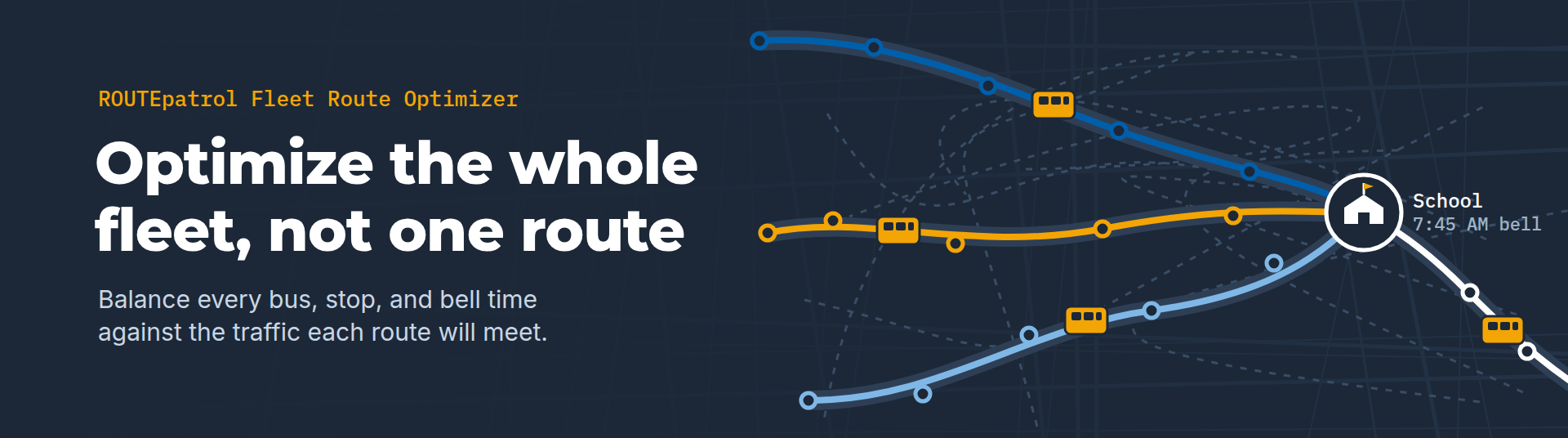
Smarter school bus routing is coming
Mapbox Traffic 2.0 brings predictive traffic intelligence to route planning. ROUTEpatrol Web can now account for where traffic will be when the bus gets there, not only where it is now.
- 2.5 hoursTraffic forecast window ahead of a trip
- 98%Share of trips with an accurate ETA, per Mapbox
- ~1 minuteLatency from a real speed change to an updated ETA
School bus routing has long relied on distance, road networks, posted speeds, and scheduled travel times. Your team knows the shortest route on a map is not always the fastest or most reliable one at 7:15 on a Monday morning.
That is why a new release from Mapbox has our attention. Mapbox Traffic 2.0 is its next-generation traffic engine. New AI models deliver more accurate arrival predictions, more precise congestion data, and forecasts of traffic conditions ahead of a vehicle's trip.
For school transportation, these capabilities could make traffic-aware routing far more useful.
From traffic data to predictive routing
The real opportunity is not seeing that a road is congested. It is knowing what traffic will look like when the bus actually reaches that road.
Traffic 2.0 forecasts conditions up to 2.5 hours ahead. Its models learn by comparing estimated arrival times with actual trip completion times.
Take a bus that leaves the depot at 6:15 AM and reaches a busy corridor at 7:05 AM. Traffic at 6:15 may look normal. Historical patterns may show the corridor routinely backs up by 7:00.
What this could mean for ROUTEpatrol
ROUTEpatrol already runs on Mapbox technology. That puts us in a strong position to bring Traffic 2.0 into route analysis and optimization, including:
- Historical traffic patterns that flag roads that routinely slow down during school transportation hours.
- Predictive traffic conditions that estimate congestion based on when the bus reaches each part of its route.
- More accurate travel-time estimates for planned routes.
- More precise congestion data, tied to specific maneuvers instead of treating a whole roadway as equally slow.
- Faster recognition of change when actual road speeds drift from expected conditions.
The goal is not the shortest route. It is routes that are more realistic, more predictable, and better matched to what your buses face every morning and afternoon.
Why historical traffic matters for school buses
School buses run on tightly structured schedules. A bus does not travel a route at a random time. It may cover the same streets at about 6:45 AM every school day. That makes historical traffic patterns extremely valuable.
Two routes, one 7:00 AM window
Route A uses normal road speeds. Route B reflects typical 7:00 AM traffic.
Distance-based optimization might pick Route A. Traffic-aware optimization could recognize that Route B is slightly longer but historically faster and more reliable during the actual morning window.
That helps your team make better routing decisions before buses leave the yard.
More accurate ETAs
Mapbox reports that Traffic 2.0 produces accurate ETAs for 98% of trips. Its models continuously compare predicted travel times with actual arrival times. Better travel-time predictions could improve several parts of your operation:
Route planning
Build schedules around realistic drive times.
Stop timing
Stop arrival estimates reflect expected road conditions.
Dispatch
See sooner when traffic is affecting a route.
Parent communication
Better travel-time data supports better bus arrival expectations.
Congestion is more than "red means slow"
Traffic 2.0 can separate congestion by roadway maneuver. A backup at a highway exit may slow vehicles taking the exit while barely affecting vehicles going straight.
For buses working through complex intersections, highway exits, and busy corridors, that precision means a more realistic picture of travel time.
Traffic intelligence that responds faster
Historical patterns matter, but traffic does not always follow history. Crashes happen. Construction shifts. Weather changes travel. Unexpected congestion builds.
Mapbox says Traffic 2.0 absorbs new speed signals within seconds, with latency from a real-world speed change to an updated ETA as low as one minute.
Instead of treating traffic as one static variable, routing technology can treat it as something that changes across the route and throughout the day.
The question routing has always answered
What's the best way to connect these students, stops, schools, and buses?
The question traffic intelligence adds
What's the best route given the conditions the bus will likely meet at the exact time it travels?
At BusBoss, we are implementing all of these Mapbox capabilities to strengthen ROUTEpatrol and our broader Student Safety Technology Stack.
Our objective has not changed: give transportation professionals better information and better tools to run safe, efficient, reliable operations. Traffic 2.0 is a valuable new source of intelligence to get there.
We're looking forward to putting it to work for you.
Source: Mapbox, "Announcing Mapbox Traffic 2.0" and BUILD with Mapbox 2026 announcements. Performance figures are as reported by Mapbox.



 (484) 941-0820