Navigating the world of school bus safety technology can feel overwhelming. As a district administrator or transportation coordinator, you are entrusted with the immense responsibility of protecting your community's most precious cargo. The pressure to choose the right solutions, while justifying costs and managing complex implementation, is constant. How can you be confident that your investment will truly enhance student security and provide peace of mind for parents and staff?
This comprehensive guide for 2026 is designed to be your trusted roadmap. We will break down the essential technologies, from on-board cameras and collision avoidance systems to intelligent routing software and student ridership tracking. You will gain a clear understanding of how each solution works, what to look for when evaluating vendors, and how to build a powerful, integrated safety ecosystem for your fleet. Our goal is to empower you to make an informed decision with confidence, improve operational efficiency, and ensure every student’s journey is as safe as possible.
For decades, the foundation of student transportation safety has been passive: the iconic yellow color, reinforced steel construction, and high-backed seats designed for protection. While the iconic bus has a long and proven track record, as detailed in the extensive school bus safety history, today’s challenges demand a more active approach. Driven by rising parent expectations for real-time data and a push for greater accountability, the industry is shifting toward a proactive safety model. The goal is no longer just to protect students during a collision but to create a 360-degree safety ecosystem that safeguards our precious cargo at every step of their journey.
This evolution leverages modern school bus safety technology to mitigate persistent risks, from illegal stop-arm passing to on-board bullying. By integrating smart solutions, transportation departments can gain unprecedented visibility and control. This shift is further accelerated by federal and state regulations that increasingly encourage or mandate the adoption of advanced safety systems, transforming how districts manage and optimize student transportation with confidence.
To build a comprehensive safety strategy, it is critical to identify the primary points of vulnerability. Technology provides targeted solutions for each of these high-risk areas:
The most significant impact of school bus safety technology is the transition from a reactive to a proactive safety culture. Instead of simply reviewing footage after an incident occurs, districts can now use data to prevent them. By analyzing trends from GPS tracking, telematics, and camera systems, administrators can identify high-risk bus stops, address recurring behavioral issues, and optimize routes for maximum safety. This flow of real-time information empowers drivers and transportation managers to make immediate, data-driven decisions, turning every bus into a managed, secure environment.
While much of the focus is on the bus's journey, the environment inside the vehicle is equally critical for protecting your district’s precious cargo. Modern on-board school bus safety technology transforms the bus interior into a secure, transparent, and manageable space. These systems provide a new level of accountability for both students and drivers, ensuring that every trip is as safe as possible from the moment a student steps on board until they reach their destination.
High-definition camera systems are a cornerstone of interior bus safety. They act as a powerful deterrent against bullying, vandalism, and other behavioral issues by creating an environment of accountability. When incidents do occur, the recorded footage provides clear, impartial evidence, allowing administrators to resolve disputes quickly and fairly. Furthermore, these systems help ensure drivers adhere to district policies and federal school bus safety regulations, offering valuable insights for performance reviews and training.
Knowing who is on the bus and where they are supposed to be is fundamental to student safety. Ridership tracking systems, often using RFID cards or mobile apps, automate this process with precision. This technology provides confidence by:
The safest drivers are skilled, aware, and continuously improving. On-board driver monitoring systems use telematics to track key performance metrics like speeding, harsh braking, and rapid acceleration. This isn't about surveillance; it's about empowerment. The system provides real-time feedback to drivers and flags patterns of risky behavior for transportation managers. This data enables targeted coaching and training, proactively enhancing driver skills and reinforcing safe operating habits across the entire fleet.
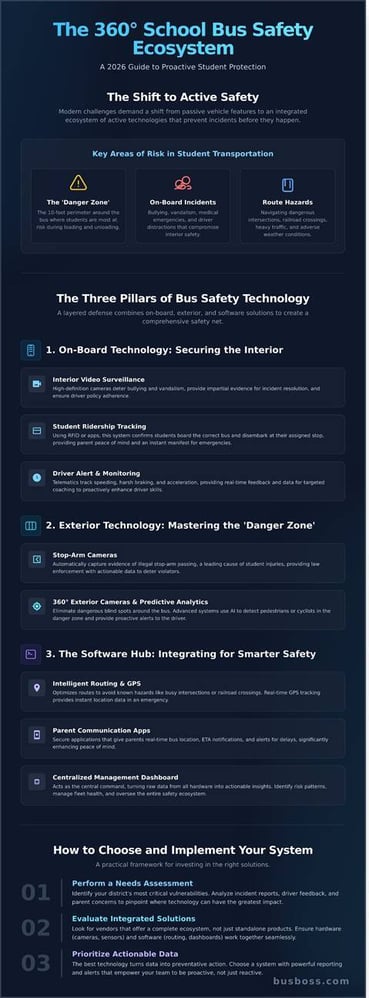
The 10-foot perimeter around a school bus, known as the "danger zone," is where children are most vulnerable. The critical moments of loading and unloading demand the highest level of situational awareness from drivers and respect from other motorists. Modern school bus safety technology provides a powerful suite of tools designed specifically to master this environment, protecting students by enhancing driver visibility, alerting nearby pedestrians, and holding other motorists accountable for unsafe behavior. These systems work in concert to create a secure perimeter, ensuring our precious cargo is safe from curb to classroom.
Illegally passing a stopped school bus is one of the most dangerous violations on the road. Automated stop-arm camera systems provide a reliable solution for enforcement and deterrence. When a bus extends its stop-arm, these high-resolution cameras automatically detect and record any vehicle that passes illegally. The system captures clear video evidence and license plate images, which are securely packaged and provided to law enforcement for efficient citation processing. More importantly, the widespread implementation of these cameras serves as a powerful deterrent, changing driver behavior and reinforcing the message that student safety is non-negotiable.
Traditional mirrors can never fully eliminate the dangerous blind spots where a small child can disappear from view. To solve this, 360-degree camera systems stitch together live feeds from multiple exterior cameras, creating a seamless, top-down "bird's-eye view" of the bus's entire perimeter on an in-cab monitor. This comprehensive visibility is often paired with advanced pedestrian detection sensors that use radar or analytics to actively scan the danger zone. If a student or object is detected, the system provides immediate visual and audible alerts, empowering the driver to take preventive action with confidence.
Making a school bus impossible to ignore is a fundamental safety principle, and today’s technology goes far beyond standard flashing lights. This crucial layer of school bus safety technology is designed for maximum conspicuity and proactive warnings. Key innovations include:
Adopting these advancements helps districts align with the highest school transportation industry standards, creating a multi-layered safety net for every student.
While onboard cameras and sensors act as the eyes and ears of a modern school bus, it is the software that provides the intelligence. A robust transportation management system serves as the central command center, transforming disparate data points-from GPS pings to student ridership scans-into actionable insights. This integration is the core of effective school bus safety technology, creating a cohesive ecosystem where every piece of information works to protect your precious cargo.
By connecting hardware, route plans, and communication channels, this software hub empowers districts to move from a reactive to a proactive safety posture, managing daily operations with confidence and precision.
Gaining real-time visibility into your fleet is a foundational safety measure. GPS tracking allows transportation managers to monitor bus locations, verify on-time performance, and ensure drivers adhere to their prescribed routes. By establishing digital boundaries, or geofences, the system can automatically trigger alerts for unauthorized stops or deviations, allowing for immediate intervention. This same data can be shared securely with parents and staff, providing peace of mind and an accurate, transparent view of the bus’s journey.
The safest trip is one that is planned with intention. Route optimization software goes beyond finding the shortest path; it identifies the most secure one. This powerful tool helps planners design routes that actively avoid known hazards like busy intersections, blind corners, and high-risk railroad crossings. This proactive approach allows transportation coordinators to model ‘what-if’ scenarios, ensuring bus stops are placed in the safest possible locations. See how BusBoss optimizes routes for safety by giving you the tools to plan with confidence.
Closing the information loop with parents is critical for both safety and efficiency. Integrated parent communication apps replace anxious phone calls with instant, reliable information. Parents can receive real-time ETAs for their child’s bus, get immediate notifications about delays, and confirm their child has boarded or disembarked. In the event of an emergency or a district-wide schedule change, the app becomes an invaluable tool for sending mass alerts, ensuring every family is informed instantly.
Adopting new technology requires a strategic, not reactive, approach. An effective plan ensures your investment solves real-world challenges and enhances student protection. Rather than chasing the latest trends, transportation directors should follow a needs-based framework to select and implement the most impactful school bus safety technology for their district. This methodical process builds confidence and delivers measurable results.
Before you can find the right solution, you must fully understand the problem. Start by analyzing internal data, including incident reports and driver logs, to identify recurring issues like frequent hard braking or stop-arm violations. Supplement this data by surveying drivers and parents to learn their top safety concerns. Finally, evaluate your district’s unique environmental risks, such as routes through high-traffic zones or on poorly lit rural roads.
With a clear picture of your safety gaps, you can align specific technologies to solve them. If your audit reveals issues with on-board behavior, student tracking, and video surveillance systems become a priority. Once needs are ranked, explore funding opportunities, including federal and state grants designed to improve school transportation safety. Calculate the potential return on investment (ROI) by considering reduced insurance premiums, lower liability exposure, and improved operational efficiency.
Choosing a vendor is choosing a long-term partner. When vetting potential solutions, demand clarity on key operational factors to understand the full picture. Key questions to ask include:
The most advanced tools are only effective if your team is prepared to use them. Develop a comprehensive training plan for drivers and transportation staff that covers both technical operation and the safety benefits. Communicate clearly with all stakeholders, from the school board to parents, about how the new technology works and how it will keep students safer. Establishing clear policies for data and footage use is critical for maintaining trust and ensuring compliance.
Following a structured implementation plan ensures your investment in school bus safety technology delivers maximum value. A trusted partner can help guide you through every step of this critical process, ensuring your precious cargo is always protected.
As we look toward 2026, the landscape of student transportation has evolved. True security is no longer about individual gadgets but a fully integrated ecosystem. By combining advanced on-board and exterior hardware with a powerful software hub, districts can create a comprehensive safety net for every student. This modern approach to school bus safety technology transforms raw data into actionable insights, empowering you to manage routes with confidence and respond to incidents with precision.
Implementing this system doesn't have to be complex. For over 25 years, BusBoss has been the trusted partner for school districts dedicated to protecting their precious cargo. Our comprehensive software integrates with leading safety hardware, and our dedicated support ensures your success. By taking proactive steps today, you can build a safer, more secure journey for every student in your care.
Secure Your Precious Cargo. Request a BusBoss Demo Today.
While many components are vital, the most critical element is an integrated platform that connects GPS tracking, routing software, and student monitoring. This unified system provides a complete operational view, ensuring drivers have optimized routes, dispatchers have real-time visibility, and parents have peace of mind. This approach transforms individual tools into a comprehensive safety ecosystem, protecting your precious cargo from every angle and maximizing accountability across your entire transportation department.
Advanced technology directly mitigates the driver shortage by maximizing the efficiency of your current staff. Route optimization software creates shorter, more logical routes, reducing driver hours and potentially consolidating routes to cover more ground with fewer vehicles. Furthermore, tools like turn-by-turn navigation and digital pre-trip inspection checklists reduce driver stress and administrative burden. This improves job satisfaction, which is a key factor in retaining the skilled drivers you already have.
Yes, data consistently shows that stop-arm cameras are highly effective. They serve as a powerful deterrent, as public awareness of their use grows. More importantly, they provide indisputable video evidence of violations, enabling law enforcement to issue citations with a much higher degree of success. This accountability directly leads to a reduction in dangerous illegal passing incidents, creating a safer environment around the bus for every student who needs to cross the road.
The cost of a comprehensive school bus safety technology package varies based on fleet size, the specific modules selected, and hardware requirements. A per-bus, per-month subscription model is common for software, with a one-time cost for hardware. Investing in a scalable platform allows you to implement foundational tools now and add more advanced features later. For an accurate quote, it is best to consult with a provider to discuss your district's specific safety and operational needs.
Protecting student and driver data is paramount. Reputable systems ensure privacy through multiple layers of security, including end-to-end data encryption, secure cloud hosting, and strict, role-based access controls. This means only authorized personnel can view sensitive information. These measures are designed to prevent unauthorized access and ensure your district remains compliant with privacy regulations like FERPA, giving you full confidence in the security of your transportation data.
Absolutely. The majority of modern school bus safety technology is specifically designed to be retrofitted onto existing fleets, regardless of bus age or manufacturer. Components like GPS tracking units, internal and external cameras, and student tracking tablets are installed as modular additions. This allows transportation departments to upgrade their safety and operational capabilities without the significant capital expense of purchasing new vehicles, ensuring a consistent standard of care across every bus in service.


 Orbit Software, Inc.
424 King Street
Pottstown, PA 19464
 (484) 941-0820