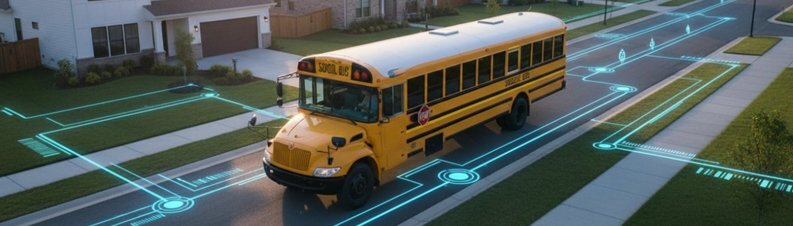
At 5:45 AM on a Tuesday, a transportation coordinator receives three texts from drivers who won't be coming in. They're left staring at a static map, knowing that 150 students might be stranded while fuel prices hover at $4.00 per gallon. You likely recognize this daily pressure. Managing a district fleet in 2026 isn't just about getting from point A to point B; it's about surviving a 15% national driver shortage while keeping your "precious cargo" safe. You shouldn't have to choose between a balanced budget and student security.
This guide shows you how modern school bus route planning software transforms these logistical headaches into streamlined, automated operations. By implementing intelligent optimization, districts can reduce annual costs by $50,000 or more per bus through the elimination of "deadhead" mileage and inefficient idling. We'll explore how real-time student tracking provides the data you need to silence angry parent phone calls and present clear ROI figures to your board. From SIS integration to GPS accuracy, you're about to discover the tools that ensure every child arrives on time, every single day.
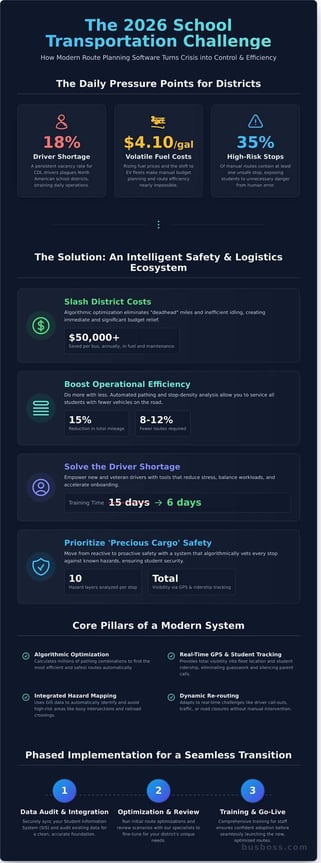
Modern school bus route planning software has evolved into a comprehensive safety and logistics ecosystem. It replaces the outdated 2024 model of static, annual routing with dynamic, real-time adjustments. By 2026, transportation departments will face a complex intersection of $4.10 per gallon fuel costs and a 25% increase in electric vehicle (EV) fleet adoption. These variables make manual planning impossible. At its heart, this technology solves a specialized version of the vehicle routing problem by calculating the most efficient paths while accounting for student-specific constraints. The core philosophy remains clear; safety provides the primary return on investment, while the resulting operational efficiency pays for the system itself. Districts using automated tools often see a 15% reduction in total mileage within the first year of implementation.
The 2026 labor market shows a persistent 18% vacancy rate for CDL drivers across North American school districts. Route optimization tackles this by increasing stop density, which often reduces the total number of required routes by 8% to 12%. Software creates driver-friendly routes by balancing workloads and minimizing difficult maneuvers like U-turns or backing up. This reduces physical stress and lowers turnover rates. Recruits gain confidence faster because integrated turn-by-turn navigation provides real-time guidance, cutting traditional route-familiarization training from 15 days down to just 6 days. When drivers feel supported by their tools, they stay longer, which stabilizes the entire transportation department.
Manual routing creates dangerous gaps in student accountability. A 2025 industry report found that 35% of manual routes contained at least one high-risk stop, such as a pickup on a road with a speed limit exceeding 45 mph. School bus route planning software uses GIS data and hazard mapping to establish a baseline for safe stops. It identifies no-go zones near railroad crossings or high-accident intersections automatically. This prevents human error from placing a child in a vulnerable position. In 2026, a safe route protocol means that every stop must be algorithmically vetted against 10 specific environmental hazard layers to ensure your precious cargo never stands in harm's way. This level of precision isn't just a luxury; it's a fundamental requirement for modern student protection.
Traditional manual plotting relies on a dispatcher's local knowledge and static maps. While this worked for decades, it's often inefficient because it can't account for real-time variables or complex math. Algorithmic optimization changes the game. It uses mathematical models to evaluate millions of potential pathing combinations in seconds. This technology prioritizes safety by minimizing left-hand turns. These turns are statistically more dangerous and lead to increased idling time. By following NTSB school bus safety standards, districts can reduce intersection risks while simultaneously lowering fuel consumption and improving driver confidence.
Modern school bus route planning software also tackles the problem of "deadhead" mileage. This refers to the distance a bus travels without any students on board. When a bus drives empty from the garage to the first stop or back from the last school, it's a drain on the district budget. Optimization tools identify the most logical garage-to-stop sequences to keep these miles at an absolute minimum. Effective coordination of multi-school bell times is another critical feature. By staggering start times across elementary, middle, and high schools, a single bus can complete three separate runs instead of one. This reduces the total number of vehicles needed on the road. It's a logistical puzzle that's impossible to solve manually when managing hundreds of students and dozens of drivers.
Efficiency translates directly into dollars. Data shows that reducing total mileage by just 10% can save a mid-sized district over $50,000 annually in fuel and maintenance costs. These savings allow administrators to reallocate funds toward classroom resources or driver retention programs. Beyond the budget, there's a clear environmental benefit. Fewer miles driven means a smaller carbon footprint for the entire fleet. For districts transitioning to Electric Vehicles (EVs), school bus route planning software becomes even more essential. It calculates routes based on battery range, terrain, and proximity to charging stations to ensure no bus runs out of power mid-route.
Special education transportation is often the most expensive and complex part of a district's operation. These routes require door-to-door service and must accommodate specific equipment like wheelchair lifts or climate control. Address changes happen frequently in these programs. Software handles these shifts instantly, recalculating paths to maintain efficiency without disrupting the schedule. It's also vital for compliance. Most state regulations limit student ride times to 60 minutes or less. Automated routing ensures every student arrives on time while staying within these legal boundaries. If you're looking to optimize your special education routes, look for systems that allow for these specific student requirements. This level of precision protects your budget and your precious cargo simultaneously.
Modern school bus route planning software has evolved into a comprehensive ecosystem. It's no longer just about drawing lines on a map; it's about total visibility. Real-time GPS tracking has shifted the focus from simple location data to driver behavior analytics. Managers can now monitor hard braking, rapid acceleration, and excessive idling. This data ensures every driver follows NHTSA school bus safety guidelines to protect the children on board. By correcting these behaviors, districts often see a 12% reduction in fuel consumption and lower maintenance costs over a single school year.
Ridership tracking provides a precise digital manifest. You'll know exactly which 38 students are on a specific bus at any given second. This visibility extends from the front office to the parents' home. Integrated communication portals are a game-changer for administrative efficiency. Districts implementing these systems typically see their office phone traffic drop by 40% or more during peak morning and afternoon hours. Parents don't need to call to ask about delays because they see the status on their screens. Additionally, the software automates state reporting. What used to take transportation coordinators three weeks of manual data entry for 2024 reimbursements now takes less than an hour of verified data exporting.
Manual data entry is the primary cause of routing errors and safety risks. When a student's address changes in the SIS but isn't updated in the routing software, it creates a dangerous disconnect. Our LiveSYNC technology eliminates this gap. It synchronizes data between the SIS and your school bus route planning software automatically. If a student moves on Tuesday morning, their new bus stop is ready by the afternoon run. We prioritize data security by using AES-256 encryption and secure cloud storage. This ensures that student PII (Personally Identifiable Information) remains protected against unauthorized access at all times.
The mobile tech stack connects the driver, the district, and the parent in one loop. ROUTEpatrol provides drivers with real-time updates and digital manifests via in-cab tablets. Drivers get turn-by-turn directions that adjust instantly if a road is closed. On the other side, PARENTpatrol gives families peace of mind. The app sends proximity alerts when the bus is within a specific radius, such as 0.5 miles or three blocks. These proactive alerts have been shown to reduce "no-show" rates at bus stops by 15%. This keeps the entire fleet running on schedule and ensures your precious cargo is never left waiting in the dark or inclement weather.
Transitioning to new school bus route planning software doesn't have to be a logistical nightmare. Success depends on a structured, five-phase rollout that prioritizes data integrity and staff confidence. It's about protecting your precious cargo while modernizing your fleet operations. The process begins long before the first bus leaves the lot.
Data migration often feels like the heaviest lift for IT managers and transportation directors. Professional consulting services take over the manual entry and formatting, moving your legacy data into the new system with 99.9% accuracy. We implement A+ Software Checkpoints at every stage to verify that student stop assignments match your district's specific safety policies. This process transforms your team into "BusBosses" who understand the deep logic of their data. They stop being just software users and start being route architects.
When you present a proposal for school bus route planning software to the school board for 2026 funding, focus on concrete numbers. On average, districts using optimized routing reduce total mileage by 12% within the first year. This translates to lower fuel costs and reduced vehicle wear-and-tear. Don't overlook the hidden ROI. Improved community trust and a 20% reduction in parent complaint calls provide value that's hard to quantify but easy to appreciate. A well-documented proposal showing these 2025 benchmarks makes the 2026 budget approval much smoother for everyone involved.
Ready to see how a structured implementation can save your district time and money? Schedule your SuccessRoute consultation today to begin your data audit.
Since 1999, BusBoss has focused on one goal, getting students to and from school safely. We have spent more than 25 years perfecting our approach to student transportation. We don't sell a simple, standalone routing tool. Instead, we provide a robust Safety Technology Stack. This integrated system ensures that your routing data, GPS tracking, and student ridership information work together in real time. Most systems leave gaps between the office and the road. We bridge those gaps to ensure no student is left behind.
When you choose our school bus route planning software, you aren't just buying code. You're gaining a partner with US-based support teams who understand the unique pressures of the American education system. Our GIS mapping experts specialize in localized data. They don't rely on generic consumer maps that might lead a bus down a narrow alley or a weight-restricted road. We build routes that account for specific local hazards, such as 10-ton weight limits on rural bridges or dangerous four-lane intersections that require right-side-only pickups.
Safety drives every decision we make. It's why we use the phrase "precious cargo" as our guiding principle. Our software helps you manage routes with total confidence; you'll know exactly where every bus is and which students are on board at any given second. This visibility reduces liability for the district and provides essential peace of mind to parents. We prioritize precision over shortcuts every time.
Software alone won't solve a driver shortage or a budget crisis. An expert strategy is required. Our professional consultants perform deep-dive route audits to find every possible efficiency. In a 2022 case study, a mid-sized district utilized our optimization services to consolidate three routes entirely. This move saved them $142,000 in fuel and maintenance costs within a single academic year. We help you look at the big picture. Explore our route optimization consulting services to learn how our 25 years of experience can be applied to your specific district challenges.
Every district has a unique footprint. Our live demos reflect that reality. We don't show you a "one size fits all" template. Instead, we perform a personalized route analysis using your specific parameters. We customize the walkthrough for your role, whether you're a fleet contractor or a district transportation director. You'll see exactly how our school bus route planning software integrates with your existing Student Information System (SIS) to automate data transfers. This eliminates manual entry errors and keeps your records current. Request your live BusBoss demo today and put your precious cargo first.
Transitioning to 2026 requires more than just a map. It demands a system that prioritizes student safety while maintaining a lean budget. Implementing school bus route planning software isn't just a technical upgrade; it's a commitment to operational excellence. Districts that optimize their routes often see a proven $50k savings per bus annually. This financial relief allows administrators to reinvest in classroom resources or driver retention programs. You don't have to manage these complex transitions alone. With 25+ years of industry experience, our team provides the US-based support and training you need to succeed from day one.
Efficiency doesn't happen by accident. It's the result of methodical planning and robust optimization algorithms. By streamlining your daily operations, you ensure that every student arrives on time and every mile driven serves a purpose. It's time to gain total confidence in your transportation department's performance. Your students deserve a reliable ride every single morning.
Request A Live Demo of BusBoss Routing Software
Take the first step toward a safer, more cost-effective future for your community. We're ready to help you protect your most precious cargo.
School bus routing software typically costs between $2,000 and $15,000 per year, depending on your fleet size and specific feature requirements. Small districts with fewer than 10 buses usually pay on the lower end of that scale, while larger districts with 100 or more buses see higher annual licensing fees. You should also budget for a one-time implementation fee that ranges from $1,500 to $5,000 to cover data conversion and initial setup.
Yes, modern school bus route planning software integrates with 95% of major Student Information Systems like PowerSchool, Skyward, and Infinite Campus. This automated data exchange ensures that student address changes or new enrollments sync every 24 hours. You won't have to manually enter student data twice, which reduces administrative errors by up to 40% based on industry benchmarks.
GPS tracking improves safety by providing real-time location data that reduces emergency response times by 30% during mechanical failures or accidents. Dispatchers can see exactly where a bus is within 5 feet of its actual position. This technology allows parents to receive alerts when the bus is 3 blocks away, ensuring students don't wait outside in unsafe conditions for extended periods.
The software handles driver absences by instantly pushing optimized route maps and turn-by-turn directions to a sub-driver's tablet or mobile device. Sub-drivers maintain 100% route accuracy because they follow the exact path and stop sequence programmed into the system. This eliminates the need for paper maps and ensures that your precious cargo arrives on time even when a regular driver is unavailable.
You can track student ridership in real-time using RFID card readers or barcode scanners installed at the bus entrance. These systems record the exact second and GPS coordinate where a student boards or exits, providing 99.9% tracking accuracy. Administrators can access this data instantly through a secure dashboard to confirm a student's location or verify ridership numbers for state funding reports.
Implementing a new school bus route planning software system typically takes between 6 and 12 weeks from the initial data hand-off to go-live. This timeline includes 2 weeks for data conversion, 4 weeks for route optimization, and 2 weeks for staff training through programs like SuccessRoute. Districts that start the process by May 1st are usually fully operational before the first day of school in August.
BusBoss fully supports electric school bus routing by accounting for battery range limits and charging station locations. The software calculates routes based on a 15% range reduction in cold weather to ensure buses don't run out of power mid-route. It helps transportation directors plan charging schedules during mid-day gaps, maximizing the efficiency of an EV fleet throughout the 180-day school year.
The software includes dedicated modules for field trips and athletic events that automate the entire request and approval workflow. By centralizing these special trips, districts often see a 20% reduction in driver overtime costs through better resource allocation. It manages driver rotations and billing automatically, ensuring that coaches and teachers receive accurate cost estimates for their trips within 24 hours of a request.


 Orbit Software, Inc.
424 King Street
Pottstown, PA 19464
 (484) 941-0820