
The morning bell rings, but for your transportation department, the day's biggest challenge has already begun: a flood of "where is my bus?" calls from anxious parents. This daily logistical scramble, coupled with concerns over route deviations and driver performance, can feel overwhelming. But what if you could replace that uncertainty with complete confidence and control? This is the transformative power of a modern school bus GPS tracking system-a solution designed to turn chaos into calm, providing the visibility you need to manage your fleet effectively.
In this definitive 2026 guide, we move beyond dots on a map to show you how to build a truly transparent, safety-first operation. You will discover how today’s advanced technology silences the phone lines, delivers documented fuel and time savings, and builds unwavering trust with your community. Prepare to learn how to leverage real-time data to optimize every route and, most importantly, ensure the safety of your precious cargo on every single trip.
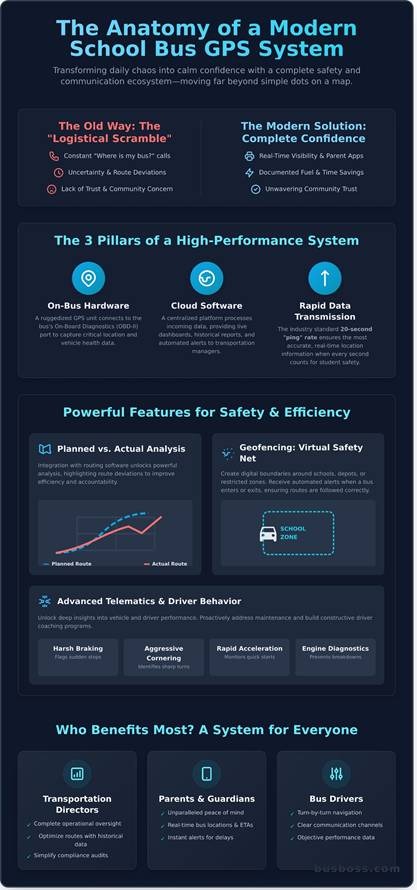
When school administrators think of GPS, the image of a simple dot moving across a digital map often comes to mind. While that was once the standard, the modern school bus GPS tracking system has evolved into a comprehensive ecosystem. It’s a sophisticated blend of on-bus hardware, powerful cloud-based software, and intuitive mobile interfaces designed to streamline operations and, most importantly, protect students. This evolution from basic location tracking to predictive telematics is driven by a non-negotiable principle: transporting our "precious cargo" demands a far higher standard of safety and accountability than any commercial fleet.
A truly effective system isn’t just a tool; it’s a strategic asset built on three foundational pillars: pinpoint accuracy in location and data, seamless integration with existing school information systems (SIS), and immediate accessibility for every stakeholder. These pillars ensure the platform delivers confidence and control, not just data.
At its core, the system combines a GPS hardware unit installed on each bus with a centralized, cloud-based management platform. This setup provides real-time, or "active," tracking, which is essential for student safety. Unlike passive systems that require data to be manually downloaded, an active system continuously transmits information, allowing for immediate response to delays or emergencies. The integration of Modern School Bus Technology has transformed these vehicles into mobile data hubs. In essence, a comprehensive school bus GPS tracking system acts as the central nervous system of your entire student transportation operation.
The value of a modern tracking system extends across the entire school community, delivering specific, critical benefits to each group involved in the daily transportation of students.
A high-performance school bus GPS tracking system is far more than a simple dot on a map. It's a comprehensive ecosystem of hardware, software, and data working in unison to protect your precious cargo. Understanding its core components allows you to leverage its full potential for enhancing safety and operational efficiency. The system relies on three integrated pillars: rugged hardware installed in the vehicle, intelligent software for analysis, and rapid data transmission that provides real-time visibility.
The foundation is a ruggedized GPS unit, built to withstand the constant vibrations and temperature changes of a bus environment. This device, often connected to the vehicle's On-Board Diagnostics (OBD-II) port, captures critical data. This information is then transmitted to a centralized software platform, where transportation managers can access live dashboards, historical reports, and automated alerts. For maximum safety and responsiveness, the industry standard for data transmission is a 20-second "ping" rate, ensuring you have the most accurate location information when every second counts.
Telematics unlocks a deeper level of insight into both vehicle and driver performance. The system automatically flags "harsh events"-like sudden braking, aggressive cornering, or rapid acceleration-that could indicate unsafe driving. By monitoring engine diagnostics, you can proactively address maintenance issues before they lead to a roadside breakdown. This data adds a critical layer of active monitoring to existing school bus safety features and empowers you to build constructive driver coaching programs focused on continuous improvement.
Geofencing acts as a virtual safety net around your fleet. This feature allows you to draw digital boundaries around critical locations like schools, depots, specific bus stops, and even restricted or high-risk zones. The system then generates automated notifications the moment a bus enters or exits one of these predefined areas. This provides immediate confirmation that routes are being followed correctly, validates that every stop was made on time, and alerts you to any unauthorized activity, ensuring complete accountability.
A standalone GPS device can show you a dot on a map, but it can't provide the context needed for true operational control. When your GPS and routing software operate in separate "data silos," you have information but lack actionable intelligence. This disconnect creates inefficiencies and compromises your ability to respond to deviations in real-time. A truly effective school bus GPS tracking system bridges this gap by integrating live location data directly with your pre-planned routes, transforming raw data into a powerful management tool.
This integration provides a complete picture of your transportation operations, allowing you to manage with confidence and ensure the safety of your precious cargo. By unifying these critical systems, you move from reactive problem-solving to proactive, data-driven management that enhances safety, boosts efficiency, and improves communication with parents. Districts that implement integrated systems often report a significant reduction in parent inquiries, in some cases by over 25%, by providing accurate, real-time ETAs through a parent app.
The most powerful feature of an integrated system is its ability to perform "Planned vs. Actual" route analysis. The software overlays the bus's real-time GPS path on top of the route assigned by your transportation department. This comparison immediately flags any discrepancies, allowing you to:
To maximize safety and accuracy, your school bus GPS tracking system must communicate seamlessly with your Student Information System (SIS). A daily data sync is essential to keep routing information current. This ensures that when a new student enrolls or an existing student move, their transportation details are automatically updated in the routing and tracking platform. This automated process eliminates manual errors and guarantees that parents have immediate access to the correct bus information, all while maintaining the highest standards of data security for sensitive student information.
Successfully integrating a school bus GPS tracking system goes beyond installing hardware; it requires a thoughtful strategy that builds trust with staff, parents, and the wider community. A proactive approach to implementation ensures that the technology is viewed not as an intrusion, but as a powerful tool for protecting your district’s most precious cargo.
Before going live, establish a clear Data Privacy Policy that outlines what information is collected and how it is used, providing transparency for parents and students. Simultaneously, your dispatch team must receive comprehensive training to leverage the system’s dashboard during an emergency, enabling them to provide first responders with precise location data instantly. This preparation is key to managing routes with confidence.
To earn driver buy-in, position GPS as a tool for their protection and professional development. Frame the system as a reliable partner that supports their critical role in student safety. Key benefits to highlight include:
Launching a parent-facing app like PARENTpatrol™ requires clear and consistent communication. Announce the rollout well in advance, explaining how the app will provide peace of mind with real-time bus location updates. It is crucial to set accurate expectations by explaining the concept of "buffer zones"-small, acceptable location variations around a bus stop due to GPS signal latency. This preempts unnecessary concern. By empowering parents with self-service information, your transportation department can significantly reduce inbound phone calls, freeing up staff to focus on critical operational tasks.
Ultimately, the return on investment becomes clear. A well-implemented system pays for itself through optimized routes that reduce mileage and fuel costs from excessive idling, proving that enhanced safety and operational efficiency go hand in hand. Learn more about creating a seamless rollout plan at busboss.com.
Choosing a GPS provider is about more than just technology; it's about choosing a partner dedicated to student safety. For over 25 years, BusBoss has been the trusted name in school transportation management, offering engineering solutions that create a seamless connection between your district, your drivers, and the families you serve. Our advantage lies in a fully integrated ecosystem where every component works in harmony.
Unlike standalone systems, our powerful GPS data doesn't just show you a bus on a map-it feeds directly into our core routing engine. This allows for real-time adjustments, accurate reporting, and unparalleled operational efficiency. This connection extends to your community through our PARENTpatrol Mobile App, giving parents the transparency and peace of mind they crave with secure, real-time bus location updates and notifications. For administrators, this integration translates into customizable reports that turn raw data into actionable insights for optimizing routes and enhancing safety protocols.
We ensure your success from day one with our proprietary implementation process, A+ Software Checkpoints. This methodical approach guarantees a smooth, district-wide rollout tailored to your specific operational needs. Our partnership doesn’t end at launch; through our ongoing SuccessRoute Training, we empower your staff with the skills and confidence to master the system. Whether you are a small rural district or a large transportation contractor, our support and software adapt to you.
An integrated school bus GPS tracking system from BusBoss does more than track vehicles; it builds a network of safety, communication, and accountability that protects every student. By connecting all stakeholders on a single, reliable platform, you can streamline operations, reduce costs, and gain the confidence that comes with knowing your precious cargo is in safe hands. See how our comprehensive solutions can transform your transportation department.
Request a Live Demo of BusBoss GPS Tracking today and take the first step toward a safer, smarter fleet.
As we look toward 2026, it’s clear that the future of student transportation management hinges on more than just location data. The key takeaway is that a modern system must transcend basic tracking by integrating powerful routing software, creating a comprehensive command center for your entire fleet. Furthermore, successful implementation is a collaborative effort, built on a foundation of clear communication, thorough training, and community trust. Choosing the right school bus GPS tracking system is a critical decision that directly impacts safety, budget, and parental peace of mind.
For over 25 years, BusBoss has been the trusted partner for more than 1,100 school districts, helping them achieve new levels of operational excellence. Our integrated solutions are proven to reduce parent calls by up to 25%, giving your team back valuable time and providing your community with the confidence it deserves.
Ready to see how a true transportation partner can protect your precious cargo? Schedule a Demo to See How BusBoss GPS Protects Your Precious Cargo. Take the next step toward a safer, smarter, and more streamlined future for your district.
A parent app is a feature powered by the comprehensive school bus GPS tracking system, but they are not the same. The core GPS provides transportation coordinators with a powerful management tool for route optimization, driver monitoring, and fleet diagnostics. The parent app is a secure portal that shares specific, relevant data from this system, like bus location and estimated arrival times, to give parents peace of mind without compromising operational security.
The cost of implementing a GPS tracking solution varies based on your fleet's specific needs, including the number of buses, the type of hardware selected, and the software features required. The investment typically includes a one-time cost for the hardware units per vehicle, plus an ongoing software subscription for data, support, and feature access. This structure ensures the system is a scalable and cost-effective solution for enhancing the safety of your precious cargo.
Absolutely. A GPS tracking system is a powerful tool for improving fleet efficiency and reducing fuel consumption. By analyzing route data, transportation managers can identify and eliminate unnecessary mileage and overlapping paths. The system also monitors driver behaviors like excessive idling, speeding, and unauthorized use, allowing you to address these fuel-wasting habits directly. This optimization streamlines operations and delivers significant, measurable cost savings for your district.
Modern, reliable GPS tracking units are designed to function confidently even in areas with intermittent cellular coverage. Our devices feature "store and forward" technology. If a bus travels through an area without a signal, the unit continues to log all location and engine data. As soon as the vehicle re-enters a coverage area, it automatically uploads the stored information to the server. This ensures a complete, uninterrupted record of every route, with no data gaps.
Yes, a school bus GPS tracking system typically operates on a subscription-based model. This recurring fee is essential as it covers the cellular data transmission from the GPS unit to our secure servers, access to the software platform, regular system updates, and dedicated technical support. This model ensures your system remains reliable and fully supported, allowing you to manage your fleet with confidence and focus on student safety.
In an emergency, real-time information is critical for ensuring student safety. A GPS tracking system provides the exact location of a bus, allowing you to dispatch first responders with precision and speed. Transportation managers can instantly see if a bus has deviated from its route or stopped unexpectedly. This immediate visibility eliminates guesswork, accelerates response times, and provides the critical data needed to manage any situation and protect your precious cargo.
Data security and student privacy are paramount. Reputable GPS tracking providers use robust security measures to protect all collected information. Data is transmitted using encryption and stored on secure, access-controlled servers. User access to the management software is protected by passwords and permissions, ensuring that only authorized school district personnel can view sensitive route and student information. We are committed to maintaining the highest standards of data security for your district.
Yes, monitoring driver behavior is a core function that directly enhances student safety. The system tracks key metrics such as speed, hard braking, rapid acceleration, and idling times. This data provides objective insights into driver performance, allowing you to identify and address unsafe habits through targeted training. It also helps you recognize and reward your safest drivers, fostering a culture of accountability and responsibility across your entire transportation department.


 Orbit Software, Inc.
424 King Street
Pottstown, PA 19464

 (484) 941-0820