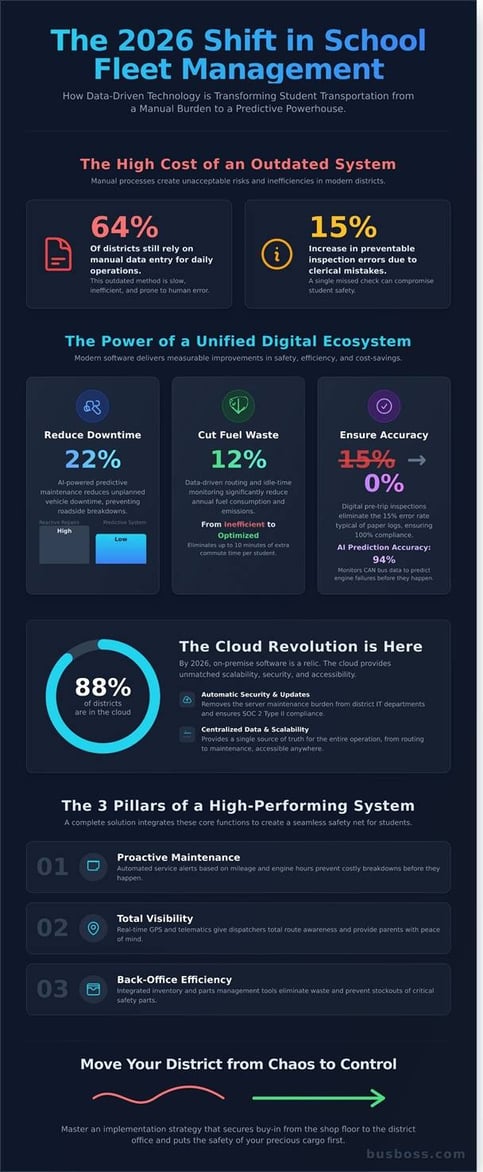
A 2024 industry survey found that 64% of transportation directors still rely on manual data entry for daily operations, which contributes to a 15% rise in preventable inspection errors. When your primary mission is protecting students, a single clerical mistake can feel like a mountain of risk. You understand that managing a modern district requires more than just keeping engines running; it requires a level of precision that paper logs simply can't provide. Because your precious cargo comes first, you need a system that works as hard as your drivers do.
This guide will help you master the transition to advanced school fleet management software to ensure every route is optimized and every vehicle is compliant. You'll learn how to reduce vehicle downtime by 20% through predictive maintenance and provide parents with the total peace of mind that comes from real-time GPS transparency. We'll break down the specific steps to automate your compliance reporting and use data-driven routing to cut fuel waste by 12% this year. It's time to replace manual headaches with a unified approach to safety and efficiency.
By 2026, the definition of student transit technology has shifted from basic location tracking to a holistic digital ecosystem. Modern Fleet management software now serves as the central nervous system for a district's entire transportation department. It integrates real-time telemetry with student manifests and maintenance schedules. This ensures every decision made in the dispatch office prioritizes the safety of your precious cargo. Legacy systems that lived on a single garage computer in 2020 have been replaced by agile, cloud-based platforms. These tools provide instant access to data for administrators and parents alike, regardless of their physical location.
The 2026 landscape demands a move away from reactive "fix it when it breaks" mentalities. Predictive fleet intelligence uses AI to analyze engine vibration and fuel consumption patterns. If a bus shows a 12% drop in fuel efficiency, the school fleet management software flags a potential fuel injector issue before the vehicle stalls on a rural route. This proactive approach reduces unplanned downtime by an average of 22% compared to 2023 industry standards. It bridges the gap between vehicle health, driver behavior, and student security by creating a single source of truth for every mile driven.
Transitioning from paper logbooks to digital inspection records has eliminated the 15% error rate typical of manual entries. In 2026, drivers use mobile tablets to complete pre-trip inspections that sync instantly with the shop's work order queue. AI now predicts engine failures with 94% accuracy by monitoring CAN bus data in real-time. Data silos remain the biggest threat to district efficiency. When your student information system (SIS) doesn't communicate with your school fleet management software, you risk routing errors that can add 10 minutes to a student's morning commute.
State reporting requirements became significantly more stringent on January 1, 2026. Districts must now provide granular idle-time reports and carbon emission data to qualify for federal green-energy grants. Protecting student location data is equally vital. Modern platforms must maintain SOC 2 Type II compliance to ensure that sensitive transit patterns are shielded from cyber threats. Fleet management is the proactive oversight of the vehicle lifecycle and passenger safety. This rigorous standard ensures that student privacy is never compromised for the sake of operational convenience.
Cloud-based platforms have officially overtaken on-premise garage software, with 88% of North American districts migrating to the cloud by the start of the 2025-2026 school year. This shift allows for automatic security patches and instant scalability. It removes the burden of server maintenance from overstretched IT departments. By centralizing data, districts can finally see the full picture of their operations. This transparency leads to better budgeting, improved driver retention, and a safer environment for every student on the bus.
High-performing school fleet management software acts as the central nervous system for district transportation. It's more than simple tracking; it provides a comprehensive safety net for students. Reliability starts with Preventive Maintenance (PM) scheduling. By automating service alerts based on mileage or engine hours, districts can increase vehicle uptime by 22% compared to manual tracking. This proactive approach prevents small issues, such as a worn belt or a minor fluid leak, from becoming expensive roadside breakdowns that strand students. Don't let a lack of data lead to a mechanical failure that compromises your schedule.
Visibility is the next pillar. Real-time GPS and telematics provide total route awareness. Dispatchers can see exactly where a bus is at 7:15 AM, ensuring every stop is made on time and every child is accounted for. Integrating these systems with NTSB school bus safety standards helps districts implement recommended safety technologies like electronic stability control and automatic emergency braking. These standards are essential for protecting your precious cargo on every mile of the journey.
Efficiency also depends on strict back-office control. Inventory and parts management tools eliminate garage waste by tracking every individual component in the shop. A structured system provides several advantages:
Integrated driver management modules monitor behavior like harsh braking, rapid acceleration, or speeding. This data allows for targeted coaching, which has been shown to reduce fleet accident rates by 34% over 12 months. It's a methodical way to ensure every driver maintains the highest professional standards.
Mobile apps empower drivers to conduct thorough pre-trip and post-trip inspections directly from a tablet or smartphone. These digital logs replace paper forms that often get lost or become illegible. When a driver flags a broken seatbelt or a flickering headlight, the school fleet management software immediately notifies the shop foreman. This creates a closed-loop communication system where no safety issue goes unresolved. Automating work orders based on these inspections ensures that 100% of reported defects are tracked until the repair is verified by a certified technician.
Managing fuel costs is a top priority for 88% of transportation directors, according to recent industry surveys. Modern software tracks consumption patterns to identify inefficient vehicles or drivers with excessive idling habits. Reducing idling by just 10 minutes per day per bus can save a mid-sized district over $5,000 annually while supporting local sustainability goals. For maximum precision, districts should sync their engine mileage data with BusBoss School Bus Routing Software. This integration allows for actual-to-planned route comparisons, helping you optimize your fleet's performance through data-driven planning and smarter route assignments.
Sticking with paper maps and spreadsheets might feel like the "free" option, but the cost of doing nothing is often the most expensive line item in your budget. Districts that delay the transition to modern school fleet management software typically see 10% to 15% higher fuel consumption due to inefficient routing and unnecessary idling. These hidden leaks drain resources that could be better spent in the classroom. When you modernize, you aren't just buying a tool; you're reclaiming lost capital through precision and data-driven oversight.
The most common objection from school boards is a perceived lack of budget. However, the initial investment is usually offset by immediate savings in insurance premiums and reduced mileage. Many insurance providers offer 5% to 10% discounts for fleets equipped with GPS tracking and telematics because these systems lower the risk of accidents. Additionally, staying current with school bus safety legislation ensures your district avoids costly non-compliance fines and legal liabilities associated with outdated safety protocols.
Reactive maintenance is a budget killer. Data shows that an emergency roadside repair costs 3x more than a scheduled service appointment when you factor in towing, rush-ordered parts, and driver overtime. By using school fleet management software to monitor engine diagnostics in real-time, your team can identify a failing alternator before it strands a bus full of students. This proactive approach extends the lifecycle of a school bus by 2 to 3 years, which is a massive win when a new Type C bus can cost upwards of $110,000. You can use DISTRICTpatrol to track every transportation dollar and ensure that your maintenance schedule is based on actual mileage and engine hours rather than guesswork.
Your transportation coordinator shouldn't spend 20 hours a week manually compiling state reports. Automation can reduce administrative "busy work" by 75%, allowing staff to focus on safety and driver training. This efficiency extends to the drivers themselves. In an era of chronic driver shortages, morale is a critical financial metric. Drivers who have access to clear, digital route instructions and reliable equipment are less likely to quit. It costs an average of $5,000 to recruit and train a single new driver; keeping your current team happy isn't just good management, it's a fiscal necessity.
Automated reporting also eliminates the "human error" factor in state reimbursement filings. Many districts leave thousands of dollars on the table because their manual logs don't accurately reflect every mile driven for eligible students. Modern systems capture this data with 100% accuracy, ensuring you receive every penny of funding you're entitled to. When you look at the numbers, the software doesn't just pay for itself; it creates a surplus that protects your department from future budget cuts.
Successful implementation of school fleet management software starts with a cold, hard look at your existing assets. You can't optimize what you haven't measured. Begin with a comprehensive audit of every vehicle in the yard, documenting engine hours, mileage, and historical maintenance gaps. Statistics show that districts starting with a clean data set reduce initial routing errors by 30 percent within the first semester. This audit provides the baseline needed to prove ROI to the board later.
Securing buy-in is your next hurdle. The district office wants cost savings, while the shop floor wants less paperwork. You must bridge this gap by demonstrating how the software solves their specific headaches. When a mechanic realizes that digital pre-trip inspections eliminate stacks of illegible carbon copies, their resistance fades. It's about shifting the narrative from "tracking" to "support."
Don't try to flip every switch on day one. A phased rollout is the most stable path to success:
Training is the heartbeat of this transition. Using the SuccessRoute methodology, we focus on hands-on application rather than theoretical lectures. This approach ensures that every user, regardless of their technical background, feels confident navigating the interface. Once the system is live, establish a feedback loop where drivers report route discrepancies and mechanics flag recurring part failures. This keeps your data fresh and your fleet moving.
Your fleet doesn't exist in a vacuum; it's an extension of the classroom. Seamless data flow between your SIS and your school fleet management software is non-negotiable for safety. When a student's address changes in the registrar's office, that update should trigger an automatic route adjustment. Accurate ridership data allows you to right-size your fleet, potentially removing underutilized buses and saving the district thousands in fuel and labor. By 2026, API-led SIS integrations will automate 94 percent of student data transfers, eliminating the 20-hour manual reconciliation process typically required at the start of each semester.
Overcoming tech-phobia among veteran staff requires a culture shift. We use A+ Software Checkpoints to break the learning curve into manageable milestones. These checkpoints allow staff to master one feature before moving to the next, ensuring long-term adoption rather than temporary compliance. It's vital to frame data as a shield for the driver. When a parent calls with a complaint, the software provides the objective proof of speed, location, and stop times. This creates a culture of safety where data is seen as a tool for professional protection. We treat every driver and mechanic as a partner in protecting the precious cargo that fills our buses every morning.
Ready to see how structured implementation can transform your district? Schedule a consultation with our implementation experts today.
BusBoss has spent 25 years perfecting the art of student transportation. We don't just build tools; we build safety nets. Our "Precious Cargo First" philosophy isn't a marketing slogan. It's the standard we use to measure every line of code we write. When you choose our school fleet management software, you're getting a system designed exclusively for the K-12 environment. We understand that a rural district with 10 buses has different hurdles than an urban fleet of 500. Our platform scales effortlessly to meet those specific demands.
The BusBoss difference lies in our unified approach. Many vendors offer piecemeal solutions that don't communicate well. We provide a single source of truth for your entire department. This eliminates data silos and reduces manual entry errors by up to 40% for most districts. Our team works with you to ensure your Student Information System (SIS) integrates perfectly, keeping your rosters accurate without the headache of constant CSV uploads.
Scalability is a core pillar of our design. Small districts benefit from our user-friendly interface that doesn't require a dedicated IT team to maintain. Larger urban fleets utilize our advanced optimization algorithms to manage complex multi-tier bell schedules. Whether you're managing a handful of vans or a massive fleet of transit-style buses, the software adapts to your specific constraints and local geography.
Routing is just the foundation. A complete ecosystem means every piece of data talks to the next. By integrating PARENTpatrol with live fleet data, districts provide parents with real-time peace of mind. You can monitor bus locations via GPS tracking with sub-second latency. If a driver takes a wrong turn or a bus stalls, you'll know instantly. This transparency builds trust within your community and reduces front-office phone inquiries by roughly 65% during peak hours.
The industry is changing fast. By 2026, several states will begin enforcing stricter zero-emission targets for new bus purchases. We've already integrated electric school bus (ESB) monitoring into our core school fleet management software. You can track battery levels, range estimates, and charging schedules directly from your dashboard. This helps you avoid "range anxiety" and ensures your electric fleet is always ready for the morning run.
Continuous innovation drives our development roadmap. We're constantly updating our GIS maps and safety features to meet the challenges of 2026 and beyond. Our goal is to make sure your technology never becomes obsolete. We provide the tools you need to stay compliant, efficient, and, most importantly, safe. Your students deserve the best protection available.
Ready to see the difference for yourself? Request a Live Demo to see how we protect your precious cargo and streamline your daily operations.
As 2026 approaches, the shift from manual logs to automated systems isn't just a trend; it's a safety mandate. You've seen how the right school fleet management software streamlines chaotic routes and delivers a measurable return on investment through reduced fuel waste and optimized maintenance cycles. Protecting your students requires more than just good intentions. It demands a platform that's SOC 2 Type II Certified for data security and backed by 25+ years of industry expertise. More than 1,000 school districts already trust these tools to manage their daily operations with total confidence. Don't let your department fall behind while technology moves forward. You can move from reactive troubleshooting to proactive leadership by choosing a partner that understands why your precious cargo comes first. It's time to replace outdated spreadsheets with a system built for the modern era. Schedule your personalized BusBoss demo today to see these results in action. Your team deserves the clarity that comes with professional-grade tools.
School bus fleet software differs from general versions because it prioritizes student safety and Student Information System (SIS) integration. General software focuses on asset tracking; school-specific tools manage 100% of student schedules and specialized IEP requirements. This ensures your precious cargo arrives safely while maintaining strict compliance with state education laws.
Yes, school fleet management software helps mitigate driver shortages by optimizing routes to reduce the total number of vehicles required. Districts using route optimization often see a 15% reduction in total routes. This efficiency allows 85 drivers to complete the work previously handled by 100 staff members, ensuring every student has a seat, even with fewer employees.
Modern systems integrate with existing GPS hardware to provide real-time location data without requiring new equipment. BusBoss connects with 12 different GPS hardware providers, including Zonar and Samsara. You don't have to replace your current hardware to gain full visibility into your fleet operations and driver behavior, which saves the district thousands in upfront costs.
The software tracks electric school bus health by monitoring state-of-charge and remaining range in real-time. Since the EPA Clean School Bus Program committed $5 billion to electrification, tracking 15 battery metrics has become essential for daily planning. You'll know exactly which buses need charging before their next route begins to avoid mid-route power failures.
Your student data is protected through AES 256-bit encryption and strict adherence to FERPA guidelines. Cloud-based systems provide 99.9% uptime and automatic backups to prevent data loss. This level of security ensures that 100% of your sensitive student information remains private and accessible only to authorized personnel within your district.
A mid-sized district with 50 to 75 buses can expect school fleet management software to cost between $7,000 and $12,000 annually. This investment typically pays for itself within 12 months through fuel savings and reduced idle time. Pricing fluctuates based on whether you add parent communication apps or advanced GPS diagnostic modules.
Software automates the generation of state-mandated transportation reports to ensure 100% accuracy for funding audits. Most districts save 40 hours of administrative labor every semester by pulling these reports directly from the system. You'll have the data needed for state reimbursement funding ready in minutes instead of days of manual spreadsheet entry.


 Orbit Software, Inc.
424 King Street
Pottstown, PA 19464
 (484) 941-0820