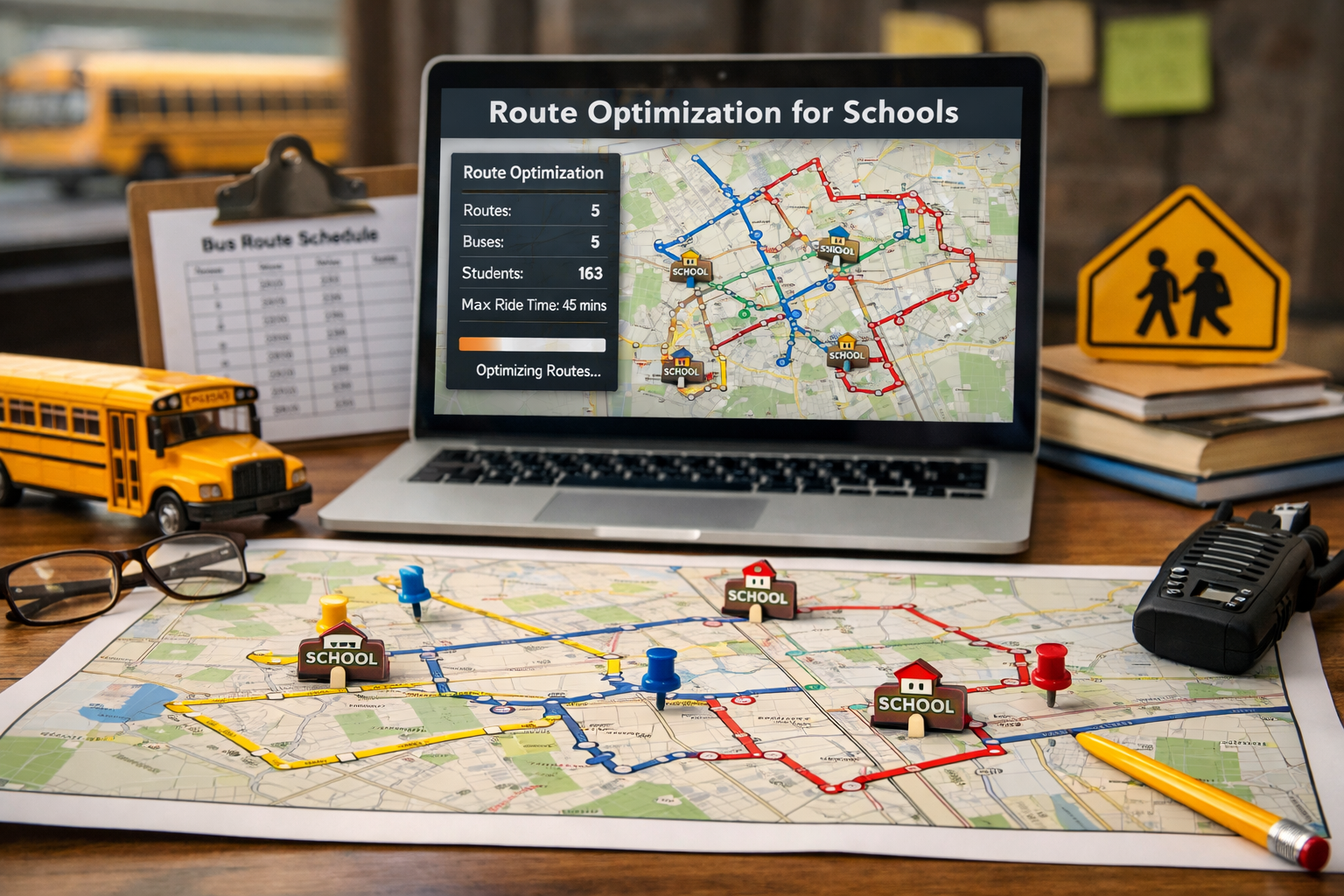
Spiraling fuel costs, complaints about lengthy ride times, and the constant challenge of a driver shortage-these are the daily realities for school transportation departments. When manual planning consumes valuable time and resources, achieving efficiency feels impossible. The solution lies in a strategic approach: effective route optimization for schools. This isn't just about finding the shortest path; it's about building a smarter, safer, and more reliable transportation system from the ground up, ensuring your precious cargo always comes first.
In this complete guide, we will show you how to master this strategic process. You'll learn how to significantly cut your transportation budget, create shorter and more direct routes that parents appreciate, and streamline your entire operation with confidence. Discover how to ensure compliance with all regulations and gain the flexibility to adapt to new students or changing bell times with ease. Get ready to transform your transportation challenges into a model of safety and efficiency.
Key Takeaways
School bus route optimization is far more than just finding the shortest path on a map. It is a complex, strategic process designed to create the safest, most reliable, and most efficient transportation network for your district. When your vehicles carry a community's precious cargo, the "best" route is one that carefully balances competing priorities: operational costs, student ride times, vehicle capacity, and, above all, safety.
The core goal is to transport every student to and from school safely and on time, every single day. Achieving this requires a dynamic approach that addresses the high costs of inefficiency while delivering benefits that extend far beyond the transportation department's budget.
The financial drain of a poorly planned system is immediate, with wasted fuel from excessive mileage and unnecessary driver overtime quickly eroding your budget. Operationally, this leads to accelerated vehicle wear and tear, increasing maintenance needs. But the human cost is just as high, manifesting in a constant stream of parent complaints and administrative headaches. Districts that implement modern route optimization for schools often report transportation cost savings of 10-30% by tackling these inefficiencies head-on.
While the financial return is compelling, the true value lies in the comprehensive improvements it brings to your entire operation. A well-optimized system creates a positive ripple effect across the district.
Ultimately, route optimization is not a one-time task but an ongoing process of refinement. As student populations shift and road conditions change, a dynamic strategy ensures your transportation department remains efficient, safe, and responsive to the needs of your community.
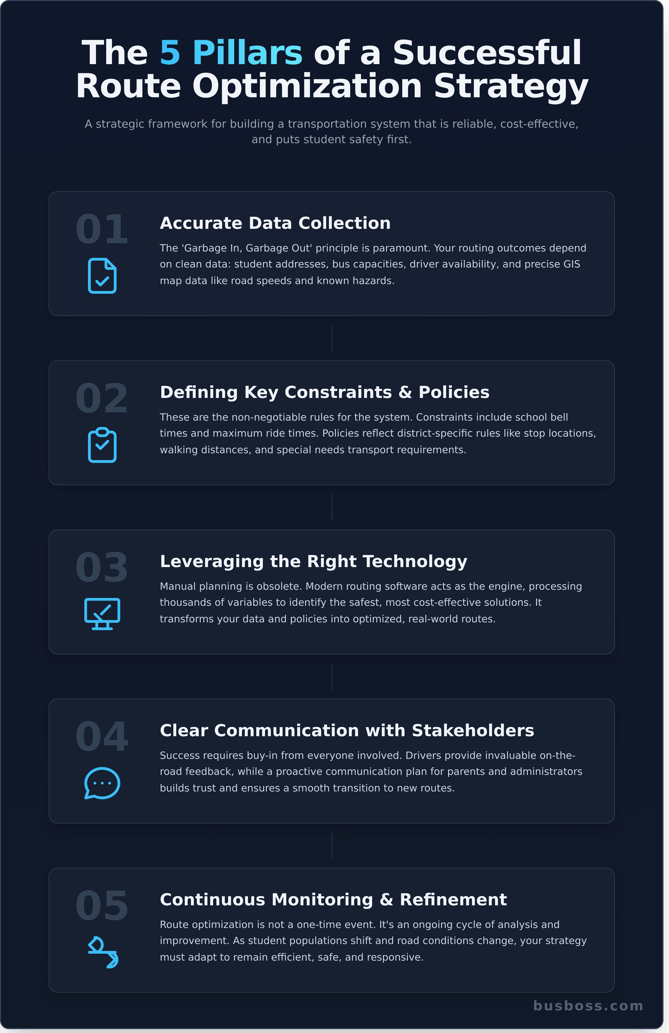
Before a single route is drawn, a successful strategy must be built on a solid foundation. Effective route optimization for schools isn't just about software; it's a methodical process resting on five interconnected pillars. Overlooking any of these can compromise safety, efficiency, and budget. This strategic framework helps districts build a transportation system that is reliable, cost-effective, and puts the safety of their precious cargo first.
The core principle is 'Garbage In, Garbage Out.' Your routing outcomes are only as reliable as the data you provide. This starts with clean student addresses, bus capacities, and driver availability, ideally integrated with your Student Information System (SIS). It is then layered with Geographic Information System (GIS) data-road speeds, turn restrictions, and known hazards-to create a true digital model of your district.
These are the rules that form the 'logic' of the optimization engine. Constraints include non-negotiable limits like school bell times and maximum student ride times. Policies reflect district-specific rules such as stop locations and walking distances. This pillar also accounts for special needs transport and alternate addresses, ensuring compliance and safety for all students.
Manual planning with maps and spreadsheets cannot manage the complexity of modern school transport. The right routing software is the engine that transforms your data and policies into efficient routes. Its powerful algorithms process thousands of variables simultaneously to identify the safest, most cost-effective solutions. This technology is the key to achieving tangible, on-the-ground results.
An optimized route plan is only successful if adopted by the people who use it. Key stakeholders-drivers, parents, and administrators-must be part of the process. Drivers offer invaluable on-the-road experience to help refine routes. A proactive communication plan for parents is also essential, ensuring they have the necessary information and building confidence in the new system.
Route optimization is not a one-time event but an ongoing cycle of improvement. After deployment, routes must be monitored. Comparing planned routes with actual GPS data and driver feedback helps identify areas for refinement. As new students enroll or roads change, this pillar ensures your system adapts, remaining efficient and safe throughout the school year.
Effective route optimization for schools is not an accident; it is the result of a deliberate, methodical process. By following a structured approach, your transportation department can transform its operations, ensuring greater safety, efficiency, and reliability. This four-step framework provides a clear standard operating procedure for turning optimization goals into tangible results.
Before you can improve, you must understand your current performance. A comprehensive audit is the critical first step. Gather hard data to create a clear baseline from which to measure all future improvements. Focus on collecting key metrics:
This data helps identify pain points and serves as the benchmark for quantifying success.
With a baseline established, you can define what success looks like. Vague goals are not actionable; instead, set SMART (Specific, Measurable, Achievable, Relevant, Time-bound) objectives that address the pain points from your audit. Examples of strong goals include:
This is where modern technology streamlines the complex planning involved in route optimization for schools. Using advanced routing software, you can model countless scenarios to find the optimal solution without disrupting current operations. Explore "what-if" situations like adjusting bell times or stop locations. The software generates data-driven routes to compare against your baseline, showing projected savings in mileage, time, and cost before you make a single change.
Successful implementation requires careful planning. Avoid a chaotic "big bang" launch by rolling out new routes in phases. Equip drivers with comprehensive training, clear route sheets, and turn-by-turn directions. Conducting dry runs before school starts helps drivers familiarize themselves with new paths. Crucially, establish a feedback loop to capture driver insights and make necessary adjustments, ensuring the new system works on the road as well as it does on paper.
Executing this process with a trusted transportation management system ensures your district can manage its routes with confidence and achieve its safety and efficiency goals.
Implementing a route optimization strategy is not a one-time event; it is an ongoing cycle of improvement. To manage this process effectively and justify the investment in powerful transportation management tools, you must track tangible results. As the saying goes, you can't manage what you don't measure. By monitoring the right key performance indicators (KPIs), you can directly connect the benefits of route optimization for schools to the goals of efficiency, safety, and budget control.
These metrics provide a clear, data-driven view of your department's performance and the direct financial impact of optimized routing. They are essential for demonstrating a strong return on investment to district leadership.
While efficiency is crucial, the safety of your precious cargo always comes first. These metrics ensure your routing decisions enhance student well-being and adhere to all district and state regulations.
The success of a transportation plan is also measured by the satisfaction of the people it serves: parents, students, and drivers. Monitoring feedback provides invaluable qualitative data.
Tracking these diverse metrics provides a holistic view of your transportation department's health and progress. BusBoss reporting dashboards make tracking these KPIs simple.
Mastering school bus routing is a powerful step toward creating a safer, more cost-effective, and reliable transportation system. As we've explored, this involves more than just finding the shortest path; it's about building a strategic framework, leveraging accurate data, and consistently measuring performance. Ultimately, successful route optimization for schools is a continuous commitment to the well-being of your students and the efficiency of your district's operations.
Embarking on this journey is a significant undertaking, but you don’t have to do it alone. For over 25 years, BusBoss has been a trusted leader in student transportation, helping hundreds of school districts across the country manage their routes with confidence. Our comprehensive software combines powerful routing tools with GPS, parent apps, and dedicated expert support to ensure your precious cargo always comes first.
Ready to transform your district's transportation and unlock new levels of safety and efficiency? See How BusBoss Can Optimize Your Routes. Request a Live Demo. Take the confident next step toward a smarter, more secure future for your students.
Best practice is to conduct a comprehensive route review annually, typically during the summer months. However, routes should also be re-evaluated whenever significant changes occur, such as new housing developments, school boundary adjustments, or substantial shifts in student enrollment. Modern software allows for quick, dynamic adjustments mid-year to maintain peak efficiency and safety. This proactive approach ensures your transportation system remains cost-effective and responsive to your community’s needs, protecting your precious cargo year-round.
Absolutely. A robust route optimization platform is designed to manage the complex requirements of students with special needs. You can input specific IEP data, such as the need for wheelchair-accessible vehicles, ride time limits, curb-side pickup requirements, or the presence of an on-board aide. The system then builds routes that strictly adhere to these critical parameters, ensuring every student receives the safe, reliable, and compliant transportation they are entitled to.
Route planning is the foundational process of creating a path from point A to point B. Route optimization, however, is a far more advanced and strategic process. It uses sophisticated algorithms to analyze countless variables-like traffic patterns, bell times, vehicle capacity, and student needs-to find the most efficient solution possible. While planning creates a functional route, optimization creates the best route, saving time and resources while enhancing student safety and service reliability.
The implementation timeline depends on data quality and district size, but it is a managed, phased process. After the initial data import and cleanup, which can take a few weeks, the software can generate optimized scenarios in hours. The most critical phase is validation, review, and communication with drivers and parents. A full, confident rollout for a new school year typically involves a 2-3 month strategic partnership, ensuring a smooth and safe transition for everyone involved.
To begin, you will need clean, accurate data. The core requirements include student information (addresses, grade levels, and school of attendance), which is typically imported from your Student Information System (SIS). You will also need school location data, bell schedules, and a detailed fleet inventory, including vehicle capacities and special equipment. Providing hazard information, such as non-service roads or dangerous intersections, further enhances the system’s ability to create safe, reliable routes.
Effective route optimization for schools directly addresses the driver shortage by maximizing efficiency. The software streamlines routes to reduce mileage and travel time, often allowing districts to cover the same area with fewer buses and, therefore, fewer drivers. This not only reduces operational costs but also helps improve driver retention by creating more manageable, consistent, and logical routes. By doing more with your existing resources, you can mitigate the impact of a smaller driver pool.


 Orbit Software, Inc.
424 King Street
Pottstown, PA 19464
 (484) 941-0820