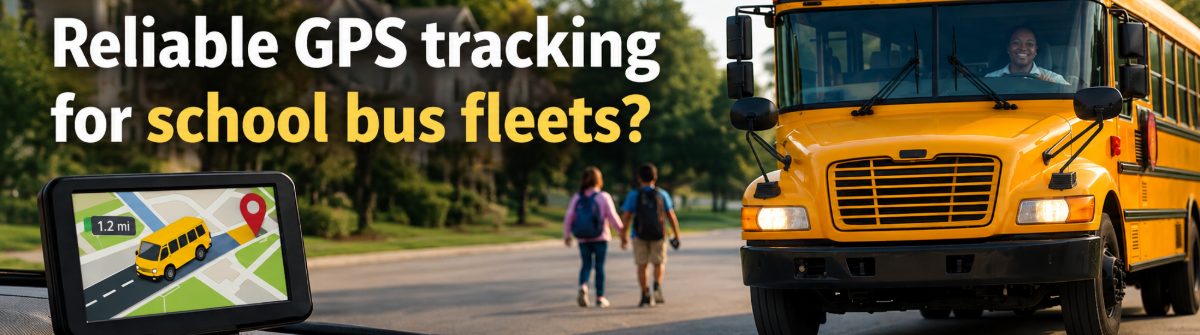
When it comes to student transportation, the word "reliability" isn't just a marketing buzzword, it’s a promise made to parents, administrators, and the community. Every morning and afternoon, thousands of school buses hit the road, and the stakes couldn’t be higher. In an era where we can track a pizza delivery in real-time, the expectation for knowing exactly where a school bus is located has become the standard.
But here is the reality, not all tracking systems are created equal. You might have a dot on a map, but if that dot is lagging by three minutes, or if the hardware doesn’t communicate with your routing software, is it actually helping you?
In this guide, we’re diving deep into what makes for reliable GPS tracking for school bus fleets, focusing on the critical integration of hardware and software, and why safety and efficiency are two sides of the same coin.
Reliability in a school bus fleet context goes beyond just "working most of the time." It’s about data integrity. A reliable system provides:
When these elements work together, you transition from reactive management to proactive safety. If a bus is running late, you shouldn't find out from a frustrated parent’s phone call. You should know the moment the bus deviates from its planned path.
The biggest mistake a transportation department can make is treating GPS hardware and routing software as two separate islands. When your GPS isn’t integrated with your routing platform, you’re left manually comparing two different sets of data.
At BusBoss, we emphasize that the true power of reliable GPS tracking for school bus fleets lies in the integration. By combining routing software with live GPS data, you can compare "Planned vs. Actual" routes. This allows you to see if a driver is taking an unapproved shortcut or if a specific stop is consistently taking longer than scheduled due to traffic patterns.
Integration also simplifies administrative tasks. For example, integrating with systems like Pearson PowerSchool ensures that student data is always up-to-date, which is vital when verifying which students are on which bus at any given moment.
Safety is the heartbeat of school transportation. Reliable GPS tracking acts as an invisible safety net. With high-fidelity tracking, fleet managers can monitor driver behavior through G-force detection and speed alerts.
Is a driver taking corners too sharply? Are they consistently exceeding the speed limit on a rural road? A reliable system doesn't just record this data; it flags it. You can even use this data to create safe driving incentives to encourage your best drivers to stay with the district, which is a huge win during the current school bus driver shortage.
Furthermore, for students with unique needs, reliability is even more paramount. Inclusive solutions for special education transportation require precise timing and specific equipment monitoring, all of which are facilitated by a robust GPS and routing integration.
Let's face it, the most common calls to a transportation office are "Where is the bus?" and "Why is the bus late?"
When you have reliable GPS tracking, you can provide parents with an app that shows the bus's location in real-time. This communication between parents and transportation drastically reduces the volume of phone calls to the office and, more importantly, provides peace of mind. Parents can see when the bus is three minutes away, allowing them to keep their children inside during inclement weather until the last possible moment.
Beyond safety, there’s a massive financial argument for investing in high-quality GPS tracking. Every minute of idling and every extra mile driven adds up to thousands of dollars in wasted fuel and maintenance costs over the school year.
By using the data from a transportation routing software system, you can:
If you’re wondering how to pay for these upgrades, there are many avenues for funding student safety technology that can help bridge the gap in your budget.
Reliable tracking isn't just for the daily commute. Managing field trips involves complex scheduling and often takes buses into unfamiliar territory. Using GPS tracking improves field trip management by allowing dispatchers to monitor buses that are far from the home base, ensuring that students are safe whether they are across town or across the state.
Not every system is the right fit for every district. Before you commit to a vendor, it's essential to do your homework. We’ve compiled a list of the best questions to ask when considering a student bus tracking system.
A few highlights include:
Even the most advanced GPS system is only as good as the people using it. Proper training for school bus drivers and dispatchers ensures that the technology is viewed as a tool for support, not a "big brother" surveillance device. When drivers understand how the software helps them stay on schedule and protects them in the event of a false claim, they are much more likely to embrace it. You can learn more about how to properly use transport software here.
Reliable GPS tracking for school bus fleets is no longer an optional luxury, it is a fundamental component of a modern, safe, and efficient transportation department.
At BusBoss, we specialize in making sure your fleet is more than just a collection of vehicles, it’s a data-driven operation focused on the safety of every student. Our TRIPpatrol and Orbit software solutions are designed to provide the reliability you need to sleep better at night.
Ready to see how reliable GPS tracking can transform your fleet? Contact the BusBoss team today for a personalized consultation or check out our case studies to see how we’ve helped districts just like yours.


 Orbit Software, Inc.
424 King Street
Pottstown, PA 19464

 (484) 941-0820