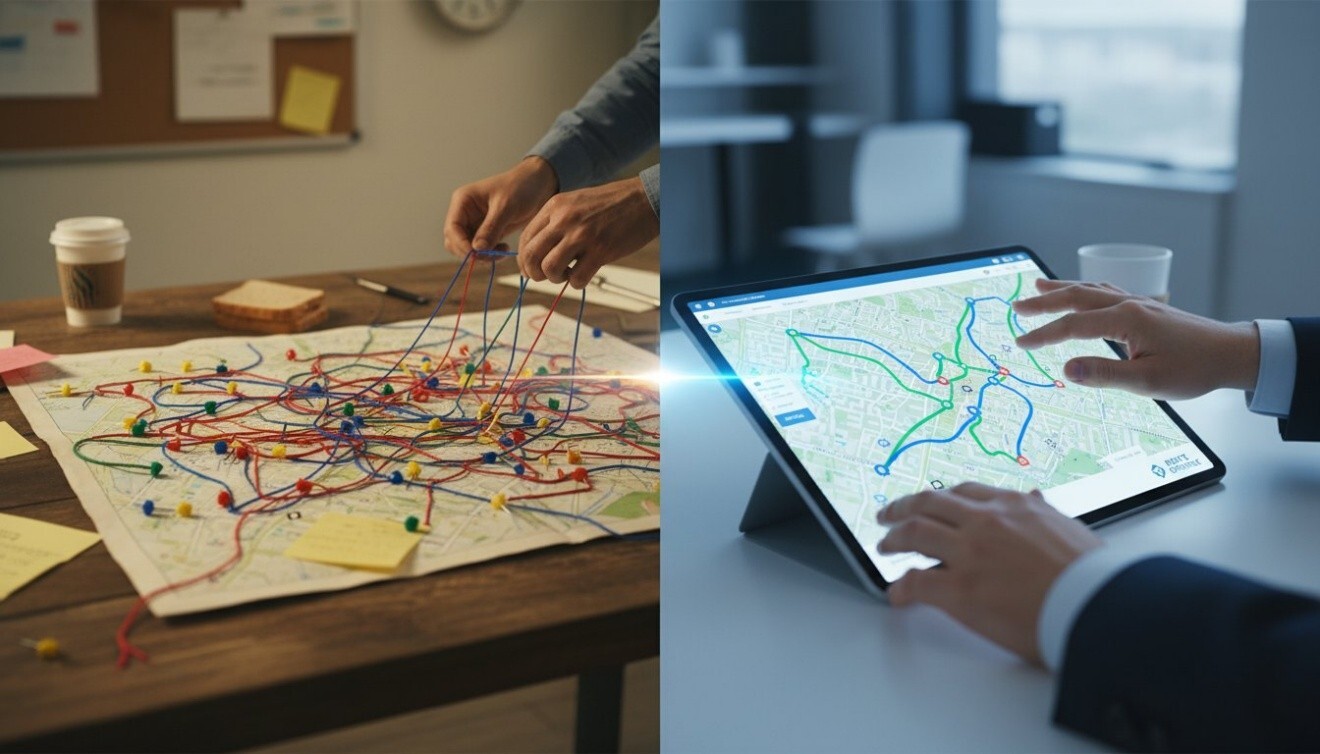
The morning bell rings, but your work started hours ago-piecing together routes with outdated maps, fielding calls about a late bus, and trying to manage rising fuel costs. If this sounds familiar, you know the daily stress of traditional transportation planning. As we look toward 2026, the operational cracks in this system are becoming impossible to ignore. The critical debate over manual vs automated bus routing is no longer about simple preference; it's about performance, fiscal responsibility, and the safety of your students.
This guide provides a clear-eyed look at the future of school transportation management. We will move beyond the surface-level discussion to deliver a data-backed analysis of the crucial differences in cost, efficiency, and, most importantly, the safety of your precious cargo. You will discover why switching to a modern, automated system is no longer a luxury but a strategic necessity for districts aiming to streamline operations, reduce daily stress, and manage routes with absolute confidence.
For many school districts, the transportation office looks the same as it did decades ago: a large wall map, a box of pushpins, and a series of complex spreadsheets. While familiar, this reliance on manual planning creates a significant operational risk. The entire system often depends on the institutional knowledge of a single veteran router. When that person retires or leaves, their expertise walks out the door, leaving the district vulnerable and scrambling to ensure every student gets to school safely and on time.
Manual planning is anything but free. A transportation coordinator spending hours each week on repetitive route adjustments is a direct labor cost that could be reallocated to higher-value tasks. More significantly, unoptimized routes directly inflate budgets through excess fuel consumption, unnecessary driver overtime, and accelerated vehicle wear and tear. These inefficiencies lead to inaccurate mileage and ridership reports, which can jeopardize state funding and erode the school board’s confidence in your department's management.
When protecting your district’s precious cargo, guesswork is not an option. Manual routing offers no real-time visibility, leaving you unable to confirm a bus's location during an emergency or account for all students. Responding to unexpected road closures, accidents, or severe weather becomes a slow, reactive process of phone calls and radio chatter. Furthermore, it's nearly impossible to manually guarantee compliance with complex rules like maximum student ride times or vehicle capacity limits, introducing potential safety and liability risks.
The core debate in manual vs automated bus routing often comes down to adaptability. With a manual system, one small change, like enrolling a new student-triggers a cascade of difficult adjustments. Planners must manually assess multiple routes, recalculate stop times, and redistribute paper schedules, a process that can take hours. This is a classic example of the complex vehicle routing problem, which is notoriously difficult for humans to solve optimally. This static approach offers no data for future improvements, making it impossible to proactively streamline operations.
Moving beyond pins and paper maps, automated bus routing software is an intelligent transportation management system. It's not just a digital map; it's a powerful tool designed to optimize your entire operation for safety, efficiency, and cost-effectiveness. In the debate of manual vs automated bus routing, the automated approach leverages a dynamic combination of sophisticated algorithms, real-time GPS data, and up-to-the-minute student information. This transforms the role of a transportation planner from a reactive route-drawer to a proactive, strategic manager with complete command over their fleet.
At the heart of the software are powerful route optimization algorithms. These systems analyze millions of potential route combinations in seconds-a task impossible for any human. They expertly balance a complex web of constraints, such as varying bell times, maximum student ride times, vehicle capacities, and road restrictions. As detailed in research from Carnegie Mellon University, managing these variables is a significant logistical challenge. The software solves this by allowing you to optimize for specific goals, whether it's using the fewest buses, creating the shortest routes, or minimizing overall travel time.
Unlike static paper maps, automated systems provide a live, dynamic view of your entire fleet through integrated GPS. This real-time tracking is a game-changer for daily operations and emergency response. If a bus breaks down or is delayed, you know immediately and can dispatch a replacement or reroute other vehicles with confidence. This live data also enhances driver accountability and provides valuable performance insights, ensuring every route is run as safely and efficiently as planned.
A key advantage in the manual vs automated bus routing discussion is seamless data integration. Automated software connects directly with your district's Student Information System (SIS). This eliminates the time-consuming and error-prone process of manually entering new student addresses or updating information. Any change in the SIS is automatically synced, ensuring your routes are always based on the most current and accurate data, which is critical for the safety of every child.
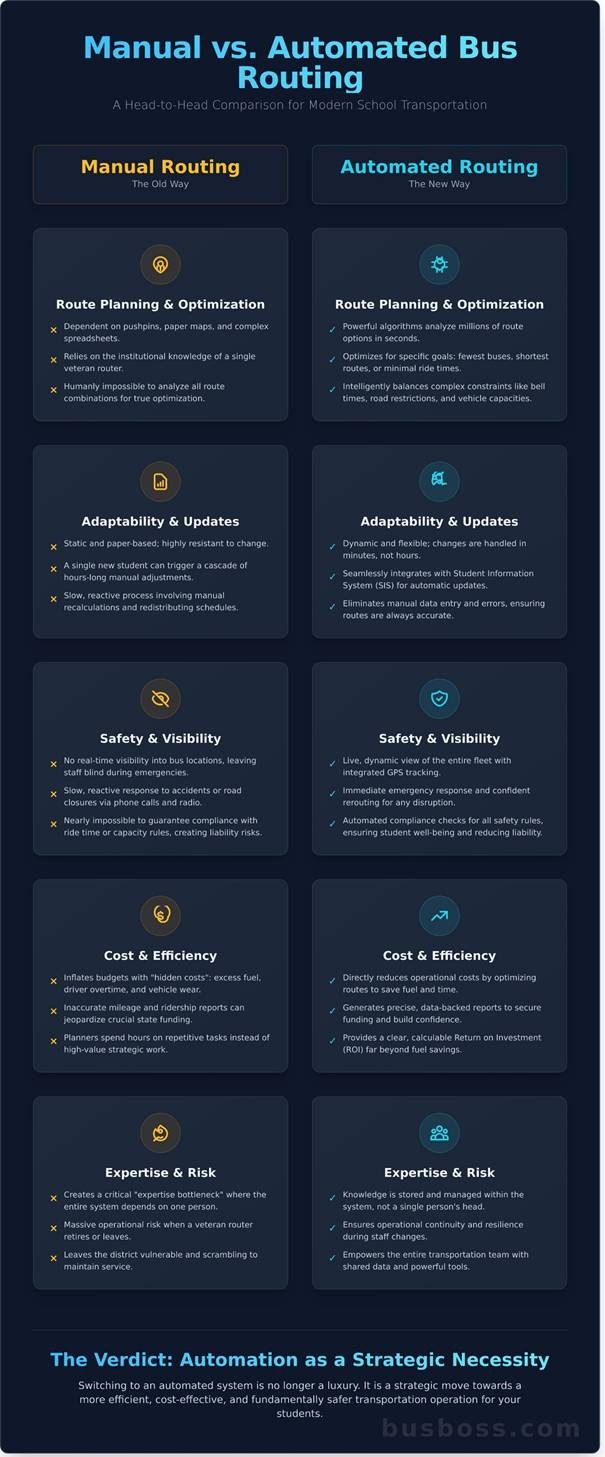
To truly understand the difference in the manual vs automated bus routing debate, it’s essential to move beyond abstract concepts and look at the daily realities of a transportation director. This head-to-head comparison breaks down common tasks, showcasing how each approach handles the challenges you face every day.
The Manual Method: This involves weeks of painstaking work-poring over physical maps, redrawing boundary lines with highlighters, and manually building complex spreadsheets. The process is slow, prone to human error, and nearly impossible to adjust once started.
The Automated Solution: Import your student data, set key parameters like maximum ride times and capacity limits, and let the software generate optimized routes in a matter of hours. This process, which leverages complex algorithms similar to those outlined in a recent technical paper on route optimization, allows you to model different scenarios, such as changing bell times or adding a new stop, to find the most efficient and cost-effective plan with confidence.
The Manual Method: An unexpected closure triggers a chain of frantic phone calls. You must reach the right driver, verbally guide them through an unfamiliar detour, and then field calls from other drivers and concerned parents, all while hoping the information is relayed correctly.
The Automated Solution: Your dashboard instantly flags all affected buses on a live map. With a few clicks, you can create an efficient detour and push the updated turn-by-turn directions directly to the drivers' tablets. You can even proactively notify parents of the delay, turning a crisis into a managed event.
The Manual Method: Reporting season means days spent manually compiling driver mileage logs, cross-referencing student ridership counts, and hoping the final numbers are accurate. This tedious process drains resources and leaves your district vulnerable during an audit.
The Automated Solution: Generate detailed, accurate reports for state funding, bell time studies, and federal compliance in seconds. The software automatically logs every mile and tracks every student scan, ensuring your data is precise, defensible, and always audit-ready.
The Manual Method: A parent calls, worried. You have to radio the driver, interrupt their route, wait for them to respond with their location, and then call the parent back. The entire process is inefficient and ties up your staff and the driver.
The Automated Solution: Instantly check the bus's real-time location on your live map and give the parent a precise update. Better yet, empower parents to answer the question themselves with a dedicated tracking app. See how our PARENTpatrol app reduces parent phone calls.
When evaluating manual vs automated bus routing, the discussion often centers on the initial software cost. However, a comprehensive financial analysis reveals that modern routing software is not an expense, but a strategic investment that delivers a significant return. By moving beyond manual methods, districts can unlock substantial savings, streamline operations, and enhance safety, creating a powerful business case for automation.
The true cost of sticking with manual routing lies in hidden inefficiencies, wasted resources, and unnecessary risks. A data-driven approach allows you to see the complete financial picture and make decisions with confidence.
The most immediate and quantifiable returns come from operational optimization. Automated routing systems consistently reduce fleet mileage by a conservative 5-15%. For a mid-sized district, this translates directly into major savings:
Beyond the hard numbers, automation generates value by streamlining your entire transportation department. This efficiency boost prevents the need for additional administrative hires as your district grows. Consider the time saved on tasks like generating state-mandated reports, managing driver schedules, and fielding parent phone calls with real-time bus location data. This reclaimed time is a powerful, albeit softer, return on investment.
While efficiency is important, the safety of your precious cargo is paramount. Automated routing software includes safety-centric features, like identifying hazardous stop locations or preventing students from crossing busy streets. This focus on safety helps reduce the risk of accidents, which can carry immense financial and emotional costs. Furthermore, accurate, automated reporting ensures compliance with state regulations, helping you avoid costly fines. This commitment to safety is the most invaluable ROI of all. Discover how bus routing software can secure your investment.
The prospect of overhauling a familiar, long-standing manual routing system can seem daunting. Concerns about data migration, staff training, and implementation disruption are valid. However, with a proven partner and a methodical approach, the transition is not just manageable-it's a streamlined process designed to build confidence and deliver immediate value. The debate over manual vs automated bus routing often overlooks the comprehensive support modern providers offer.
You are not alone in this process. A dedicated vendor will guide your team through a structured transition, ensuring a smooth and successful deployment. The journey can be broken down into three clear phases.
The foundation of any powerful routing system is clean, accurate data. This initial step involves gathering and organizing your student information, school locations, and zone boundaries. A quality vendor will not leave you to handle this alone; their experts will assist with data conversion, importing information from your Student Information System (SIS), and cleaning up GIS map data to ensure routing accuracy from day one. This foundational work is critical for the system's long-term success.
Once your data is in place, the focus shifts to your team. A dedicated project manager from your software provider will lead the implementation, tailoring the system to your district's unique rules and policies. This is followed by comprehensive training for planners, dispatchers, and administrative staff. Programs like BusBoss's SuccessRoute Training are designed to empower your team, ensuring they can manage routes with confidence and leverage the software to its full potential.
The final step is a carefully managed launch. To ensure a seamless transition and build trust in the new system, many districts run the new, optimized routes in parallel with their old ones for a short period. This allows for real-world testing and fine-tuning. The goal isn't a one-time fix, but a permanent upgrade to your operations. Automated routing provides the tools for continuous refinement, allowing you to adapt to changing student populations and road conditions, ensuring the safe, efficient transport of your precious cargo for years to come.
By partnering with an experienced provider, you can navigate the transition from manual vs automated bus routing with a clear, supportive roadmap. To learn more about our structured implementation process, explore the solutions offered by BusBoss.
As we look toward 2026 and beyond, the debate over manual vs automated bus routing has reached a clear conclusion. Manual planning, with its inherent inefficiencies and potential for error, can no longer meet the complex safety and budgetary demands of modern school districts. The evidence is undeniable: automated routing software delivers superior route optimization, significant cost reductions, and, most importantly, enhanced safety for every student. It transforms transportation from a daily challenge into a streamlined, data-driven operation.
Making the switch is more than an upgrade; it's a commitment to a safer, more efficient future. With over 25 years of experience, BusBoss is the trusted partner for hundreds of school districts, ensuring your precious cargo comes first. Our dedicated SuccessRoute training and support guarantee a smooth transition for your team. See the difference for yourself.
Ready to manage your routes with confidence? Request a Live Demo to See Automation in Action and take the first step toward building a smarter, more reliable transportation system for your community.
The transition timeline varies based on district size and data quality, typically ranging from a few weeks to a couple of months. The process involves key stages like data conversion from your Student Information System (SIS), map setup, and comprehensive staff training. A dedicated implementation team works with you to ensure a smooth, managed rollout, minimizing disruption to your daily operations and ensuring your team is confident from day one. This initial investment in time quickly pays off in long-term efficiency.
While there is an upfront investment, automated routing software is designed to be cost-effective, even for small districts. The return on investment is realized through significant savings in fuel, vehicle maintenance, and administrative hours. Modern solutions offer scalable pricing models, ensuring you only pay for the features you need. This shifts the focus from an expense to a strategic investment in operational efficiency and the safety of your precious cargo, making it a financially sound decision.
Absolutely. Robust routing software is specifically designed to manage complex transportation needs with precision. It can seamlessly handle individual student requirements, such as wheelchair-accessible vehicles or maximum ride time constraints for special needs students. The system also expertly manages logistical challenges like tiered bell schedules, alternate addresses for joint custody situations, and out-of-district placements, ensuring every student receives safe and reliable transportation tailored to their specific circumstances.
Comprehensive training is essential for success, and it's designed for users of all technical skill levels. Our dedicated training programs guide your transportation staff through every aspect of the software, from daily operations to advanced route optimization. The training is hands-on and tailored to your district's specific data and policies, ensuring your team can manage routes with confidence and maximize the software's powerful capabilities from the very beginning.
Automated routing platforms centralize information, which is key to improving communication. In the debate of manual vs automated bus routing, automation provides a clear advantage with integrated parent portals and driver apps. These tools offer real-time GPS tracking, push notifications for delays, and instant updates on route or stop changes. This proactive communication stream reduces parent inquiries and empowers drivers with the accurate, up-to-the-minute information they need to operate safely and efficiently.
This is a common concern, but the opposite is true-you gain more strategic control. The software acts as a powerful planning assistant, not a replacement for your expertise. It generates optimized route suggestions based on your specific rules and constraints. Your transportation managers retain full authority to review, manually adjust, and approve every route. This allows them to combine powerful data analysis with their invaluable local knowledge for the safest, most efficient outcomes.


 Orbit Software, Inc.
424 King Street
Pottstown, PA 19464

 (484) 941-0820