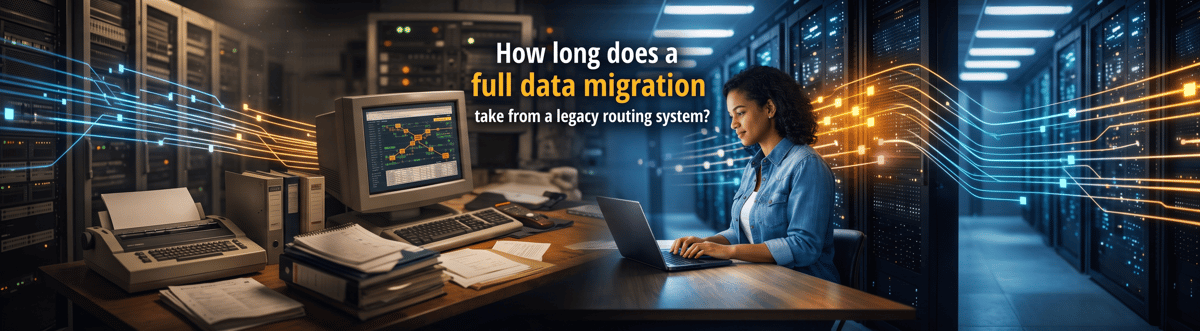
If you have been in the school transportation industry for a while, you know the "comfortable" feeling of a legacy system. It’s the software you’ve used for a decade. You know all its quirks, even if those quirks involve manual data entry, frequent crashes, and a user interface that looks like it belongs in 1995.
But there comes a point where the "comfort" of an old system starts costing you more than the fear of a new one. Maybe you are struggling with the school bus driver shortage and need better optimization to cover routes, or perhaps your current system simply can’t keep up with modern parent demands for real-time tracking.
The big question that stops most Transportation Directors in their tracks is, "How long is this actually going to take?"
Nobody wants to be halfway through a data migration when the first day of school hits. Let’s take a realistic, no-nonsense look at the timelines, the hurdles, and how you can move from your legacy system to a modern solution like BusBoss without losing your sanity.
If you are looking for a quick number, most school district migrations take anywhere from three to nine months.
However, a full-scale enterprise migration lifecycle: from the moment you sign the contract to the moment your last bus is tracked perfectly on a map: can technically span 12 to 26 months if you include long-term planning and post-launch optimization.
According to industry research, the timeline is heavily dictated by the migration approach you choose:
Before a single row of data moves, you need a plan. This is the stage where many districts try to cut corners, and it’s exactly why migrations fail or stall.
During this phase, we look at what you actually have. Legacy systems are notorious for "data rot." This includes:
You need to decide if you are doing a "Big Bang" migration (switching everything over on a single weekend) or a phased approach (moving one terminal or one grade level at a time). Most experts suggest a phased approach to minimize risk, even if it takes a bit longer. To understand more about the initial steps of modernizing, check out our Orbit Software guide.
This is the "heavy lifting" portion of the migration. In a legacy system, data is often stored in proprietary formats that don't play nice with modern SQL databases.
We have to extract that data, but more importantly, we have to transform it. Modern routing software relies heavily on accurate mapping. If your old system used a localized grid that doesn't align with global GPS coordinates, every single stop will need to be verified.
This is also the best time to integrate your Student Information System (SIS). Linking your routing software to platforms like Pearson PowerSchool can save an incredible amount of time and money in the long run. In fact, PowerSchool integration is one of the most effective ways to ensure your data stays "clean" after the migration is over.
You wouldn't buy a bus without a test drive, and you shouldn't launch routing software without a "sandbox" period. This is where we load your migrated data into a private version of BusBoss and let your team try to break it.
During this phase, Transportation Directors typically look for:
Testing is often the longest phase because it’s where the "real world" meets the "digital world." You might find that a stop that worked in the old system is now flagged as unsafe because of updated turn-radius requirements or new safety regulations.
Why do some districts finish in three months while others take a year? It usually comes down to three things:
If your data is currently managed in three different Excel sheets and a physical notebook, the "transformation" stage is going to be a hurdle. Clean data equals a fast migration.
Migration isn't just a software job; it's a people job. If your dispatchers and routers are already working 60 hours a week because of the driver shortage, they won't have the bandwidth to validate data. At BusBoss, we try to take as much of the weight off your shoulders as possible, but we still need your local expertise.
If you are also installing new GPS hardware on your fleet simultaneously, add a few months to the timeline. Coordinating the physical installation with the software migration requires a synchronized dance. However, the benefits: like improving field trip management: are well worth the wait.
We get it. Twelve months sounds like a long time. You might be thinking, "I can just keep patching my old system."
But consider the cost of doing nothing. Legacy systems often lack the optimization tools needed to lower transportation costs. A modern system can often reduce the number of routes needed by 5-10% through better algorithmic planning. In a large district, that’s hundreds of thousands of dollars in fuel and labor savings.
Furthermore, modern systems offer better web security, protecting sensitive student data from breaches that legacy systems are increasingly vulnerable to.
To wrap it up, here is your realistic "Cheat Sheet" for a data migration timeline:
Migration is a marathon, not a sprint. It requires a partner who understands that school transportation isn't just about moving dots on a map: it's about serving students and communities.
Ready to start the clock?
At BusBoss, we specialize in helping districts transition from outdated legacy systems to a reliable, modern future. We’ve seen it all, from the tiniest rural districts to massive urban fleets.
Check out our case studies to see how we’ve helped other Transportation Directors navigate this process, or contact us today to get a customized assessment of your district’s data migration needs. Let’s get your data moving in the right direction.


 Orbit Software, Inc.
424 King Street
Pottstown, PA 19464

 (484) 941-0820