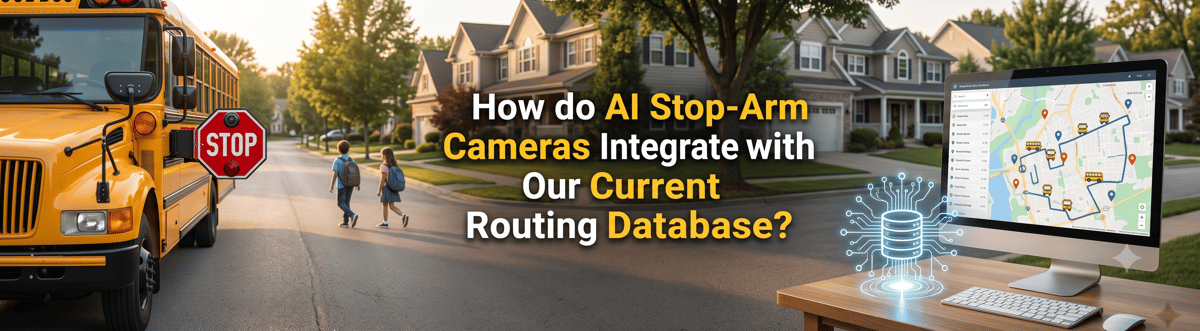
If you’re a K-12 Transportation Director, you probably spend a good chunk of your week looking at data. You’ve got routes, driver schedules, fuel costs, and student manifests all living within your central routing database. But there’s one piece of data that’s becoming increasingly vital, and frankly, a bit stressful, stop-arm violations.
We’ve all seen the viral videos of cars blowing past a stopped bus while the red lights are flashing. It’s the kind of thing that keeps us up at night. While many districts are turning to AI stop-arm cameras to catch these offenders, a common question we get here at BusBoss is, "How does this actually talk to the software I already use?"
The short answer? It’s all about the "digital handshake." But let’s dive into the nuts and bolts of how AI stop-arm cameras integrate with your routing database to create a safer, more efficient enforcement system.
In the old days (which was really just a few years ago), if you had a stop-arm camera, it functioned like a standalone DVR. If a violation happened, someone had to manually pull a hard drive or SD card, sift through hours of footage, and try to match it up with a specific bus and location.
This created a "data silo." Your routing software knew where the bus was supposed to be, but your camera system only knew what it saw. Bringing those two worlds together was a manual, time-consuming headache.
Modern AI integration changes that. By connecting your camera system directly to your route software, you transform raw video into actionable evidence.
The magic happens through three primary channels, APIs, LTE connectivity, and GPS synchronization.
API stands for Application Programming Interface. Think of it as a translator that allows two different software programs to speak the same language. When your AI stop-arm camera system has an API partnership with your routing provider, the data flows seamlessly between them.
When the AI detects a violation, it doesn't just save a clip; it pings the routing database. It says, "Hey, I’m Bus #42, and I just caught a violation at 123 Maple Street at 3:15 PM." The routing database then confirms, "Copy that, Bus #42 was scheduled for Stop #7 at that exact time."
Waiting until a bus returns to the lot to download footage is a thing of the past. Integrated systems use high-speed LTE or 5G connectivity. This allows the AI to upload violation clips to a cloud-based platform the moment they happen.
This real-time sync ensures that your central database is always up to date. You can see violations as they occur on a live map, allowing you to identify high-risk areas immediately rather than waiting for a weekly report.
Every piece of video captured by an AI stop-arm camera is tagged with "metadata." This includes the GPS coordinates, the speed of the bus, the status of the flashing lights, and the exact timestamp.
Because your routing database already uses GPS to track your fleet, it can overlay the camera’s metadata onto your planned routes. This allows you to see if a violation happened at a designated stop or during a transit segment, providing crucial context for law enforcement.
The primary goal of this integration isn't just to catch people; it's to change driver behavior. However, for that to happen, the evidence needs to be ironclad.
When the camera system and the routing database are integrated, the enforcement package is automatically generated. This package usually includes:
This comprehensive data set makes it much easier for local police departments to issue citations. In states like Indiana, where there is a heavy focus on improving school bus stop safety, having this level of integrated data is a game-changer for local law enforcement partnerships.
Integration sounds like a "tech thing," but the benefits are very much "people things."
Manual data entry is the enemy of productivity. When your systems talk to each other, your staff doesn't have to spend hours matching video clips to bus numbers. This lowers administrative costs and allows your team to focus on more important tasks, like managing the ongoing driver shortage.
If your routing database is receiving constant updates about where violations are happening, you can use that data to make your routes safer. If a particular stop on a busy four-lane highway has a high rate of stop-arm violations, you might choose to relocate that stop to a side street. Without integration, you might never see the full pattern of danger.
Let’s be honest: safety tech isn't cheap. However, many stop-arm programs are "revenue neutral" or even revenue-generating through citation fines. Having an integrated system ensures that no violations slip through the cracks, which helps in funding student safety technology for the long haul.
Before you sign on the dotted line for a new AI camera system, you need to make sure it will actually work with your current setup. Here are a few questions to toss at your potential vendors:
Getting these answers upfront will save you a world of hurt during the implementation phase.
Integrating AI stop-arm cameras with your routing database isn't just about cool technology, it’s about creating a unified shield around your students. When your cameras and your software work together, you get:
Safety shouldn't happen in a vacuum. By breaking down the silos between your bus cameras and your routing database, you’re making sure that every "red light" is backed by the full power of your district's data.
Ready to see how your routing can work smarter, not harder?
At BusBoss, we specialize in making sure your transportation data works for you, not against you. Whether you're looking to upgrade your routing software or integrate new safety tech, we're here to help.
Contact us today for a live demo of how we integrate with the latest safety technology!


 Orbit Software, Inc.
424 King Street
Pottstown, PA 19464
 (484) 941-0820