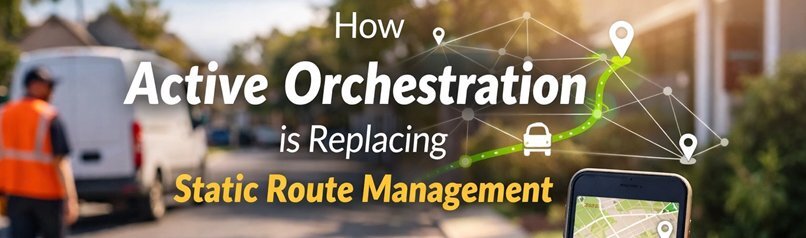
The landscape of K-12 transportation has shifted dramatically. If you stepped into a district transportation office five years ago, you’d likely see walls covered in paper maps, highlighters, and massive spreadsheets. Fast forward to March 2026, and the industry is undergoing its most significant evolution since the invention of the GPS.
For decades, "Static Route Management" was the gold standard. You planned your routes in August, tweaked them in October, and essentially crossed your fingers that nothing major changed until June. But in a world of fluctuating fuel prices, an ongoing driver shortage, and parents who expect Amazon-level transparency, "static" simply isn’t enough anymore.
We are entering the era of Active Orchestration. This isn't just a buzzword; it’s a fundamental change in how school districts move students safely and efficiently. As we look toward the 2026/2027 school year, let’s explore why active orchestration is the only way forward.
Static routing assumes that every day is the same. It assumes every student will be at their stop, every driver will show up for their shift, and every road will be clear of construction. We know that’s never the case.
When a district relies on static routes, they are inherently reactive. If a bus breaks down or a driver calls in sick, the dispatcher has to scramble. They manually reassign stops, print out new turn-by-turn directions, and hope the substitute driver doesn't get lost. This fragmentation leads to:
Active Orchestration is the transition from "planning a route" to "managing a live network." It is the continuous, real-time synchronization of routing data, vehicle telematics, driver inputs, and parent notifications.
Unlike static routing, which is a snapshot in time, Active Orchestration is a living system. It uses AI and Large Language Models (LLMs) to analyze data patterns and suggest optimizations on the fly. It doesn’t just tell a driver where to go; it tells the entire district how to breathe.
1. Real-Time Demand Adaptation
In 2026, many districts have moved toward "opt-in" transportation models. With student tracking integration, the system knows exactly who is on the bus. If the system detects that four consecutive stops have zero student check-ins via their RFID cards, Active Orchestration can recalculate the route in real-time to bypass those empty stops, saving time and fuel.
2. The Unified Tech Stack
One of the biggest hurdles to efficiency is a "fragmented tech stack", having one software for routing, another for GPS, and a third for parent communication. Active Orchestration requires a unified platform like BusBoss. When your data lives in one place, a change in the routing software instantly updates the driver’s tablet and the parent’s smartphone app.
3. Predictive Problem Solving
Instead of waiting for a driver to call in a traffic jam, Active Orchestration uses live traffic feeds to predict delays before they happen. The system can suggest a detour to the driver’s tablet automatically, ensuring the bus stays on schedule and safety remains the top priority.
The driver shortage remains the #1 challenge for K-12 transportation in 2026. However, Active Orchestration is proving to be a powerful retention and recruitment tool.
When routes are static and confusing, new drivers feel overwhelmed. By implementing Active Orchestration, districts provide drivers with high-tech support. Digital manifests that update in real-time, clear visual navigation, and instant communication with dispatch make the job significantly less stressful.
By properly using transport software, districts can optimize their existing workforce to do more with less. If the orchestration engine can consolidate five inefficient routes into four optimized ones, it's like "finding" a new driver out of thin air.
As we look toward the next school year, the push for Active Orchestration will be driven by three major factors:
1. Parent Expectations for Transparency
Modern parents are used to tracking their Uber, their pizza delivery, and their Amazon packages. They expect the same for their children. Active Orchestration feeds real-time data to parent apps, reducing the "Where is the bus?" phone calls by as much as 90%. This communication between parents and transportation is no longer a luxury, it's a requirement.
2. Fiscal Responsibility and Funding
With tightening budgets, school boards are looking for ROI. Moving from static to active management offers clear financial gains. Reduced idling time, optimized mileage, and the ability to justify every dollar spent through detailed reporting make Active Orchestration an easy sell for funding student safety technology.
3. Integration with Student Information Systems (SIS)
In 2027, the "siloed" transportation department will be a thing of the past. Integration with systems like PowerSchool ensures that when a student's address changes in the front office, the route is orchestrated to accommodate them by the next morning. This integration saves school money and eliminates the dangerous lag time that leads to students being left at the wrong stop.
Transitioning from static route management to Active Orchestration might seem daunting, but it doesn't happen overnight. It starts with audit and integration.
Start by asking these questions:
If the answer to any of these points indicates a gap, it’s time to look at a more reliable, unified solution.
The era of set-it-and-forget-it routing is over. The complexity of modern K-12 environments demands a system that is as dynamic as the students it serves. Active Orchestration provides the agility needed to handle the unexpected, the transparency parents crave, and the efficiency that keeps districts solvent.
By embracing this shift, transportation directors can move from a state of constant "firefighting" to a state of strategic management. You aren't just moving buses, you're orchestrating a complex, vital community service.
Ready to see how Active Orchestration can transform your district?
Contact BusBoss today for a personalized demo of our unified transportation management suite and discover how we can help you move toward a more efficient 2026/2027 school year.


 Orbit Software, Inc.
424 King Street
Pottstown, PA 19464

 (484) 941-0820