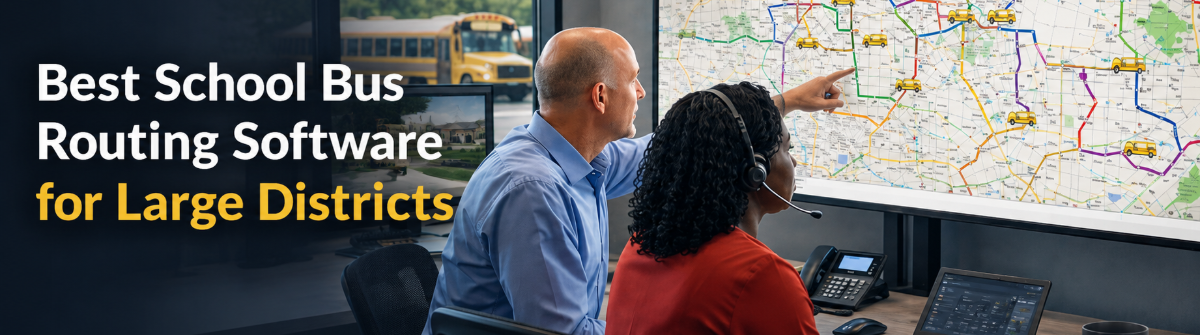
For a small school district with five buses and a single elementary school, bus routing is manageable. You might even be able to do it with a physical map and a few highliners. But for large districts, the ones managing hundreds of routes, thousands of students, and a diverse fleet of specialized vehicles, the complexity doesn’t just grow, it compounds.
When you are managing transportation for a large district, you aren’t just looking for "software." You are looking for a logistics engine capable of handling massive datasets, real-time adjustments, and the high-stakes safety requirements of a massive community.
In this guide, we will break down what truly makes the best school bus routing software for large districts and why scalability, integration, and reliability are the non-negotiables.
Large districts face hurdles that smaller ones rarely encounter. The sheer volume of data is the first obstacle. When you have 20,000+ students, a 1% error rate in your data means 200 students are at the wrong stop. That is unacceptable.
Beyond data volume, large districts deal with:
To solve these, you need a system designed for high capacity operations.
In a large district, you cannot rely on "approximate" locations. If a student is on the wrong side of a busy four-lane highway, it’s a safety disaster. The best routing software must utilize Geographic Information Systems (GIS) to provide pinpoint accuracy.
GIS integration allows transportation directors to visualize routes over high-resolution maps that include data on traffic patterns, road hazards, and even "no-turn" zones for large vehicles. Unlike generic mapping tools, GIS-integrated software like BusBoss allows you to set custom policies, such as ensuring a bus never makes a left turn across a major intersection or avoiding specific high-traffic areas during peak hours.
Many software solutions work fine when managing 50 routes, but they start to lag or crash when you ask them to optimize 500. For large districts, the software must be built on a robust architecture that can handle simultaneous users and massive calculations without slowing down.
Reliability is the cornerstone of our brand at BusBoss. Large districts need a system that offers transparent, modular pricing and, most importantly, allows the district to retain its data. In an era where "cloud-only" often means "vendor-owned," we believe districts should have the flexibility to manage their data infrastructure in a way that suits their security protocols.
One of the biggest time-wasters in large districts is manual data entry. If your Student Information System (SIS) doesn't talk to your routing software, your transportation team is constantly playing catch-up with student moves, new enrollments, and address changes.
The best school bus routing software for large districts offers direct, automated integration with major platforms like PowerSchool, Tyler SIS, and Infinite Campus. For example, integrating with Pearson PowerSchool can save a district thousands of dollars by eliminating duplicate work and ensuring that student data is always current.
When a student’s address changes in the front office, it should automatically trigger a route update in the transportation office. This level of synchronization is essential for maintaining safety and efficiency at scale.
Large districts often have a significant percentage of students requiring specialized transportation services. This isn't just about adding a stop, it’s about managing specialized equipment (like wheelchair lifts), door-to-door requirements, and specific medical needs.
The routing logic for Special Ed is fundamentally different from Regular Ed. You need software that can handle these complex variables while still optimizing for time and cost. We’ve seen how revolutionizing special education transportation can transform a district’s budget and, more importantly, the student experience.
In a large district, the transportation office is a mission control center. You need to know where every bus is at every second. This is where tools like DISPATCHpatrol come into play.
Real time dispatching allows you to see:
Furthermore, with the current school bus driver shortage, large districts are often forced to use substitute drivers. Providing these drivers with navigation tablets that offer turn-by-turn directions specifically designed for school buses is a game changer. It reduces the stress on the driver and ensures that students are picked up on time, even if the driver is on a brand new route.
The larger the district, the more phone calls the transportation office receives. "Where is the bus?" is the most common question. For a district with 10,000 students, those calls can paralyze a staff.
A robust parent portal with real-time tracking is no longer a luxury, it’s a necessity. By providing parents with a secure app where they can see their child’s bus location and receive push notifications for delays, you drastically reduce the administrative burden on your staff. More importantly, it builds trust within the community. When you improve communication between parents and transportation, you create a safer, more transparent environment for everyone.
Large districts have large budgets, but they are also under the most scrutiny. Every mile driven and every gallon of fuel used is a taxpayer expense.
Using advanced routing software allows districts to perform "what if" scenarios. What if we shifted the high school start time by 15 minutes? What if we consolidated three stops into one? The ability to model these changes before implementing them can lead to massive savings. In fact, transportation routing software systems consistently lower costs by optimizing routes to reduce "deadhead" miles and idle time.
According to industry research, two names frequently rise to the top for large-scale implementations: Edulog and BusBoss.
If you are tasked with selecting the best school bus routing software for a large district, focus on these five takeaways:
Managing a large fleet is a heavy responsibility, but with the right tools, it becomes an optimized, efficient, and safe operation.
Ready to see how BusBoss can scale with your district’s needs?
Contact us today for a live demo and see how we can simplify your most complex routing challenges. Whether you're looking for tips on using route software or need a full system overhaul, we’re here to help.


 Orbit Software, Inc.
424 King Street
Pottstown, PA 19464
 (484) 941-0820