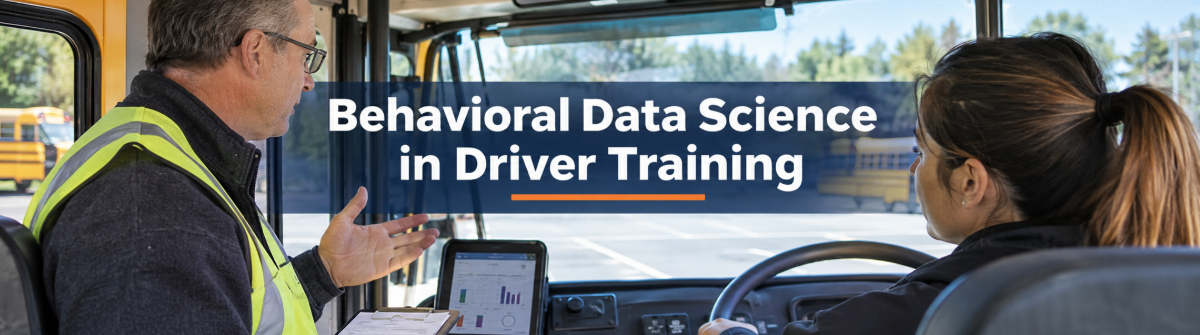
For decades, many districts have relied on a largely uniform format for driver training. That approach can miss in both directions. Experienced drivers may sit through material they already know, while drivers who need help with a specific skill may not get enough focused support.
Behavioral data science can make coaching more specific and fair. The value is not watching drivers more closely. It is using observable events to guide useful conversations, with a process drivers can understand and question. This article explains what event data can show, how it can inform training, what districts should decide about privacy and fairness, and how to test an approach before expanding it.
Event data is a starting point for a conversation, not a complete account of what happened. Safety metrics are most useful when interpreted with route, conditions, and other relevant context.
Personalized driver training depends on a repeatable process. The district should be able to explain how an event led to a coaching topic and how it will assess whether the coaching helped.
Drivers will judge a program by whether it accounts for their actual working conditions. If driver behavior monitoring feels like surveillance, trust can break down before the first coaching session. Districts should explain the purpose plainly. The focus is learning and safer habits, not catching people out.
A fair process also recognizes that data is not automatically neutral. A record can be incomplete or misleading. Driver coaching should include a person who can review the event, listen to the driver, and explain why a training step is recommended. Involving driver representatives in policy design can surface concerns early and help make the rules understandable.
Before installing a device or collecting records, write down the answers to these policy questions. Clear rules help employees understand how information will be used and give managers a consistent reference.
A pilot lets a district test both the data and the policy on a manageable scale. Plan for implementation challenges, including device setup, staff training, record review, and driver questions.
Patterns across drivers may point to a location or condition rather than an individual. If several drivers record hard stops at the same intersection, a stop review may be more useful than scheduling several separate coaching sessions. Consider visibility, traffic flow, and the approach to the stop.
The broader school transportation management picture matters here. Districts can use route history and vehicle location information as operational context, while recognizing that these records are not a driver coaching system. TRIPpatrol provides vehicle location and route history information, and BusBoss Enterprise brings GPS information into route review. The ROUTEpatrol Tablet App provides drivers with route details and captures student boarding and exiting information. ROUTEpatrol Web supports route work through a browser.
These tools can help a district understand route context, but they do not replace dedicated event data, a coaching policy, or human review. Maintenance history can also provide another relevant point of reference when reviewing a vehicle related concern. FLEETpatrol supports fleet maintenance and inspection record management. Learn more about the broader BusBoss product range.
Behavioral data science is valuable when it makes training specific without making the process feel arbitrary. The strongest programs define what is collected, account for route conditions, look for patterns, give drivers a chance to respond, and verify whether coaching made a difference. A carefully scoped pilot can show whether the approach is useful for your district and trusted by the people who will use it.
Start by documenting the policy questions, then invite driver representatives into the discussion before selecting a pilot group. To see how BusBoss tools can support route and vehicle context in your district, schedule a demo.


 Orbit Software, Inc.
424 King Street
Pottstown, PA 19464

 (484) 941-0820