

Let's talk about the elephant in the dispatch office: your driver turnover rate.
You've probably spent the last year watching good drivers walk out the door, and honestly? Your route planning might be the reason why.
I know that sounds harsh. But here's the thing, driver shortages aren't just about pay anymore. Sure, competitive wages help, but when a driver quits because their route is a nightmare to navigate, or they're constantly running late through no fault of their own, or they feel like nobody listens when they flag issues… that's on the routing system.
The good news? Most of these problems are fixable. The bad news? You're probably making at least three of these mistakes right now without realizing it.
Let's break down the seven route planning errors that are quietly destroying driver morale, and what you can actually do about them.
Here's a scenario that plays out in transportation departments everywhere: The routing team spends hours crafting what looks like a perfect route on paper. Efficient stop sequence, balanced time windows, minimal left turns across traffic. Beautiful.
Then you hand it to a driver who's been navigating your district for eight years, and they immediately spot three problems you missed.
Why this costs you drivers: Nothing burns out a professional faster than feeling like their expertise doesn't matter. Your veteran drivers know which neighborhoods have aggressive dogs that make certain stops unsafe before 7 AM. They know that the GPS says Maple Street connects to Oak Avenue, but there's actually a chained-off access road that hasn't been updated in the mapping system. They know that the 15-minute window you've allocated for the middle school run is impossible when you factor in the crossing guard's timing.
When you plan routes in isolation, you're essentially telling drivers, "We don't trust your judgment." And when drivers feel disrespected, they start looking at job postings for Amazon delivery or local transit, roles where their input might actually be valued.
The fix: Build feedback loops into your routing process. Before finalizing any new route or major change, have a driver walkthrough session. Some districts use a simple shared document where drivers can flag concerns. Others schedule quarterly route review meetings. The method matters less than the message: driver knowledge is a routing asset, not an inconvenience.
If you're using modern transportation management software, you should have tools that let drivers submit route notes or suggested optimizations directly in the system. That real-world intel is gold, use it.
Pop quiz: When you built that morning route that's supposed to take 47 minutes, did you account for:
If you answered "no" to any of these, you've built a time bomb, not a time window.
Why this costs you drivers: Chronic lateness is demoralizing. When a driver is consistently running behind despite doing everything right, they internalize failure. They start skipping their own break to make up time. They stress about angry parents and frustrated school staff. Eventually, they decide the job isn't worth the anxiety.
The kicker? It's not their fault. It's a planning failure.
The fix: Build routes with buffer time baked in. Industry best practice suggests adding 10-15% cushion to your calculated drive times. That might sound wasteful, but consider what you're actually wasting when you don't: driver mental health, fuel from speeding to make up time, and the $3,000-$8,000 it costs to recruit and train a replacement driver.
Also, revisit your routes seasonally. A route that works perfectly in October might be a disaster in January when sunrise is 45 minutes later and you're navigating snow-covered rural roads. Understanding how routing systems work means understanding that routes are living documents, not set-it-and-forget-it plans.
There's a sweet spot between "we've run the same routes since 1987" and "we're optimizing routes every two weeks." Most districts miss it.
The too-rigid problem: Districts that never update routes end up with routes that made sense when the subdivision had 12 houses but now has 340. Drivers waste time on outdated patterns, and you're burning fuel on inefficient paths.
The too-flexible problem: Some districts treat routes like draft documents, constantly tweaking them in response to every new student registration or address change. Drivers never get comfortable. Parents complain because pickup times keep shifting. Nobody can build muscle memory for their route.
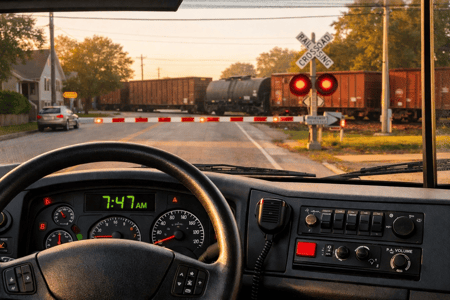
Why this costs you drivers: Inconsistent routes are cognitively exhausting. A driver who's running a different variation of "their" route every week can't work on autopilot for the routine parts, which means they're mentally fatigued for the parts that actually require focus, like navigating construction or managing behavior issues.
The fix: Establish a route change policy with clear criteria. Minor adjustments (one or two new stops) can happen as needed. Major re-routes should be limited to defined windows, like the start of each semester, unless there's a critical safety issue.
When you do make changes, give drivers advance notice. A week's heads-up with a clear change summary ("We're swapping stops 14 and 15 to reduce left turns") shows respect for their preparation time.
You know what makes drivers crazy? Routes that look efficient on a map but require 47 decision points in actual practice.
"Turn left on Brookside, then immediately right on the unmarked access road behind the church, proceed 0.3 miles to the turnaround that's not visible from the road, then back out carefully because there's no turning radius…"
Why this costs you drivers: Overcomplicated routes don't just slow things down, they're cognitively draining. Every unnecessary decision point is adding to your mental load. Multiply that across an entire route, then across an entire school year, and you've got a recipe for burnout. New drivers are especially vulnerable. If your route directions require institutional knowledge to execute, you're setting up new hires to fail (and quit within the first 90 days).
The fix: Apply the "substitute driver test." Could a substitute driver run this route with just the written directions and basic GPS, without calling dispatch for clarification? If not, simplify it.
Modern routing software should help you minimize complexity by default, fewer turns, wider turning radii, more straightforward navigation. If your current system is generating routes that require a decoder ring to understand, that's a red flag about your routing technology stack.
Here's a fun exercise: Pick your three most challenging routes. Now go drive them yourself. Not just once, drive them during the actual time windows your drivers navigate, with the actual weather and traffic conditions they face. Most transportation directors haven't done this. And it shows.
Why this costs you drivers: There's a massive gap between theoretical route planning and actual route execution. That turn that looks fine on Google Earth? It's terrifying in a 35-foot bus when there's ice on the road. That "quick stop" at the apartment complex? It involves navigating a parking lot designed by someone who apparently hates buses. When planners don't validate routes in real-world conditions, drivers feel like they're being set up to fail with impossible expectations.
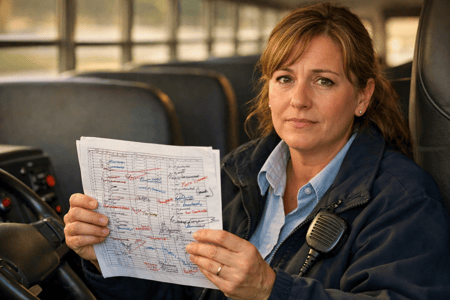
The fix: Institute a route validation protocol. Before any new route goes live, have it driven by either a routing specialist or an experienced driver during the actual operating conditions. Document issues. Adjust accordingly.
Some districts use a "shadow run" system where a new route is driven by a trainer and a new driver together before the new driver flies solo. This catches issues before they become driver-retention problems.
Not all route hours are created equal. An hour driving at 6:00 AM is different from an hour at 2:00 PM, which is different from an hour at 6:00 PM.
Yet most route planning treats all hours as fungible units. "Driver X has 6 hours of route time" doesn't tell you that they're doing split shifts with a 4-hour unpaid gap, or that they're navigating the most behaviorally challenging route during their lowest energy point of the day.
Why this costs you drivers: Fatigue-induced mistakes are demoralizing. When a driver makes an error because they're mentally exhausted from a poorly structured schedule, they blame themselves, even when it's really a planning failure.
Split shifts are particularly problematic. Asking drivers to work 6-8 AM, then come back for 2-5 PM, means they're essentially on-call for 11 hours but only paid for 5. That's not a job, that's a lifestyle punishment.
The fix: When building routes, consider the total schedule impact, not just the drive time. Can you consolidate split shifts? Can you assign your most demanding routes (behaviorally or navigationally) to drivers during their peak alertness windows?
Also, rotate challenging assignments. If one driver is always stuck with the "problem route," they'll burn out faster than their peers. Spread the difficulty load.
Let's address the elephant in the dispatch room: you're still using Google Maps for route planning, aren't you?
Look, consumer GPS tools are great for getting to Starbucks. They're terrible for planning school bus routes.
Why this costs you drivers: Google Maps doesn't know that your buses can't make the turn radius at 5th and Main. It doesn't flag low-clearance bridges. It doesn't account for school zone timing. It treats a bus the same way it treats a sedan. When drivers get routed down roads that aren't safe for buses, or when they miss critical restrictions because the planning tool doesn't flag them, it creates dangerous situations, and drivers quit over safety concerns faster than almost anything else.

The fix: Invest in transportation-specific routing software. Yes, it costs more than free consumer apps. But consider what you're spending on:
Professional routing tools account for vehicle dimensions, turning radii, restricted roads, and stop sequencing in ways that consumer apps simply can't. They also integrate with your student data, special needs requirements, and communication systems.
If you haven't explored what modern routing technology can actually do, you're planning routes with one hand tied behind your back.
Let's do some back-of-napkin math. The average cost to recruit, hire, and train a new school bus driver ranges from $3,000 to $8,000, depending on your region and CDL training requirements. If poor route planning causes you to lose just three drivers per year that you could have retained, you're looking at $9,000-$24,000 in unnecessary turnover costs.
That's not counting:
Route planning isn't just a logistics exercise. It's a driver retention strategy.
If you recognized your district in three or more of these mistakes, it's time for a route planning audit. Here's a practical 30-day action plan:
Week 1: Survey your drivers. Anonymous feedback works best. Ask specifically about route challenges, time pressure points, and areas where they feel unheard.
Week 2: Shadow-drive your three most problematic routes during actual operating conditions. Bring a notebook. Document every issue.
Week 3: Evaluate your routing technology. Is it designed for school transportation, or are you trying to make consumer tools work? Calculate what turnover is actually costing you.
Week 4: Implement one high-impact change. Maybe it's creating a driver feedback system. Maybe it's adding buffer time to chronically late routes. Maybe it's finally upgrading from Google Maps to professional routing software.
The goal isn't perfection: it's progress. Every improvement to your route planning is an investment in driver retention.
How often should school bus routes be updated?
Major route overhauls should happen 1-2 times per year (typically before each semester). Minor adjustments for new students or address changes can happen as needed, but aim to batch changes and communicate them clearly to drivers with at least one week's notice. The key is consistency: drivers need route stability to build efficiency and confidence.
What's the biggest factor in driver satisfaction with routes?
According to most driver surveys, it's not route length or number of stops: it's realistic time windows and feeling heard when they flag issues. Drivers can handle challenging routes if they trust that planners take their feedback seriously and build schedules that are actually achievable.
Should we let drivers design their own routes?
Not entirely, but their input should heavily influence final route design. The most effective approach is collaborative: routing specialists create the initial optimization based on efficiency algorithms, then drivers review and suggest practical adjustments based on real-world knowledge. This combines data-driven efficiency with boots-on-the-ground expertise.
How much buffer time should we build into routes?
Industry best practice is 10-15% above your calculated drive time. So if your routing software says a route takes 40 minutes, schedule 44-46 minutes. This accounts for normal variability like traffic, weather, and the reality that students aren't always ready exactly on time. Routes that consistently run on-time or slightly early have much better driver satisfaction than routes where drivers are chronically behind.
What's the ROI of professional routing software vs. free tools?
If professional routing software helps you retain just 2-3 drivers per year who would otherwise quit due to poor route planning, it pays for itself. Add in fuel savings from optimized routes (typically 8-15%), reduced overtime from more efficient schedules, and better parent satisfaction from reliable timing, and most districts see positive ROI within the first year.
Ready to stop losing drivers to preventable route planning mistakes? The team at BusBoss has helped hundreds of districts transform their routing from a driver frustration point into a competitive advantage. Learn how modern routing technology keeps drivers updated and satisfied: or schedule a demo to see how other districts are solving the exact challenges you're facing right now.
Your drivers didn't sign up to navigate impossible routes. Give them the tools and planning they deserve.



 Orbit Software, Inc.
424 King Street
Pottstown, PA 19464

 (484) 941-0820